Conical Pendulum · SimulatorSwing in a Horizontal Circle
A ball on a string traces a horizontal circle; tension and centripetal force decompose with adjustable string angle
Published: June 3, 2026
Objective
Verify the mass-independence of conical pendulum dynamics (the formula ω = sqrt(g / L·cosθ) contains no mass term) and confirm the tension T = mg/cosθ grows hyperbolically as the string angle approaches 90°. The simulation treats the ball as a point mass on an inextensible, massless string with no air resistance.
Setup
- Set string length L = 0.8 m, half-angle θ = 30°, and ball mass m = 0.5 kg (defaults). Before clicking Start, note the HUD values for Tension T and Angular velocity ω.
- Drag the mass slider from 0.5 kg to 1.0 kg while still in Fresh state. Observe how the Tension T readout changes but the ω readout stays the same; this is the mass-independence insight.
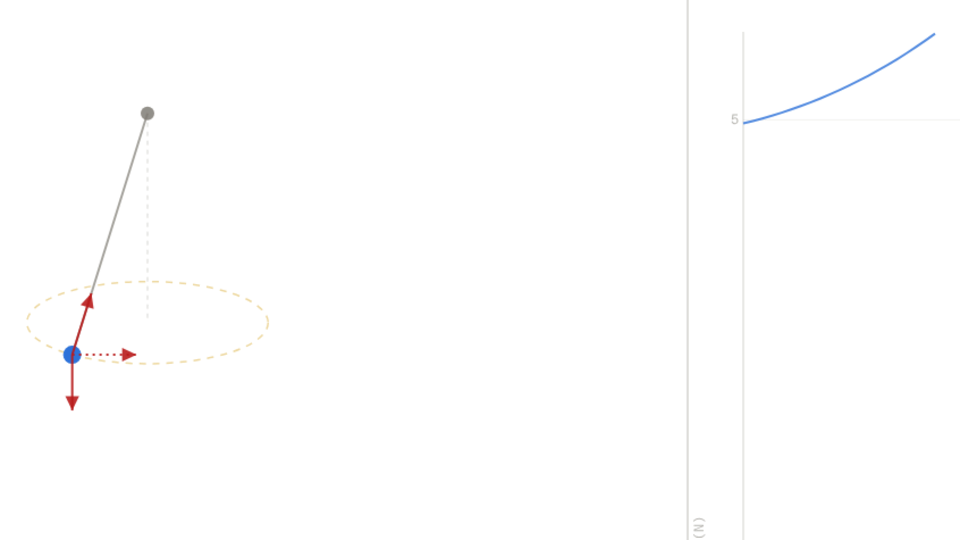
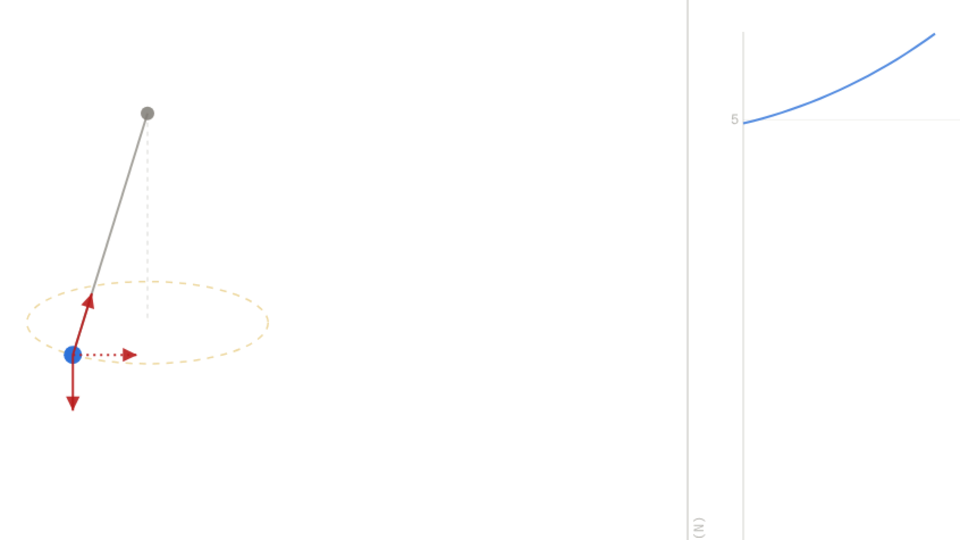
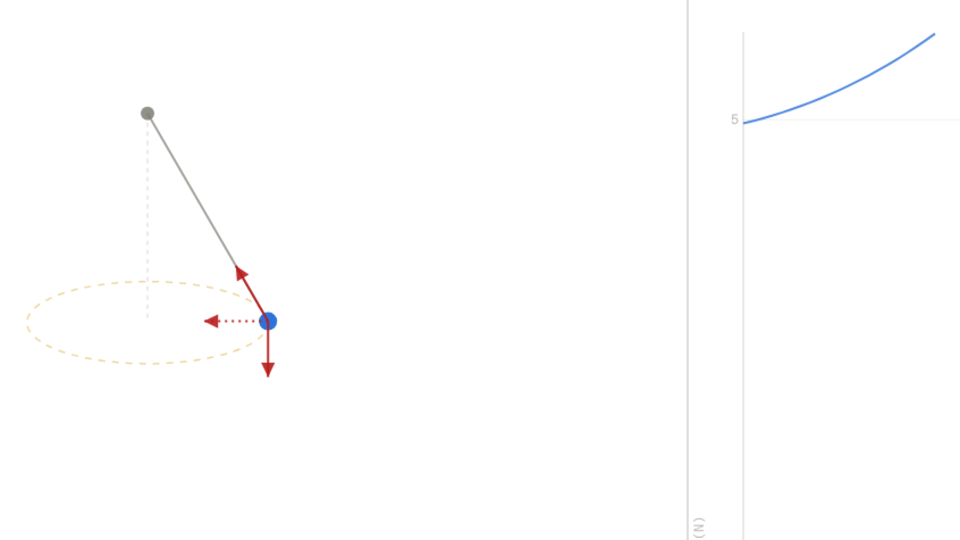
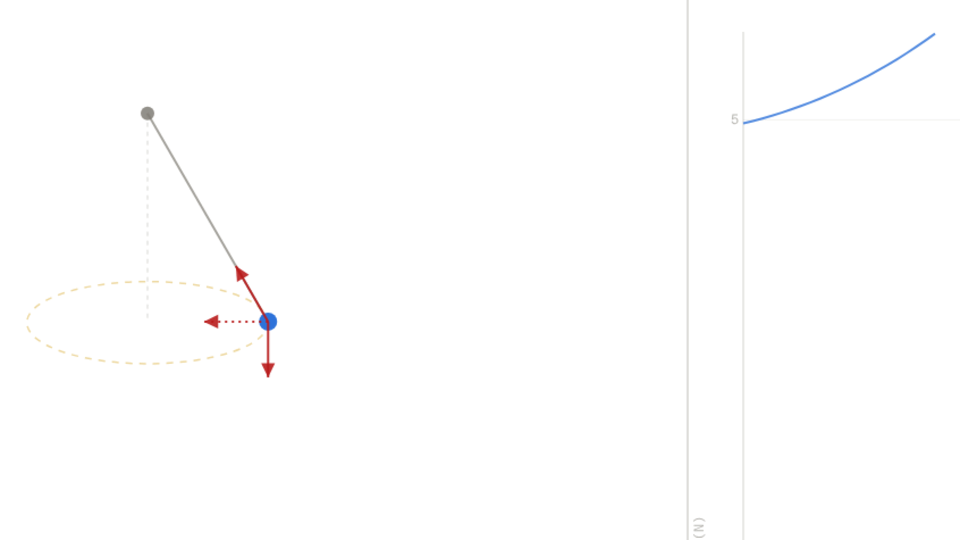
- Return mass to 0.5 kg, then click Start. Watch the ball trace the foreshortened ellipse and confirm the HUD values match your pre-run predictions.
- After the simulation stops, click Reset. Increase θ to 60° and Start again; observe ω, T, and period P change with the steeper angle.
- Increase θ to 75° and note how T blows up while the orbit becomes fast and flat. Then drag L to 1.5 m and observe that a longer string at the same angle produces a slower orbit.
Analytical Prediction
For a conical pendulum, the mass-independent angular velocity and mass-dependent tension are: With L = 0.8 m, θ = 30°, m = 0.5 kg, g = 9.81 m/s²:
Doubling mass to m = 1.0 kg leaves ω = 3.76 rad/s unchanged while T doubles to ≈ 11.33 N. The readouts should match these values within rounding.
Results Analysis
After clicking Start with defaults (L = 0.8 m, θ = 30°, m = 0.5 kg), read the four main HUD values. The Tension T readout should display approximately 5.66 N and the Angular vel. ω readout should display approximately 3.76 rad/s, both within 0.05 of the analytical predictions. The Period P readout should show approximately 1.67 s, and Centripetal F_c should read approximately 2.83 N. To verify mass-independence: click Reset, drag the mass slider to 1.0 kg, then Start again. The ω readout must remain at 3.76 rad/s (unchanged) while tensionOut jumps to approximately 11.33 N (doubled). The right-panel T–θ curve shifts upward when you drag the mass slider in Fresh state, confirming that T scales linearly with m at every angle.
Source of Error
This simulation omits air drag: the ball is treated as a smooth sphere with no aerodynamic resistance, so the orbital rate and tension are exactly those of the analytic formulas. The string is assumed massless and inextensible; a real string has mass and stretch, which both lower the effective restoring force at large angles. The ball is treated as a point mass; its rotational inertia and finite radius are ignored. There is no pivot friction or joint flex. The analytic prediction in the setup section makes these same idealizations, so the model and the formula agree exactly; any residual difference between the readouts and the computed predictions is therefore purely numerical, not physical.
Further Exploration
- Set θ = 10° (shallow) and note how T is only slightly above mg (≈ 5.0 N for m = 0.5 kg). Now gradually increase θ toward 75°. At what angle does T first exceed 10 N? Does the hyperbolic blowup on the right-panel curve match your intuition about 'nearly horizontal' orbits?
- Drag the mass slider from 0.1 kg to 2.0 kg in Fresh state. The T–θ curve on the right shifts dramatically while the ω readout never changes. Can you articulate in one sentence why heavier objects don't orbit faster? What physical balance enforces this?
- Fix mass at 0.5 kg and θ at 30°. Change string length from L = 0.3 m to L = 1.5 m and compare the period P. Does P scale as sqrt(L) as the formula predicts? Try doubling L from 0.6 m to 1.2 m and check whether P grows by the factor sqrt(2) ≈ 1.41.
- Set L = 0.8 m, θ = 60°, m = 2.0 kg. Before starting, predict T analytically (T = 2.0 · 9.81 / cos 60° = 39.2 N). Start and read tensionOut. How close is it? Now consider: could a real string survive this tension if its breaking strength is 30 N?