Rolling Disk PhysicsRolling Constraint & Moment of Inertia
Introduction
A solid disk rolling down an incline carries out two motions at once: its centre of mass slides down the slope, and the disk itself spins about that centre. The two are not independent. A geometric rule called the rolling constraint locks them together: every revolution of the disk advances its centre by exactly one circumference, so the linear and angular speeds satisfy v = ω · r at every instant. The simulator on this page tracks both quantities side by side and reports them on a single HUD.
The setup is the bridge between straight-line kinematics and full rotational dynamics. Engineers reuse it whenever a wheel, gear, roller, or flywheel converts gravity, torque, or driveline force into a combination of translation and spin. Once the two-thirds factor that distinguishes a rolling disk from a frictionless slider is internalised, more elaborate cases (hollow cylinders, bowling balls, yo-yos) drop out of the same energy bookkeeping.
Many learners expect a heavier disk, or a larger one, to roll faster down the same ramp. The readouts refute both hunches: with the Incline Angle slider at 30° and the Disk Radius slider at 0.5 m, the Speed readout settles at 8.09 m/s; resetting the radius to 2.0 m and rerunning leaves the Speed unchanged at 8.09 m/s while the ω readout drops by a factor of four.
The Physics Explained
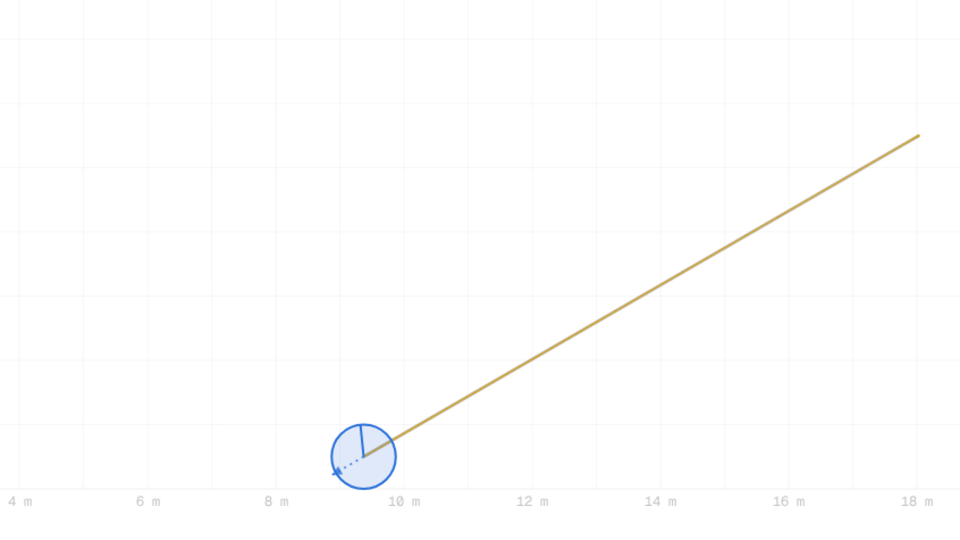
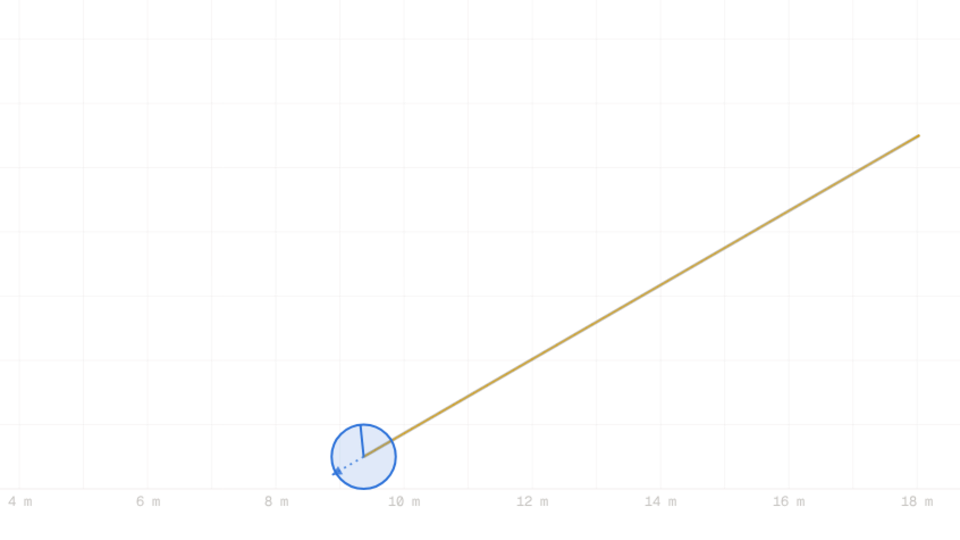
Two forces act on the disk along the slope: the component of gravity that points down the incline, m · g · sin θ, and the static friction at the contact point. Friction is what spins the disk; without it the surface would slide instead of roll. Newton's second law for translation gives m · a = m · g · sin θ − f, while Newton's second law for rotation about the centre gives I · α = f · r. The rolling constraint a = α · r connects the two.
Eliminating the friction force f and the angular acceleration α leaves a single closed-form expression: a = g · sin θ / (1 + I / (m · r²)). Every term that depended on the specific disk drops out except the dimensionless ratio I / (m · r²), which equals exactly ½ for a uniform solid disk. With that substitution the acceleration becomes a = (2/3) · g · sin θ, independent of mass and independent of radius. With the Incline Angle slider at 30° and g = 9.81 m/s², the prediction is a = (2/3) · 9.81 · 0.5 ≈ 3.270 m/s², and the simulator's Time and Distance readouts evolve consistently with that value.
Energy conservation gives the same answer through a different door. As the centre of mass drops a height h, gravity releases m · g · h of potential energy. That energy splits between translational kinetic energy ½ · m · v² and rotational kinetic energy ½ · I · ω². The rolling constraint forces ω = v / r, so the rotational piece becomes ½ · (½ · m · r²) · (v / r)² = ¼ · m · v². Two thirds of the released energy ends up in translation and one third in rotation, regardless of the disk's mass or radius, which is why the simulator's final Speed depends only on the slope and the track length.
With the Disk Radius slider at 0.5 m, the rolling constraint pins the angular speed to ω = v / 0.5 at every instant. The simulator's ω readout therefore mirrors the Speed readout scaled by 1/r: at the bottom of the 10 m track the Speed reads 8.09 m/s and ω reads 16.17 rad/s, with 8.09 / 0.5 = 16.18 confirming the constraint to two decimals. Setting the radius to 2.0 m and rerunning produces the same 8.09 m/s Speed but an ω readout of about 4.04 rad/s, exactly four times smaller.
Key Equations
The contact point of a non-slipping disk has zero velocity, which forces the centre's linear speed to equal the angular speed times the radius. With the Disk Radius slider at 0.5 m and the simulator's final Speed at 8.09 m/s, the constraint predicts ω = 8.09 / 0.5 = 16.18 rad/s, matching the ω readout of 16.17 rad/s.
Mass distributed uniformly across the disk gives this exact result from integrating r² · dm over the area. The dimensionless ratio I / (m · r²) = ½ is the only piece of the disk's geometry that survives into the acceleration formula.
This is the general result for any rolling object: solid disk, hollow cylinder, sphere, ring. Plugging I / (m · r²) = ½ for a solid disk and θ = 30° from the slider gives a = 9.81 · 0.5 / 1.5 ≈ 3.270 m/s², independent of both mass and radius.
The two-thirds prefactor is the signature of a uniform solid disk. A frictionless sliding block on the same slope would accelerate at the full g · sin θ ≈ 4.9 m/s², exactly 1.5 times faster than the disk.
Constant-acceleration kinematics applied at the bottom of the 10 m track with a ≈ 3.270 m/s²: v = sqrt(2 · 3.270 · 10) ≈ 8.09 m/s. The simulator's Speed readout reports 8.09 m/s on the same configuration.
Combining ½ · m · v² for translation and ¼ · m · v² for rotation gives a single ¾ · m · v² for the total. Two thirds of the released gravitational energy ends up as translational kinetic energy and one third as rotational kinetic energy; that split produces the two-thirds acceleration prefactor above.
Key Variables
| Symbol | Name | Unit | Meaning |
|---|---|---|---|
| θ | Incline angle | degrees (°) | Slope of the ramp from horizontal |
| r | Disk radius | m | Radius of the rolling disk |
| m | Mass | kg | Mass of the disk (cancels from acceleration) |
| I | Moment of inertia | kg·m² | About the disk's central axis |
| g | Gravitational acceleration | m/s² | 9.81 m/s² at Earth's surface |
| a | Linear acceleration | m/s² | Acceleration of the disk's centre |
| v | Linear speed | m/s | Speed of the disk's centre |
| ω | Angular speed | rad/s | Spin rate about the central axis |
| s | Distance | m | Distance travelled along the slope |
Real World Examples
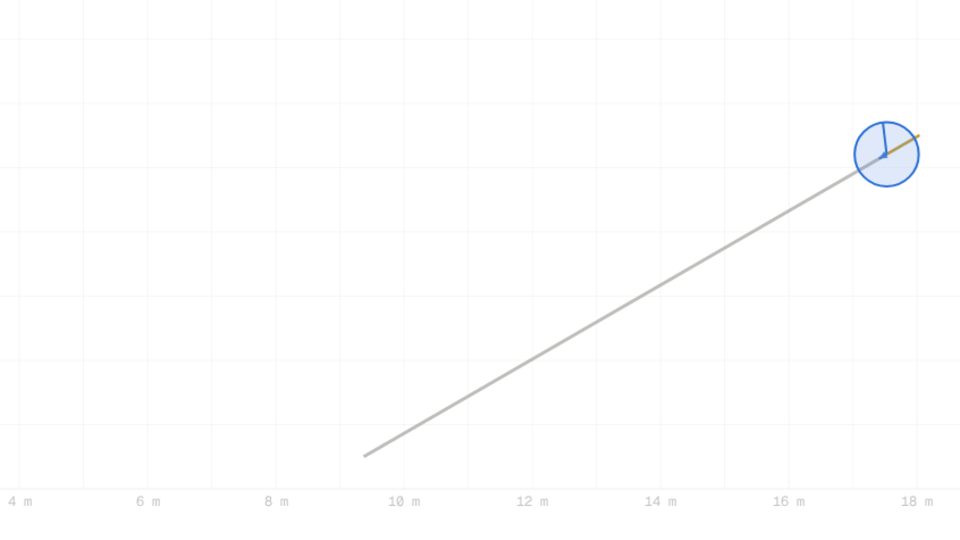
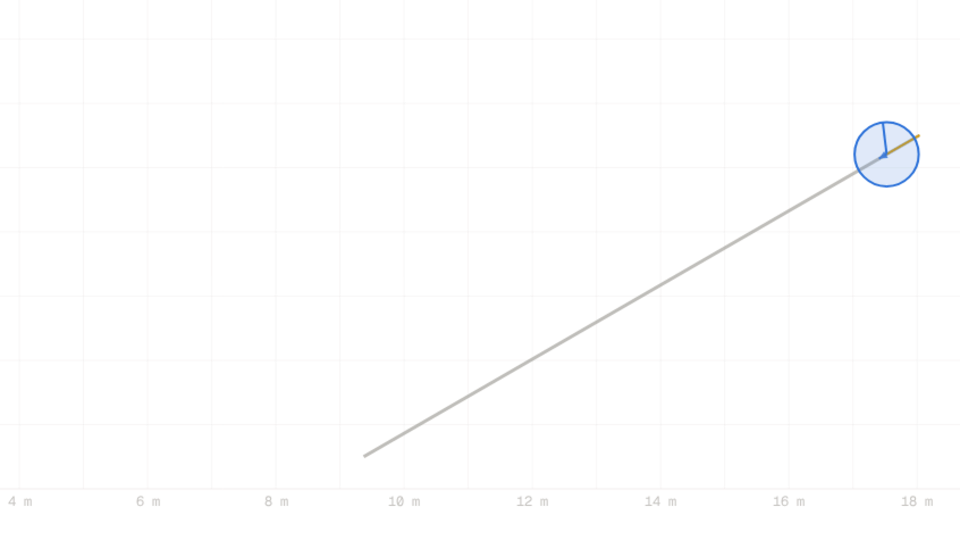
Why does a soup can beat a ring of the same mass down a ramp?
A classic introductory physics race pits a uniform-density soup can against a thin metal ring on the same ramp. The can wins every time, and the rolling-acceleration formula a = g · sin θ / (1 + I / (m · r²)) explains why. For a solid cylinder I / (m · r²) = ½, giving a two-thirds prefactor; for a thin ring the mass sits at the rim so I / (m · r²) = 1, giving only a one-half prefactor. The ring stores half its kinetic energy in rotation versus the disk's one-third, so less gets into forward motion.
The simulator quantifies the gap directly. With the Incline Angle slider at 30° and the Disk Radius slider at 0.5 m, the solid-disk Speed readout settles at 8.09 m/s after the full 10 m track. Substituting the ring's prefactor into the same kinematic chain gives v = sqrt(2 · ½ · 9.81 · 0.5 · 10) ≈ 7.00 m/s, about 13 % slower. Engineers designing rolling cargo, casters, or factory-floor stock cylinders favour the more compact mass distribution whenever they want to minimise the energy lost to spin.
How fast does an unbraked car wheel roll down a parking-garage ramp?
A typical parking-garage ramp pitches at roughly 6° to satisfy code, and a tyre acts as a hollow cylinder more than a solid disk because most of its mass sits in the rubber and steel-belt structure near the rim. Even so, the solid-disk model gives a useful upper bound. With θ = 6° the rolling acceleration drops to (2/3) · 9.81 · sin 6° ≈ 0.684 m/s². A tyre that breaks loose at the top of a 20 m ramp would reach v = sqrt(2 · 0.684 · 20) ≈ 5.23 m/s by the bottom. That is about 19 km/h, fast enough to dent a parked car.
The simulator brackets this estimate cleanly. With the Incline Angle slider held at 30° (steeper than any garage code allows) and the Disk Radius slider at 0.5 m, the Speed readout reaches 8.09 m/s over 10 m. Lowering the angle slider to gentler values shrinks the readout in proportion to the square root of sin θ, so a 6° simulated ramp would yield about 3.7 m/s over the same 10 m, within a factor of 1.4 of the 20 m parking-garage estimate. Garage designers add concrete kerbs and angled barriers because that energy is real.
Why do flywheel energy stores prefer thick rims over solid plates?
Flywheels store kinetic energy in spinning mass, and the engineering design problem is the inverse of the ramp race above. To pack as much energy as possible into a given rotation rate ω, the designer wants a large moment of inertia for a given mass: exactly the opposite of what minimises rolling resistance. A thin-rim flywheel with I / (m · r²) close to 1 stores roughly twice the rotational kinetic energy of a solid-disk flywheel of equal mass and radius spinning at the same ω, because KErot = ½ · I · ω² scales linearly with the inertia ratio.
The simulator illustrates the inversion. With the Incline Angle slider at 30° and the Disk Radius slider at 0.5 m, the simulated solid disk arrives at the bottom with ω ≈ 16.17 rad/s and rotational kinetic energy ¼ · m · v² ≈ 16.35 · m joules. A geometrically identical thin-ring flywheel released from the same height would arrive slower (≈ 7.00 m/s, ω ≈ 14.0 rad/s) but store ½ · m · v² ≈ 24.5 · m joules in spin. The ring carries about 50 % more rotational energy per kilogram, which is why engineers route the mass to the rim when storage, not transport, is the goal.
Further Reading
- Motion on an inclined ramp: the frictionless sliding block that the rolling disk's two-thirds prefactor is measured against.
- Projectile motion: same Newton's second law applied without the rolling constraint, for comparison.