Rolling Disk · SimulatorRolling, Inertia & Energy Split
A disk rolling down an incline showing rotational and translational motion; adjust the angle and radius to explore the rolling constraint.
Published: April 19, 2026 · Updated: May 28, 2026
Objective
Confirm that a solid disk rolling without slipping down an incline obeys the closed-form acceleration a = (2/3)·g·sin θ, where θ is the incline angle and g = 9.81 m/s². Verify that the rolling constraint v = ω·r links translational and angular motion, and discover why the disk's radius cancels out of the acceleration entirely. This experiment assumes a perfectly rigid disk, uniform density, no slipping at the contact point, and no air drag: energy is shared between translation and rotation in a fixed ratio set by the moment of inertia.
Setup
- Press Reset to return the disk to the top of the 10 m incline. The Time, Speed, ω, and Distance readouts will all show 0.00, indicating the disk is at rest at the launch position.
- Set the Incline Angle slider to 30°. The angleVal display should read 30, and the incline drawn on the canvas will tilt to that angle from horizontal.
- Set the Disk Radius slider to 0.5 m. The radiusVal display should read 0.5, and the blue disk on the canvas will resize to match.
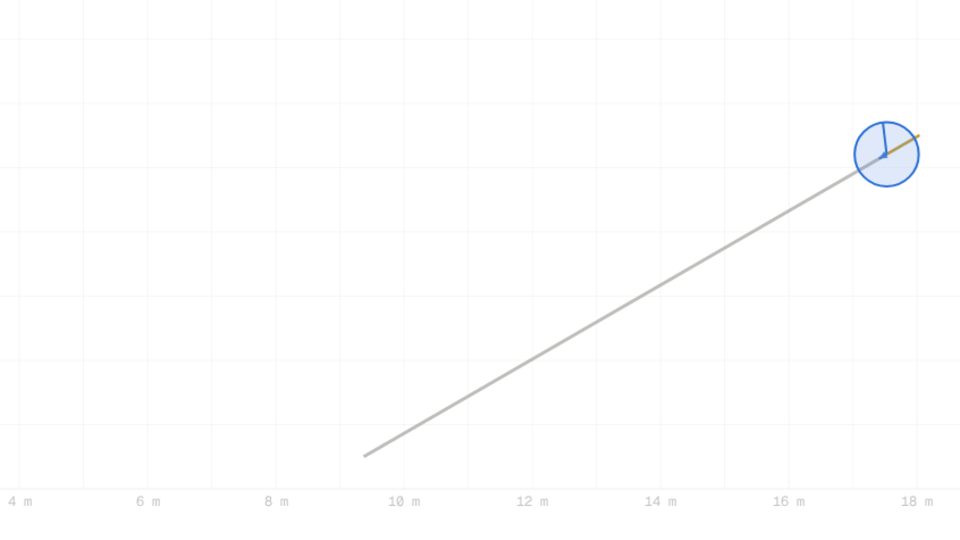
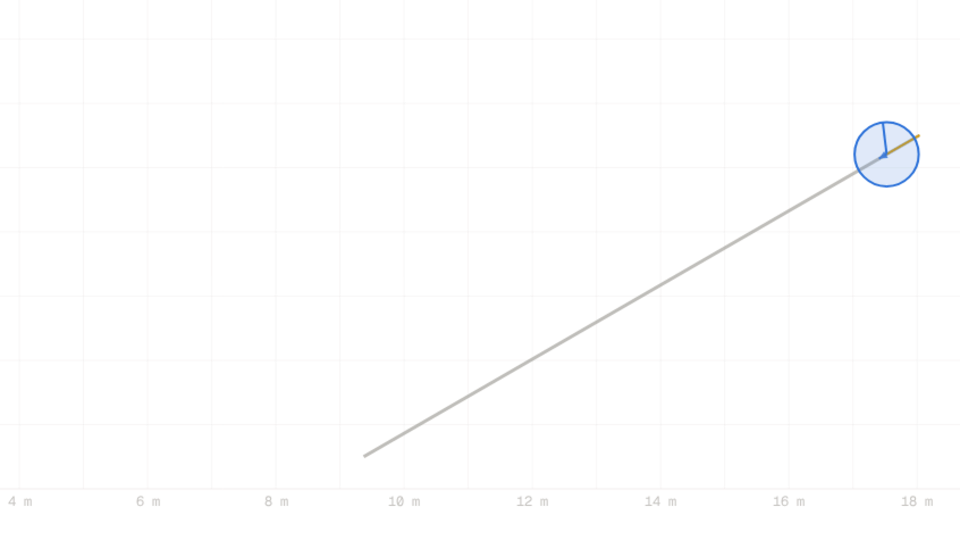
- Press Start. The disk releases from rest at the top of the incline and rolls without slipping toward the bottom marker (s = 0). A faint amber trail traces the path of the disk's centre.
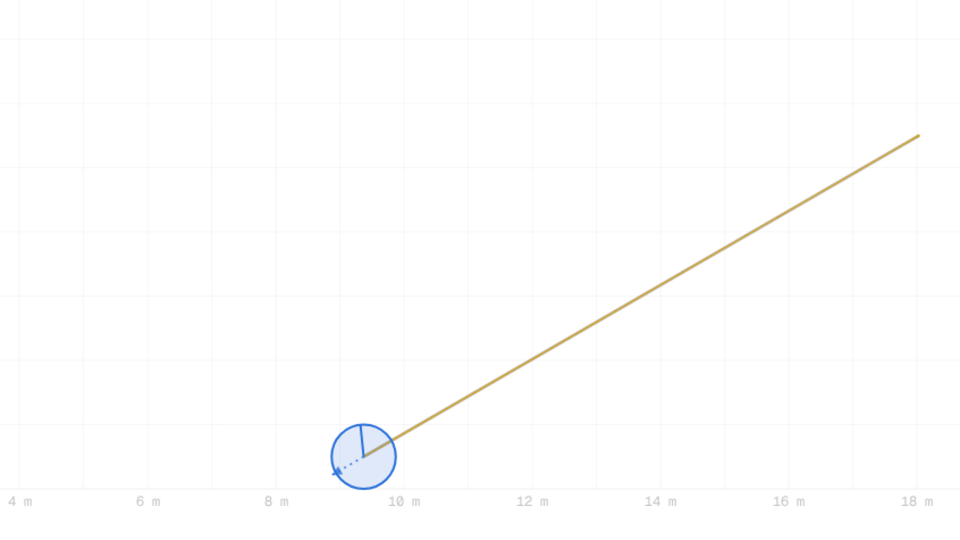
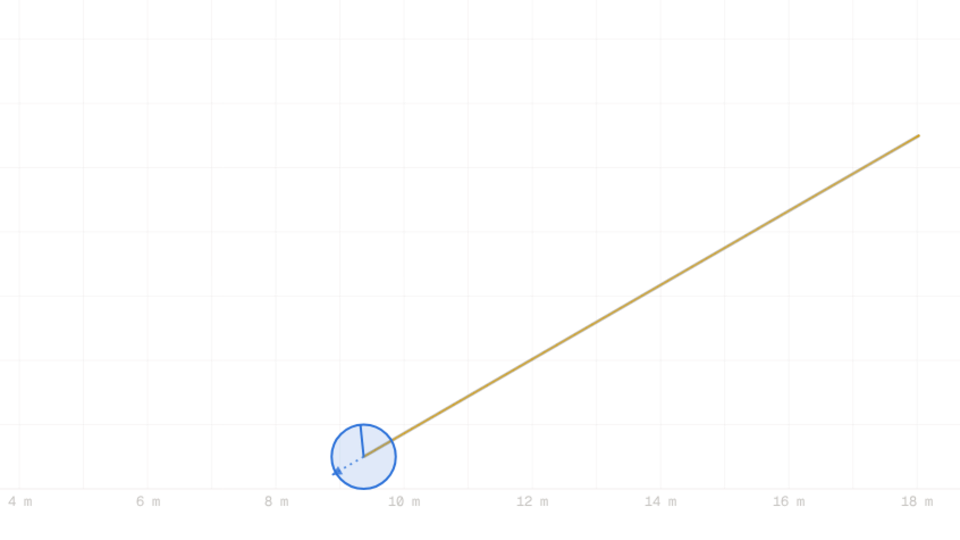
- Wait until the disk reaches the bottom of the track. The simulation stops automatically when distance traveled equals 10 m, freezing the readouts at their final values for inspection.
Analytical Prediction
For a solid disk rolling without slipping, the linear acceleration of the centre of mass is a = g·sin θ / (1 + I/(m·r²)). Because I = ½·m·r² for a uniform disk, I/(m·r²) = ½, so the acceleration simplifies to a = (2/3)·g·sin θ, independent of both mass and radius. With θ = 30° and g = 9.81 m/s²:
Starting from rest over distance s = 10 m, kinematics gives v = √(2·a·s) and t = v/a:
The rolling constraint ω = v/r with r = 0.5 m yields ω ≈ 8.087 / 0.5 ≈ 16.17 rad/s. Together: final speed 8.09 m/s, final angular speed 16.17 rad/s, total time 2.47 s, distance 10.00 m.
Results Analysis
When the simulation stops at s = 10 m, read the four HUD values. Compare each to the prediction: Time ≈ 2.47 s, Speed ≈ 8.09 m/s, ω ≈ 16.17 rad/s, Distance = 10.00 m. The simulation typically reports values within 0.5% of these analytical predictions: Time may read 2.46 to 2.48 s and Speed 8.06 to 8.10 m/s. Verify the rolling constraint directly by dividing the displayed Speed by the disk radius set on the slider; the result should match the displayed ω to two decimals. A more demanding check: press Reset, set the Disk Radius slider to 2.0 m, and run again. The Time and Speed readouts should be identical to the 0.5 m run, while ω drops by a factor of four to about 4.04 rad/s. This empirically confirms that radius cancels out of the linear acceleration but rescales the angular speed through v = ω·r.
Source of Error
What this sim does NOT model: bearing friction at the disk's centre, air drag, slipping between disk and incline (rolling-without-slipping is enforced by construction), finite contact patch deformation, or the disk's deviation from a uniform solid cylinder. The closed-form a = ⅔·g·sin θ for a solid disk and the rolling constraint v = ω·r assume the same idealizations, so they cancel rather than contributing to the residual bottom speed or transit time. The remaining gap between prediction and readouts is therefore purely numerical, not physical, for this sim.
Further Exploration
- Hold the Disk Radius slider at 0.5 m and step the Incline Angle through 15°, 30°, 45°, and 60°. Record the final Speed at each. Does the speed scale as √(sin θ), as the analytical formula a = (2/3)·g·sin θ combined with v² = 2·a·s predicts?
- Set the Incline Angle to 30° and run the simulation at Disk Radius = 0.1 m, then at 1.0 m, then at 2.0 m. Why does the final Speed stay the same across all three runs while ω changes dramatically? What does this tell you about which quantities radius affects?
- At θ = 30°, r = 0.5 m, the predicted final speed is v ≈ 8.08 m/s. A frictionless sliding block on the same incline would reach v = √(2·g·sin θ·s) ≈ 9.90 m/s. Compute the ratio of rolling speed to sliding speed analytically and confirm it equals √(2/3) ≈ 0.816.
- If the disk were a thin hoop instead of a solid disk, I/(m·r²) would equal 1 rather than ½, giving a = ½·g·sin θ. Predict the final speed at θ = 30° on a 10 m track for a hoop, then compare it to the solid-disk result of 8.08 m/s. Which arrives at the bottom first, and by how many seconds?
- At what incline angle would the rolling disk reach a final speed of exactly 5.00 m/s on the 10 m track? Solve analytically using v² = 2·(2/3)·g·sin θ·s, then set the Incline Angle slider to that value and confirm the readout matches.