Torque & Lever · SimulatorBalance Torques on a Lever
A lever with movable masses demonstrating torque balance and rotational equilibrium.
Published: April 27, 2026 · Updated: May 28, 2026
Objective
Verify the principle of moments (that a lever balances when m₁·d₁ = m₂·d₂) and confirm the rotational form of Newton's second law, τ_net = I·α. Using the Net Torque (N·m), Angle (°), and ω (rad/s) readouts, compare the simulation's behaviour against the analytical torque expression τ_net = (m₂·d₂ − m₁·d₁)·g·cos(θ) with g = 9.81 m/s². The default sliders place equal moments on each side, so the lever holds level; nudging any one slider breaks that equality and drives a predictable angular acceleration.
Setup
- Press Reset. The Time, Net Torque, Angle, and ω readouts all return to 0.00, and the lever sits horizontal with the fulcrum at the canvas centre.
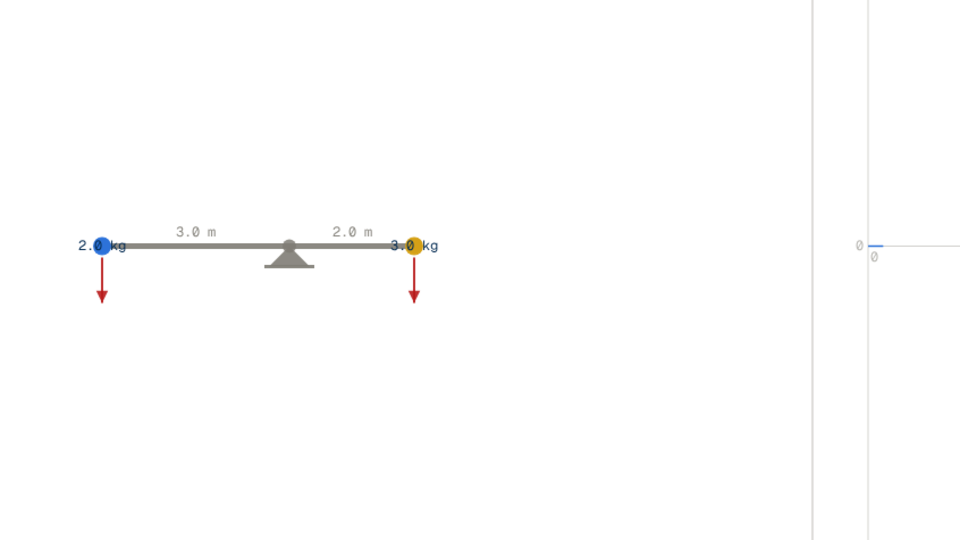
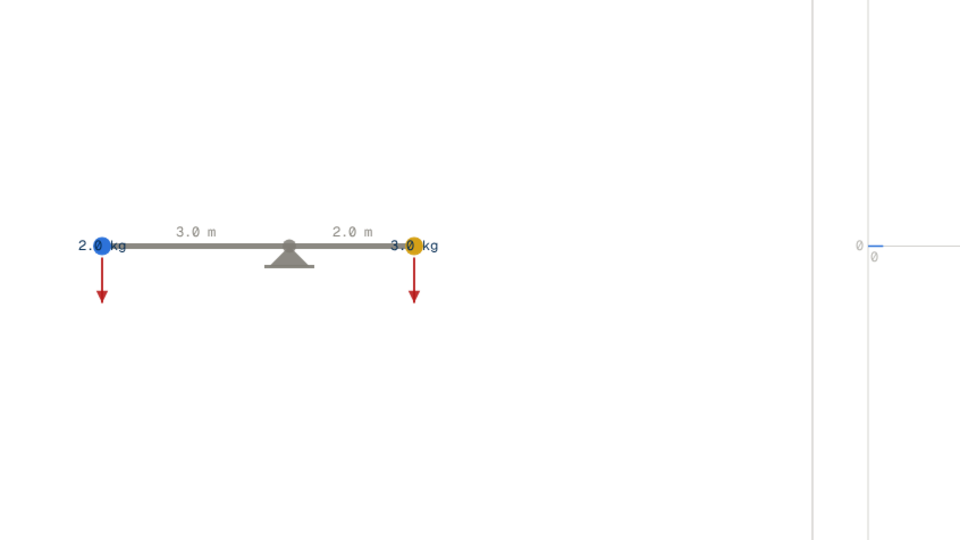
- Confirm the four sliders are at their defaults: Left Mass = 2.0 kg, Left Distance = 3.0 m, Right Mass = 3.0 kg, Right Distance = 2.0 m. Both arms carry m·d = 6.0 kg·m, so the Net Torque readout reads 0.00 N·m and the lever is in rotational equilibrium.
- Slide Left Mass up to 4.0 kg. Leave the other three sliders untouched. The Net Torque readout updates immediately to reflect the new imbalance: the left side now carries 4.0 × 3.0 = 12.0 kg·m of moment versus 6.0 kg·m on the right.
- Press Start. The lever rotates with the heavier left side dropping; the trail traces the left mass's circular path, and the Angle readout becomes increasingly negative.
- Wait until the lever reaches the ±80° tipping stop. The simulation freezes ω at 0.00 rad/s and the loop stops automatically. Record the final Time, Angle, Net Torque, and ω.
Analytical Prediction
At the moment Start is pressed (θ = 0, ω = 0), the analytical net torque comes from each side weighted by its lever arm projection. With m₁ = 4.0 kg, d₁ = 3.0 m, m₂ = 3.0 kg, d₂ = 2.0 m, g = 9.81 m/s²:
The negative sign indicates the right side rises and the left side falls. The moment of inertia for two point masses is:
As the lever tilts, cos(θ) shrinks the torque. At θ = −80°, cos(80°) ≈ 0.1736, so the Net Torque at the tipping stop should read approximately −58.86 × 0.1736 ≈ −10.22 N·m. Expected sequence at start: Net Torque ≈ −58.86 N·m, Angle = 0.00°, ω = 0.00 rad/s; at the stop: Angle = −80.00°, Net Torque ≈ −10.22 N·m, ω = 0.00 rad/s.
Results Analysis
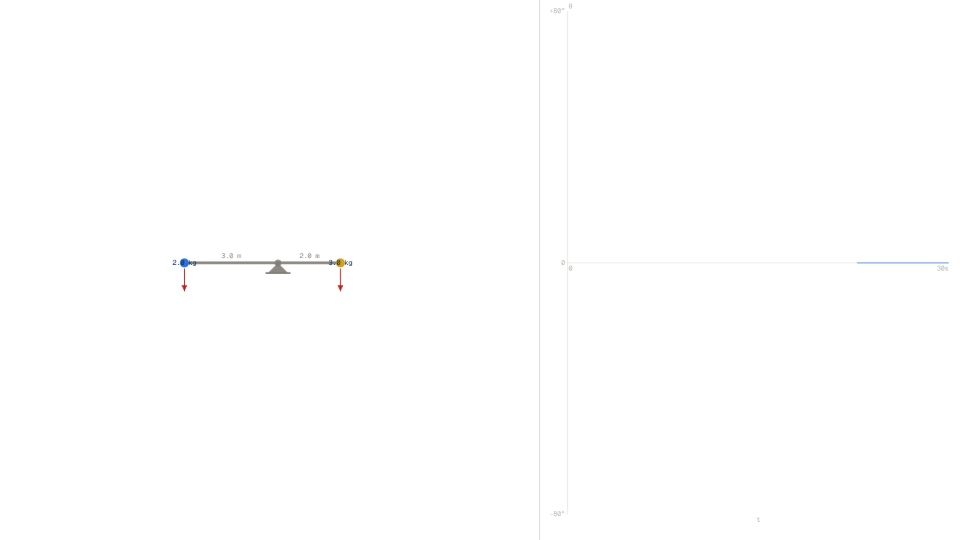
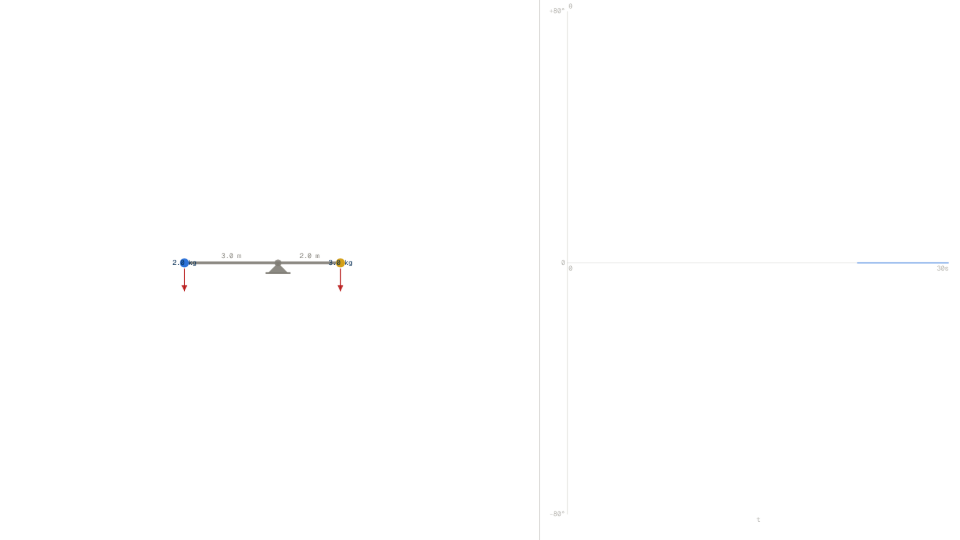
Immediately after Start, the Net Torque readout should display −58.86 N·m, matching the analytical value to two decimals. As the lever swings, watch the Net Torque shrink in magnitude: this reflects the cos(θ) factor that arises because gravity always points down while the lever arm rotates out of horizontal. When the simulation hits the 80° tipping stop, the Angle readout reads −80.00°, ω resets to 0.00 rad/s (the stop is enforced as a hard clamp, not a physical bounce), and Net Torque reads approximately −10.22 N·m, within ±0.05 N·m of the cos(80°) prediction. A second test: return Left Mass to 2.0 kg and reset, then change Right Distance to 3.0 m. The new moments are 6.0 kg·m on the left and 9.0 kg·m on the right, giving τ_net = (3.0 × 3.0 − 2.0 × 3.0) × 9.81 = +29.43 N·m. The lever should now rotate the opposite direction (right side falling, Angle becoming positive), confirming the sign convention encoded in the formula.
Source of Error
What this sim does NOT model: the lever arm's mass and moment of inertia (only the two suspended masses contribute to the rotational inertia), friction at the pivot, air resistance on the swinging arm, deformation of the arm, or the masses' finite size and rotational kinetic energy about the lever. The closed forms τ = m·g·d·cos θ for each side and α = τ_net/(m₁·d₁² + m₂·d₂²) assume the same idealizations, so they cancel rather than contributing to the residual angle or angular velocity. The remaining gap is therefore purely numerical, not physical.
Further Exploration
- Set Left Mass = 2.0 kg, Left Distance = 4.0 m, Right Mass = 4.0 kg, Right Distance = 2.0 m. Predict the Net Torque at θ = 0 from m₁·d₁ versus m₂·d₂, then press Reset (without Start) and read Net Torque to confirm. Does the lever balance?
- Hold Left Mass = 3.0 kg and Right Mass = 3.0 kg fixed. Predict what value of Right Distance balances Left Distance = 4.0 m. Adjust the slider and check that Net Torque snaps to 0.00 N·m.
- Set Left Mass = 5.0 kg, Left Distance = 5.0 m, Right Mass = 0.5 kg, Right Distance = 0.5 m for the largest available imbalance. Compute the initial α from τ_net / I, then press Start and time how quickly the lever reaches the 80° stop. Does a larger τ_net always mean a faster trip if I also grows?
- Why does the Net Torque readout shrink as the Angle grows, even though no slider has moved? Trace the cos(θ) dependence in τ = m·g·d·cos(θ) and confirm that at θ = ±90° the gravitational torque about the pivot would vanish entirely.
- Place a perfectly balanced configuration (m₁·d₁ = m₂·d₂) and press Start. The lever should not move because τ_net = 0 at every angle. Now nudge any slider by one step and press Start again. At what point does the imbalance become large enough to tip the lever all the way to ±80° instead of merely oscillating?