Torque & Lever PhysicsPrinciple of Moments m₁d₁ = m₂d₂
Introduction
Torque is the rotational analogue of force: the quantity that decides whether a rigid beam balanced on a pivot stays level or tips. For a point mass sitting on a horizontal lever, the torque it produces about the pivot equals its weight multiplied by the perpendicular distance to the fulcrum. The simulator places two adjustable masses on either side of a central pivot and tracks the running tally as Net Torque, Angle, and angular velocity readouts.
Levers make the natural entry point into rotational mechanics because they isolate one principle in a single moving picture: a system rotates only when the moments on each side fail to match. Engineers reuse the same arithmetic to size crowbars, balance crane jibs against their counterweights, and choose where a wheelbarrow's load should sit relative to the wheel. The same equation that decides whether a see-saw tips also decides whether a tower crane stays upright.
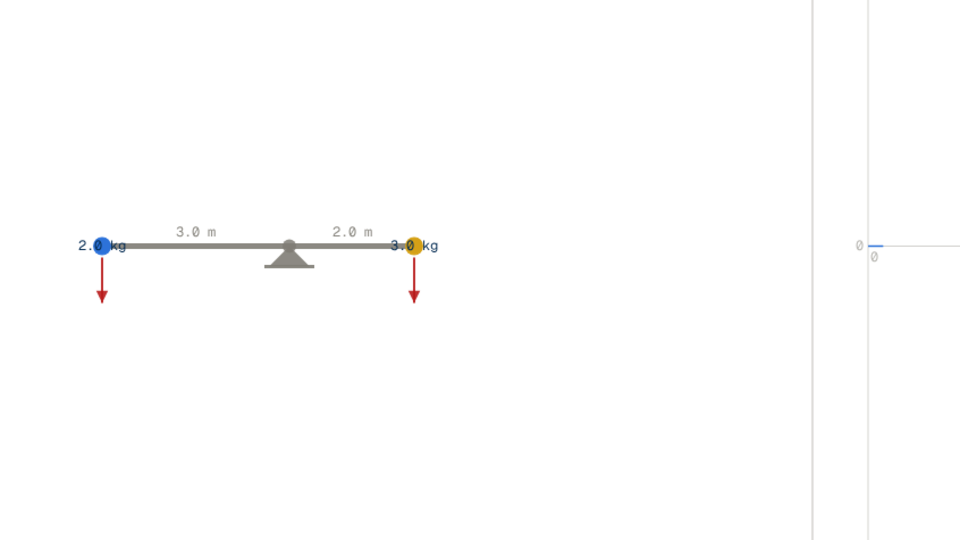
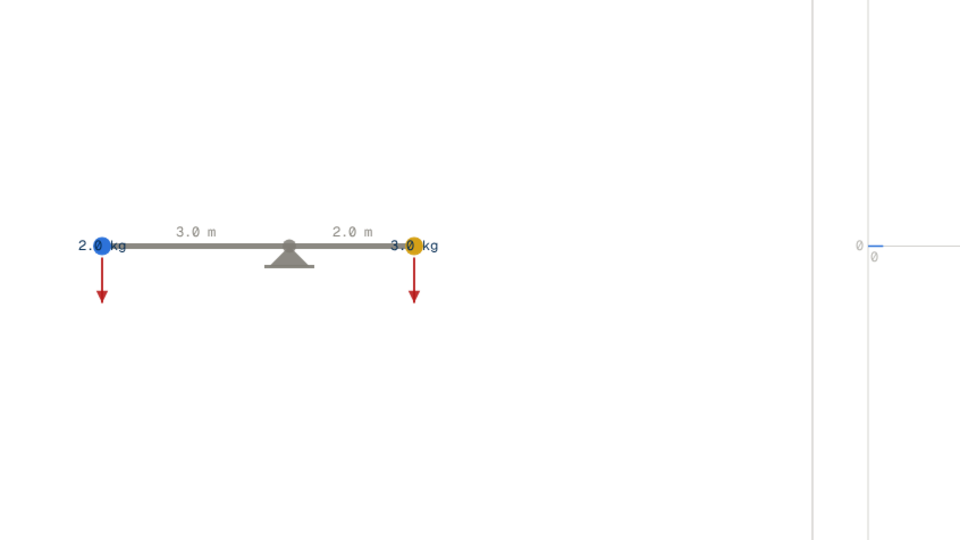
A near-universal hunch says the heavier mass always wins, regardless of where it sits on the beam. The balance test refutes it: with Left Mass = 2.0 kg at 3.0 m and Right Mass = 3.0 kg at 2.0 m, both arms carry m·d = 6.0 kg·m, the Net Torque readout settles at 0.00 N·m, and the lever holds level. Mass alone does not decide the contest; the product of mass and distance does.
The Physics Explained
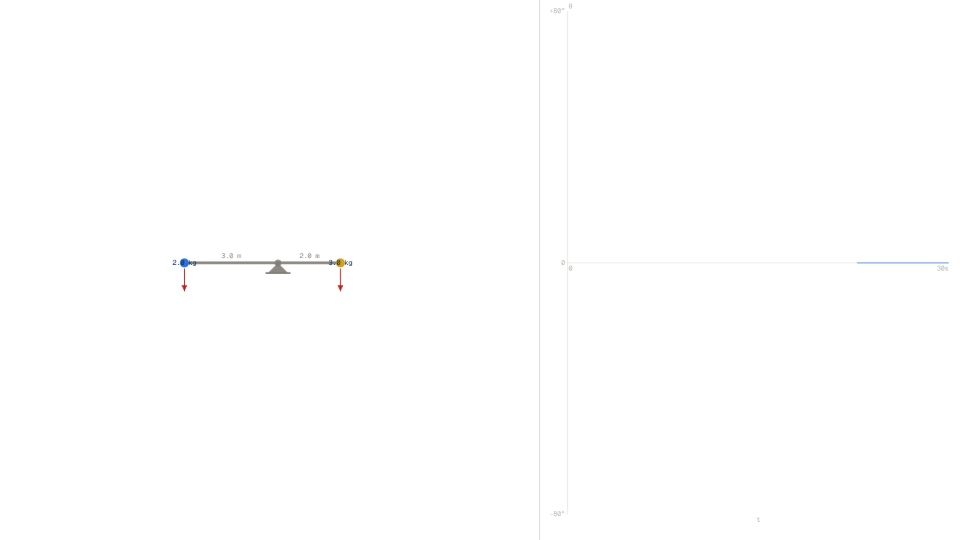
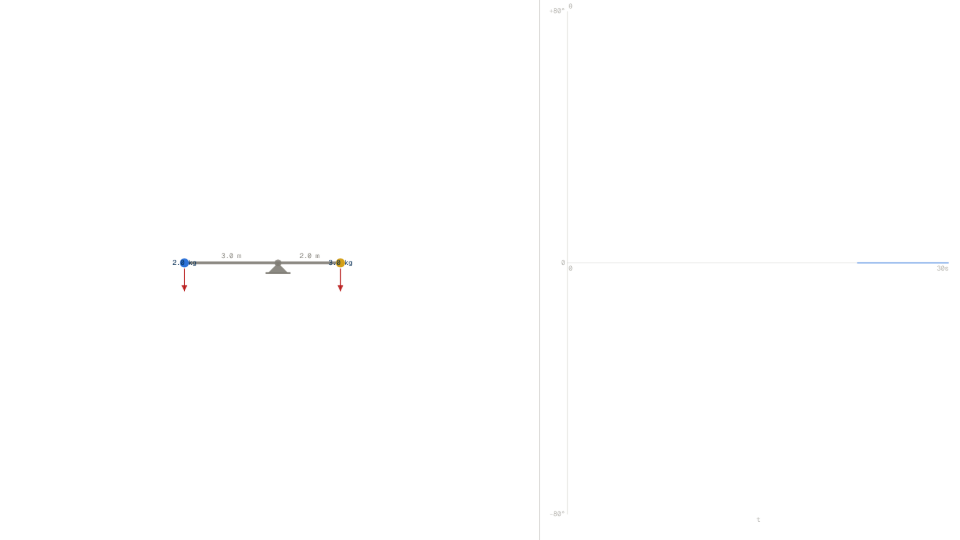
Each mass on the beam exerts a downward gravitational force m·g, and that force generates a torque about the pivot equal to m·g·d, where d is the horizontal distance from the fulcrum. The two masses pull in opposite rotational directions, so the simulator subtracts them: τnet = (m₂·d₂ − m₁·d₁)·g·cos(θ), where θ is the lever's tilt angle. With Left Mass = 2.0 kg, Left Distance = 3.0 m, Right Mass = 3.0 kg, and Right Distance = 2.0 m (the slider defaults), both products equal 6.0 kg·m and the Net Torque readout reads 0.00 N·m at every angle.
Break that equality and rotation begins. Sliding Left Mass up to 4.0 kg raises the left moment to 12.0 kg·m while the right side still carries 6.0 kg·m, leaving an imbalance of −6.0 kg·m that gravity converts into a torque of −58.86 N·m at θ = 0°. The negative sign means the heavier left side falls. Pressing Start sets the lever rotating, the Angle readout drifts negative, and the trail traces the left mass's circular arc.
The cos(θ) factor in the torque expression is what slows the lever as it tilts. Gravity always points straight down, but the lever arm rotates out of horizontal, and only the horizontal projection of that arm contributes to the torque about the pivot. At θ = 0° the cosine is 1 and the full −58.86 N·m drives the rotation; by the time the lever reaches the ±80° tipping stop, cos(80°) ≈ 0.1736 has shrunk the Net Torque readout to about −10.22 N·m. At θ = ±90° the gravitational torque about the pivot would vanish entirely.
The angular acceleration follows Newton's second law for rotation, α = τnet / I, where I is the moment of inertia. For two point masses sitting at d₁ and d₂, the moment of inertia is just I = m₁·d₁² + m₂·d₂². With the imbalanced 4.0 kg setup above, I = 4.0 × 9.0 + 3.0 × 4.0 = 48 kg·m², so α₀ = −58.86 / 48 ≈ −1.226 rad/s². The simulator's ω readout starts at 0.00 rad/s and grows in magnitude at exactly this initial rate before the cos(θ) factor begins to bleed the torque away.
Key Equations
For Left Mass = 2.0 kg at d = 3.0 m and θ = 0°: τleft = 2.0 × 9.81 × 3.0 × cos(0°) = 58.86 N·m anticlockwise. The opposite-sign torque from a right-side mass enters the net sum with a minus sign by the simulator's convention.
Plugging in m₁ = 2.0 kg, d₁ = 3.0 m, m₂ = 3.0 kg, and d₂ = 2.0 m, the bracket is (6.0 − 6.0) = 0, so the Net Torque readout reads 0.00 N·m at every tilt angle and the lever cannot start rotating from rest.
The default configuration satisfies this exactly: 2.0 × 3.0 = 3.0 × 2.0 = 6.0 kg·m. Gravity factors out of both sides, which is why traditional beam balances compare masses rather than weights: the same mass values would balance on the Moon as on Earth.
Raising Left Mass from 2.0 kg to 4.0 kg gives I = 4.0 × 3.0² + 3.0 × 2.0² = 36 + 12 = 48 kg·m². Distance enters squared, so a mass twice as far from the pivot contributes four times as much rotational inertia.
For the imbalanced 4.0 kg case at θ = 0°: α₀ = −58.86 / 48 ≈ −1.226 rad/s². The ω readout begins at 0.00 rad/s and accumulates at this initial rate, slowing as the cos(θ) factor reduces τnet while the lever tilts toward the ±80° stop.
Key Variables
| Symbol | Name | Unit | Meaning |
|---|---|---|---|
| τ | Torque | N·m | Rotational effect of a force about the pivot |
| m | Mass | kg | Mass of an object placed on the lever arm |
| d | Lever arm | m | Horizontal distance from the pivot to the mass |
| g | Gravitational acceleration | m/s² | 9.81 m/s² downward at Earth's surface |
| θ | Tilt angle | degrees (°) | Lever's rotation away from horizontal |
| I | Moment of inertia | kg·m² | Rotational analogue of mass for the system |
| α | Angular acceleration | rad/s² | Rate of change of angular velocity ω |
| ω | Angular velocity | rad/s | Rate of change of the tilt angle |
Real World Examples
How does a tower crane stay upright with a heavy load on the jib?
A tower crane is a giant first-class lever. The lifted load sits at the end of a long working jib, and a counterweight rides at the end of a much shorter counter-jib on the opposite side of the central mast. Engineers size the counterweight so that its mass times its distance to the mast roughly matches the lifted load times its distance: the same m·d = m·d balance condition behind the simulator's default 6.0 kg·m on each side.
The crane never sits at exact balance because the load distance changes whenever the trolley moves along the jib. A small residual moment is absorbed by the foundation, but the design intent is to keep that residual within the bending limits of the tower. The simulator illustrates the failure mode directly: setting Left Mass = 2.0 kg, Left Distance = 3.0 m, Right Mass = 3.0 kg, Right Distance = 2.0 m holds the lever level, while pushing Right Distance to 3.0 m raises the right moment to 9.0 kg·m and the lever tips toward the heavier side.
Modern cranes monitor the residual moment in real time and refuse to lift a load that would push the structure past its rated overturning torque. The cos(θ) factor in τ = m·g·d·cos(θ) becomes safety-critical when the jib swings: the same load held at the same trolley position generates the largest torque when the jib is exactly horizontal, which is precisely when the structure is most loaded.
Why does a long crowbar pull a nail that a short one cannot?
A crowbar trades distance for force. When a worker pushes down on the handle with effort F at distance deffort from the fulcrum, the resulting torque F·deffort lifts a load at the much shorter distance dload on the other side. Because the rotational equilibrium condition requires F·deffort = Fload·dload, the load force scales as deffort / dload: a 60 cm handle pivoting 5 cm from the nail multiplies the worker's push by a factor of 12.
The simulator shows the same multiplication when the slider distances are mismatched. Setting Left Mass = 5.0 kg at Left Distance = 5.0 m and Right Mass = 0.5 kg at Right Distance = 0.5 m produces a left moment of 25.0 kg·m versus a right moment of 0.25 kg·m, a 100-to-1 imbalance. The Net Torque readout at θ = 0° shows about −242 N·m, and the lever rotates toward the heavier side almost immediately after Start is pressed.
The trade-off is that the long handle moves through a much larger arc than the load. Pulling the nail out by 1 cm requires sweeping the handle through 12 cm at the same angular velocity. Force multiplication and distance multiplication are reciprocal; no lever ever creates energy, only redistributes it between force and distance.
How does the human forearm convert biceps tension into hand force?
The elbow is a third-class lever with the fulcrum at the joint, the effort applied by the biceps just a few centimetres along the forearm, and the load held in the hand at the far end. The biceps insertion point sits roughly 5 cm from the elbow, while the hand sits about 35 cm away, a 7-to-1 distance ratio. To hold a 5 kg dumbbell stationary, the biceps must supply roughly 7 × 5 × 9.81 ≈ 343 N of tension, far more than the dumbbell's 49 N weight.
This arrangement sacrifices force multiplication for speed and reach. A small contraction of the biceps moves the hand through a much larger arc, so the hand sweeps quickly even though the biceps shortens slowly. The lever simulator demonstrates the same sign convention: with Right Mass = 0.5 kg at Right Distance = 0.5 m balancing Left Mass = 5.0 kg at Left Distance = 5.0 m, the small mass close to the pivot exactly cancels the large mass far away: the geometry behind the forearm's 7-to-1 disadvantage in force.
Further Reading
- Spring-mass oscillator: Newton's second law in linear form, the translational counterpart to τ = I·α used here.
- Elastic collisions: momentum conservation as the translational analogue of angular momentum, the next step beyond static torque balance.