Magnus Effect PhysicsMagnus Force & the Best Spin Angle
Introduction
A golfer's drive seems to hang in the air far longer than it should; a curveball drops off the table; a well-struck free kick bends around the wall. All three are the same trick of physics: a spinning ball pushes on the air around it, and the air pushes back at right angles to the ball's flight. That sideways push is the Magnus force, and depending on which way the ball spins it can lift the ball, drive it down, or bend it left or right.
This simulation isolates the up-and-down version. A ball is launched with back-spin (the top of the ball rotating backward against the direction of travel), and the Magnus force points upward, partly cancelling gravity. The ball holds its height, carries farther, and comes down on a flatter line than a spinless shot would. Reverse the spin to top-spin and the force flips downward, pulling the ball into a steep dive.
The most striking consequence is what it does to the best launch angle. Without air forces, the longest throw goes at 45°. Add drag and the optimum slips a little lower. Add back-spin and it drops dramatically, to around 29° at a strong spin in the simulator, because the lift rewards a flatter, faster launch. It is the reason a golf driver is angled at barely 10° yet sends the ball soaring: the spin, not the launch angle, supplies the climb.
The Physics Explained
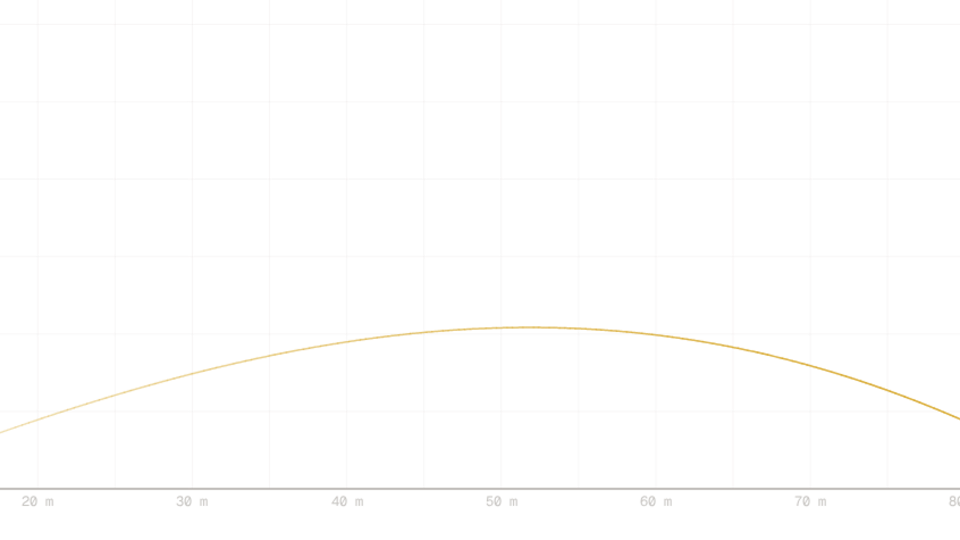
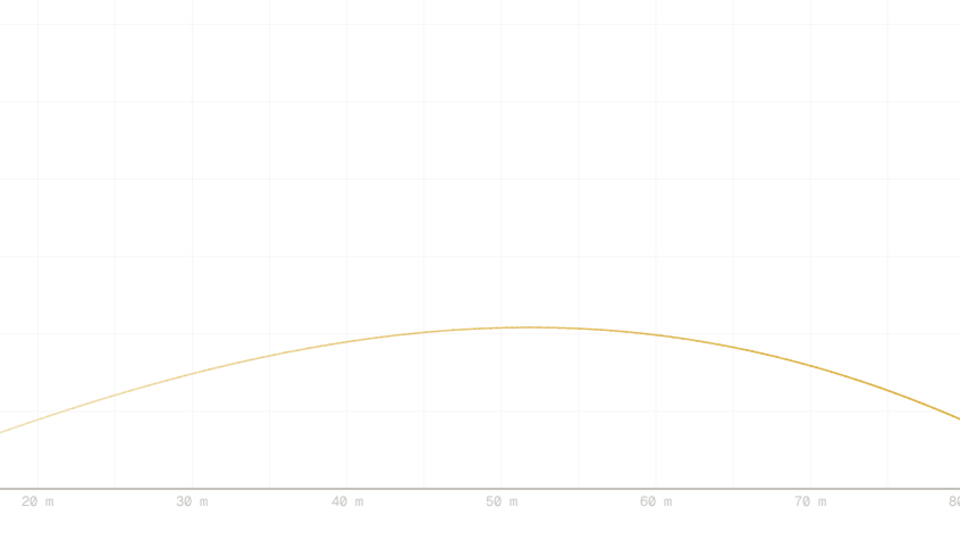
A spinning ball carries a thin boundary layer of air around with it. On the side where the surface moves in the same direction as the oncoming air, the flow speeds up; on the opposite side it slows down. By Bernoulli's principle the faster-flow side has lower pressure, so the ball is pushed from the high-pressure side toward the low-pressure side. That pressure difference is the Magnus force, and because it is set by the spin relative to the flow, it always acts perpendicular to the ball's velocity.
The simulator models the force as proportional to the spin ω and the airspeed |v|, with a coupling constant C. Resolved into components and combined with gravity and quadratic drag, the accelerations are aₓ = −(k/m)·vₓ·|v| − C·ω·vy and ay = −g − (k/m)·vy·|v| + C·ω·vₓ. The lift lives in that final +C·ω·vₓ term: for back-spin (ω positive) on a ball moving forward (vₓ positive) it is upward, working against gravity. Notice the force turns with the velocity: while the ball climbs (vy positive) the perpendicular force also has a backward horizontal part, gently curving the path.
Because the lift depends on the ball's own speed, the equations are coupled and there is no closed-form range; the simulator integrates them step by step. At launch speed 30 m/s, angle 22°, back-spin 175, and drag 0.0050, the ball carries about 81 m and reaches an apex near 10 m. Set the spin to zero and the same launch carries only about 53 m, with an apex near 6 m. The whole difference is the work the Magnus lift does in holding the ball up.
The limiting case keeps the physics honest. Turn the spin to zero and the C·ω term vanishes, leaving plain quadratic-drag projectile motion, the case covered by the projectile-with-drag simulation, whose best angle sits just below 45°. Everything the spin does is layered on top of that baseline through the single perpendicular lift term, and reversing the spin's sign simply flips the lift from a climb to a dive.
Key Equations
The lift acceleration grows with both the spin ω and the airspeed |v|, and it always points at right angles to the velocity. This double dependence, on spin and on speed, is why a flatter, faster shot gets more help from the same spin.
Drag opposes the horizontal motion; the Magnus term −C·ω·vy curves the path, nudging the ball backward while it rises and forward while it falls. It is what turns a parabola into the flatter, asymmetric arc the simulator draws.
Gravity pulls down and drag opposes the vertical motion, but the +C·ω·vₓ lift term fights gravity for a forward-moving, back-spinning ball. With enough spin the ball barely loses height through the middle of its flight: the hanging look of a long drive.
With the spin off, the Magnus terms disappear and the motion is ordinary quadratic-drag projectile flight, whose range peaks near 43°. The spin is what pushes that optimum down toward 29° and below.
Key Variables
| Symbol | Name | Unit | Meaning |
|---|---|---|---|
| v₀ | Launch speed | m/s | Initial speed of the ball relative to the ground |
| θ | Launch angle | ° | Angle of launch above the horizontal |
| ω | Spin | rad/s | Spin rate; positive is back-spin (lift), negative is top-spin (dive) |
| C | Magnus coefficient | 1/s per unit spin | Strength of the lift per unit spin and airspeed |
| k | Drag coefficient | kg/m | Strength of the quadratic drag |
| |v| | Airspeed | m/s | The ball's speed, which both drag and lift depend on |
| g | Gravitational acceleration | m/s² | Downward acceleration due to gravity; 9.81 m/s² at Earth's surface |
Real World Examples
Why does back-spin make a golf drive carry farther?
A back-spinning ball drags air faster over its top and slower underneath, and the resulting pressure difference pushes the ball upward: the Magnus lift. That lift partly cancels gravity, so the ball holds its height, stays in the air longer, and carries farther than a spinless shot.
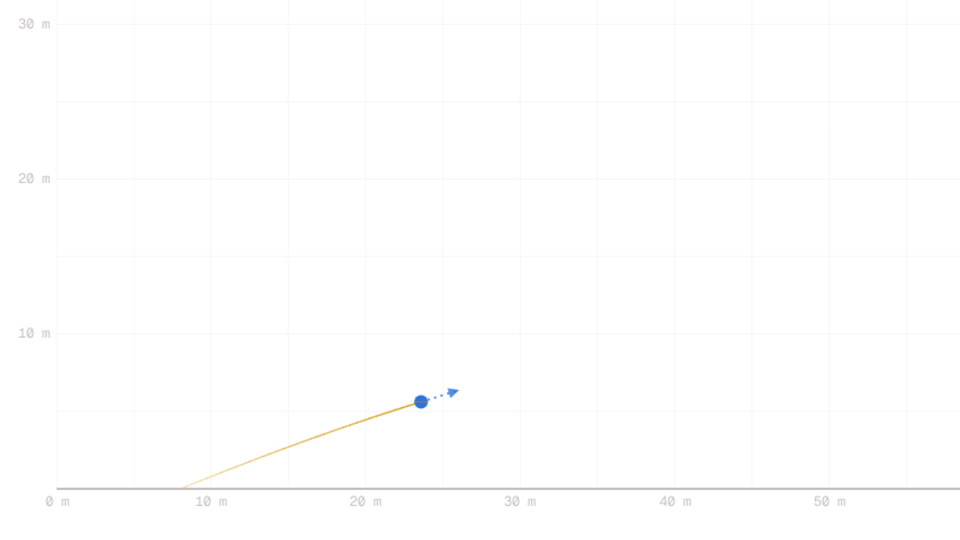
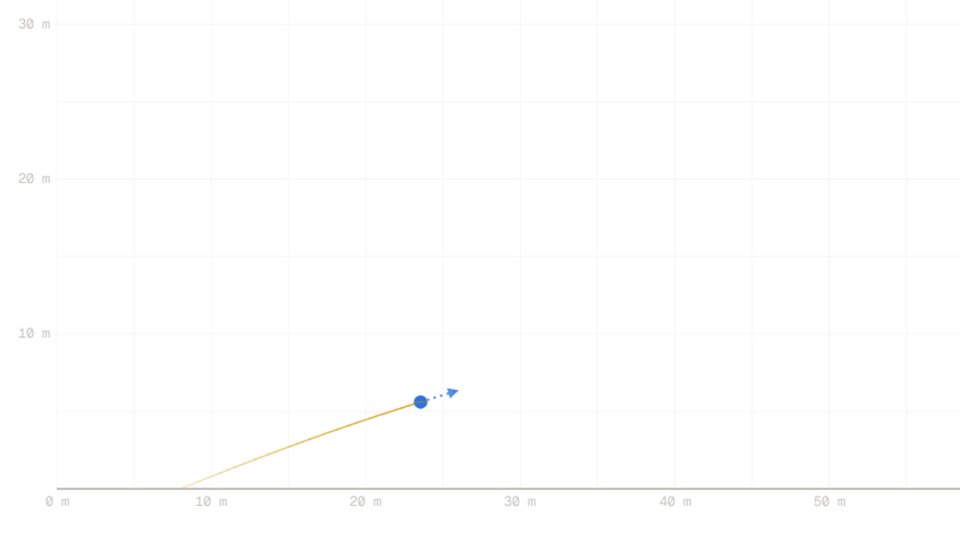
The simulator measures it. With a launch of 30 m/s at 22° and a back-spin of 175, the ball carries about 81 m and tops out near 10 m; set the spin to zero with everything else unchanged and the same launch falls short at about 53 m. The back-spin added almost 30 m of carry purely by keeping the ball aloft.
This is exactly why golf balls are dimpled and struck with thousands of rpm of back-spin: a driver that imparts good spin turns a low, fast launch into a long, hanging flight. There is a limit (too much spin makes the ball balloon upward and lose distance), but in the normal range, more back-spin means more carry, because the lift grows with both the spin and the ball's airspeed.
How does a baseball pitcher throw a curveball or a rising fastball?
The pitcher sets the spin axis to aim the Magnus force wherever the break is wanted, because that force always points perpendicular to the ball's velocity. A four-seam fastball thrown with heavy back-spin gets an upward Magnus force that fights gravity, so it drops less than the batter expects and appears to 'rise'. A curveball thrown with top-spin gets a downward force that adds to gravity, so it dives sharply through the strike zone.
The simulator shows both behaviours along the vertical: back-spin (positive) lifts the arc and stretches it, while top-spin (negative) pulls the apex down and shortens the flight. Set the spin to −150 and the ball dives well short of its no-spin range, the same way a sharp curve drops out of the zone.
A real pitcher tilts the spin axis sideways too, turning the same Magnus force into a horizontal break (the sweeping slider or the running two-seamer), but the physics is identical: spin plus airspeed makes a perpendicular force, and the direction of the spin axis decides which way the ball bends.
Why is the best launch angle for a spinning ball not 45 degrees?
The clean 45° answer holds only for a projectile with no air forces at all. Drag alone already pulls the best angle a little below 45°, because a lofted shot wastes speed climbing. Back-spin pulls it much further down, because the Magnus lift rewards a flatter, faster launch twice over: a flatter shot keeps more of its speed, and a faster ball generates more lift.
Sweeping the launch angle makes the shift plain: with no spin, the longest carry lands near 43°, just under the ideal 45°. Turn on a strong back-spin of 200 and the best angle drops to about 29°, well below 45°, because the ball now stays aloft on its own lift rather than on a steep launch.
This is why a golf driver is lofted at only about 10 to 12 degrees rather than 45: the ball's own back-spin supplies the climb that a naive, force-free calculation assumes it must buy with a steeper launch. The spin has quietly taken over the job that the launch angle does in the textbook parabola.
Further Reading
- Projectile with drag: the spin-free baseline this sim builds on, whose optimum already sits just below 45°.
- Magnus free kick: the same force aimed sideways, bending a football around the wall instead of lifting it.
- Projectile motion: the force-free parabola whose 45° optimum the spin pushes so far downward.