Magnus Effect · SimulatorSpin Lift on a Flying Ball
Spin bends a projectile's flight: back-spin lifts the ball so it carries farther on a flatter line and the best launch angle drops well below 45°, while top-spin makes it dive.
Published: June 8, 2026
Objective
Show how spin bends a projectile's flight through the Magnus force, which acts at right angles to the velocity. Back-spin lifts the ball so it holds height, carries farther, and comes down on a flatter line, pushing the range-maximising launch angle well below the drag-free 45°; top-spin does the reverse and makes the ball dive. Confirm that adding back-spin to a fixed launch lengthens the range and raises the apex, that the best angle for distance falls as the spin rises, and that reversing the spin to top-spin shortens the flight. The ball is a point mass under gravity, quadratic drag, and a Magnus lift proportional to spin times airspeed.
Setup
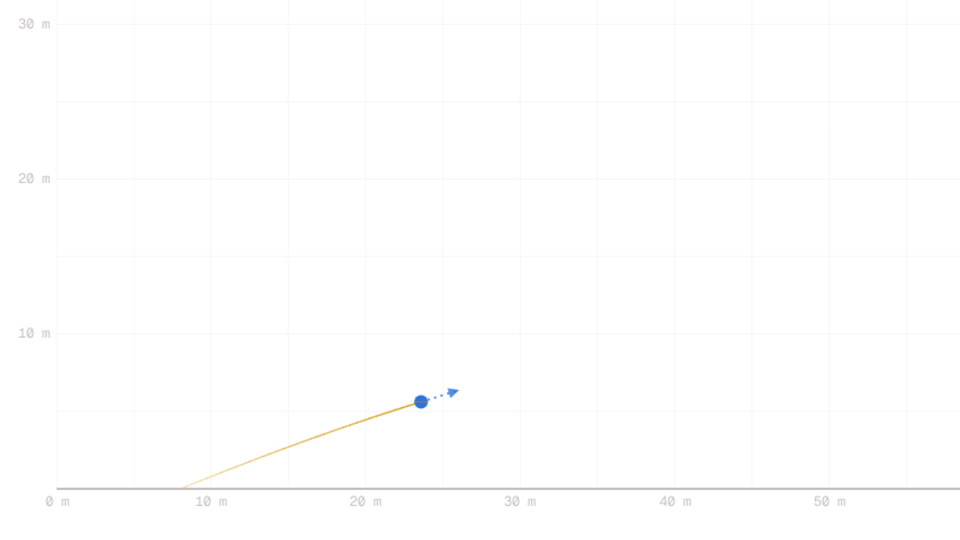
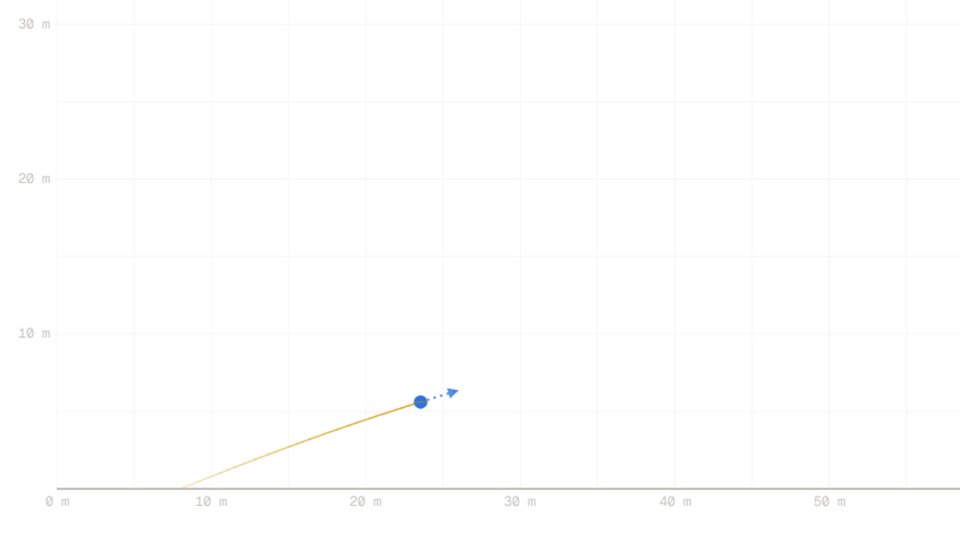
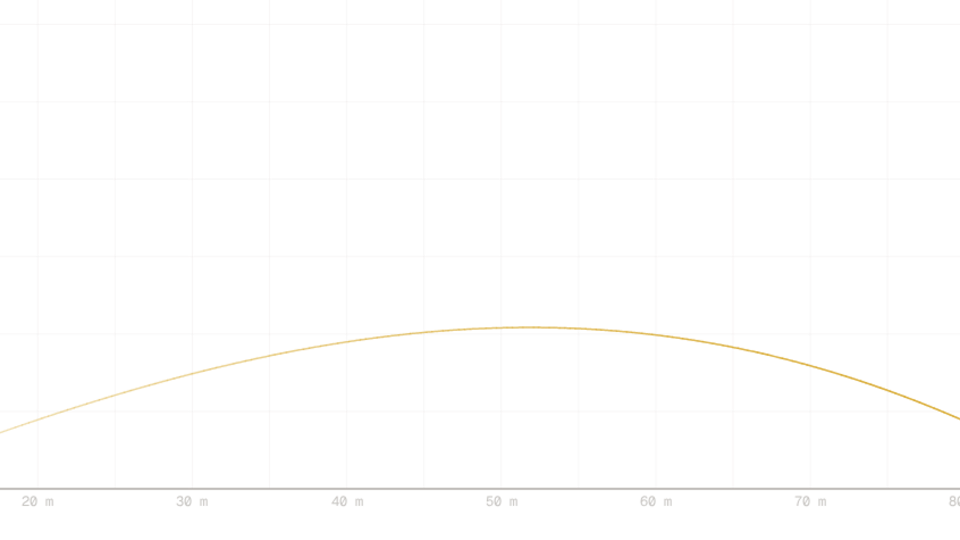
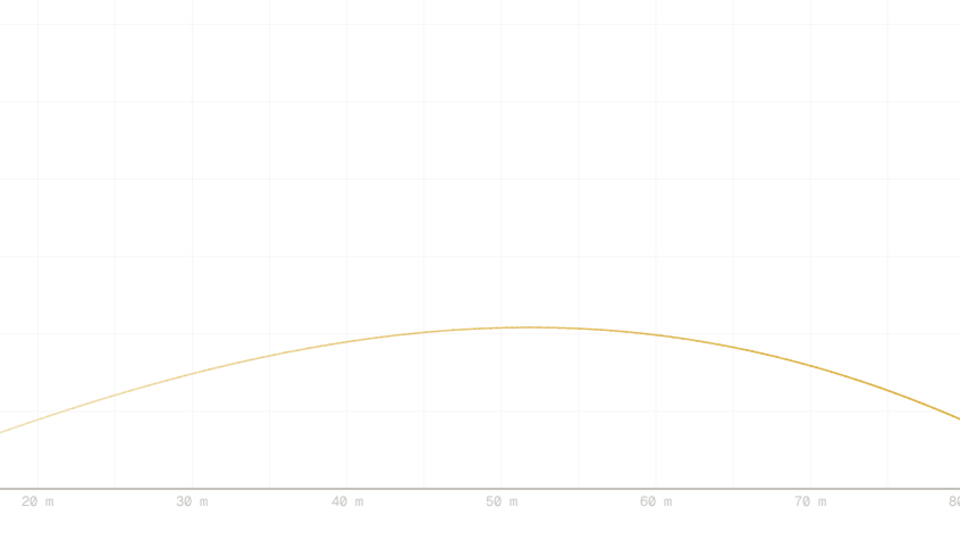
- On a fresh canvas the third button reads Reset; if earlier arcs are on screen it reads Clear; press Clear to wipe them. Leave the defaults (launch 30 m/s, 22°, spin 175 rad/s back-spin, drag 0.0050 kg/m) and press Start. The ball carries about 81 m and tops out near 10 m.
- Press Reset: the arc stays as a faded grey ghost. Drag the Spin slider to 0 and press Start. The same launch now falls short at about 53 m: back-spin added nearly 30 m of carry.
- Press Reset, set the Spin to −150 (top-spin), and press Start. The ball dives early and lands shortest of the three. The overlaid arcs fan out: top-spin shortest, no spin in the middle, back-spin longest and flattest.
- Press Clear. Set the Spin back to 175 and sweep the Angle slider: at this spin the longest carry comes near 29°, not 45°, because the lift keeps a flatter, faster shot aloft long enough to out-range a lofted one.
- Set the Spin to 0 and sweep the Angle again: now the best distance returns to about 43°, close to the drag-free 45°. Use Reset to overlay a 29° back-spin arc against a 43° no-spin arc and see which lands farther.
Analytical Prediction
The Magnus force acts perpendicular to the velocity, with magnitude proportional to the spin ω and the airspeed |v|. Splitting it into components and adding gravity and quadratic drag gives the accelerations the simulator integrates:
The +C·ω·vₓ term is the lift: for back-spin (ω > 0) on a ball moving forward it points up, opposing gravity. There is no closed form for the range, so the motion is integrated. With the defaults (launch 30 m/s, 22°, spin 175, k = 0.0050) the carry is about 81 m with an apex near 10 m. Drop the spin to zero and the same launch carries only about 53 m. The lift also moves the best angle for distance: with a strong back-spin of 200 the longest carry comes near 29°, against about 43° with no spin, well below the textbook 45°.
Results Analysis
Watch the Range and Apex readouts as you change the Spin. Adding back-spin to a fixed launch raises both: the lift holds the ball up, so it stays aloft longer and travels farther; at the defaults, going from no spin to spin 175 stretches the carry from about 53 m to about 81 m and lifts the apex from about 6 m to about 10 m. The deeper lesson is in the launch angle. With no spin, drag pulls the best angle just under the ideal 45°, to about 43°. Turn on a strong back-spin and the best angle for distance drops to about 29°, because a flatter, faster shot keeps more speed, and a faster ball gets more lift, since lift grows with airspeed. Reverse the spin to top-spin and the force flips: the ball is pushed down, the apex collapses, and the range falls below the no-spin value. With Reset keeping each arc as a ghost, overlay top-spin, no spin, and back-spin at the same launch to see the family of curves the spin sweeps out.
Source of Error
The model is a point-mass ball under gravity, quadratic drag of fixed coefficient k, and a Magnus lift modelled as C·ω·|v| perpendicular to the velocity with a constant coupling C and a constant spin. Real spin decays through the flight, real drag and lift coefficients drift with the Reynolds number and the spin ratio, and a real ball spinning about a vertical axis also curves sideways (the hook and slice of golf, the bend of a free kick), which a side view cannot show. Because the prediction and the simulation share the same idealisations, the lift-driven gains and the lowered optimum angle shown here follow exactly from the C·ω term. The one statement that survives every idealisation is the limit: with the spin set to zero the Magnus term vanishes and the flight is ordinary quadratic-drag projectile motion, with its optimum just below 45°.
Further Exploration
- Hold the launch at 22° and raise the Spin from 0 to 200 in steps, keeping each arc with Reset. How much extra carry does each step of back-spin buy, and does the gain grow or shrink as the spin climbs?
- Set the Spin to 200 and sweep the Angle to find the longest carry. How far below 45° is the best angle, and why does lift reward a flatter launch?
- Make the Spin negative (top-spin) and watch the Apex and Range collapse. Why does top-spin force a ball down, and where in sport might a player want exactly that?
- Hold the spin and angle fixed and lower the Drag. Does weaker drag let back-spin help more or less, and what does that reveal about how lift and drag trade off as speed changes?