Coulomb's Law PhysicsCoulomb's Law F = kq₁q₂/r²
Introduction
Coulomb's law is the rule that tells you how hard two electric charges push or pull on each other. It is the electrostatic counterpart of Newton's law of gravity, and it is the first quantitative law most students meet in electromagnetism because almost every later idea (electric fields, voltage, capacitance, and the structure of atoms) is built on top of it. This simulator places two point charges on a line, lets you set the sign and size of each one and the distance between them, and draws the force arrows live with the magnitude labeled in newtons.
The setup matters because the same three controls reproduce every textbook electrostatics question. Two protons, an electron orbiting a nucleus, two charged spheres on insulating stands, and the ions inside a salt crystal are all the same diagram with different numbers. Once you can read the arrows and trust the static force readout, you can predict whether a pair attracts or repels and how strongly. Pressing Start then releases the two charges along the reference axis so they accelerate under their mutual force (opposite signs draw together until their edges touch, like signs fly apart to the frame edge) while two stacked graphs on the right plot against separation r: the top traces the analytical force-versus-separation curve with a marker that rides it at the current r, and the bottom plots each particle's velocity versus separation r as two mirrored lines that fill in live.
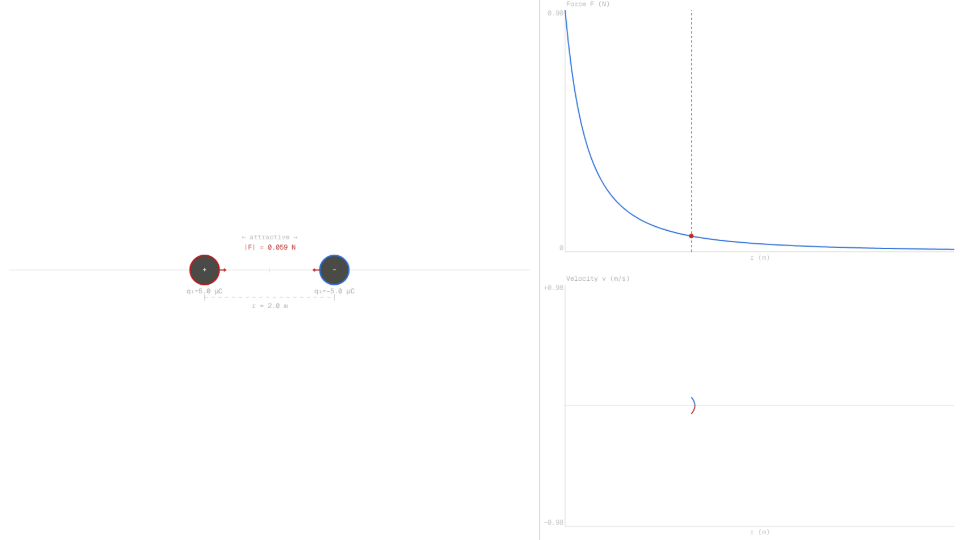
Many newcomers expect that flipping a charge from positive to negative will change how strong the force is. With q₁ = +5 μC, q₂ = −5 μC, and r = 2.0 m, the Force F readout settles at 0.0562 N with the arrows inward; switching q₂ to +5 μC keeps that same 0.0562 N but turns the arrows outward. The sign sets only the direction, while the magnitude depends solely on the charge sizes and their separation.
The Physics Explained
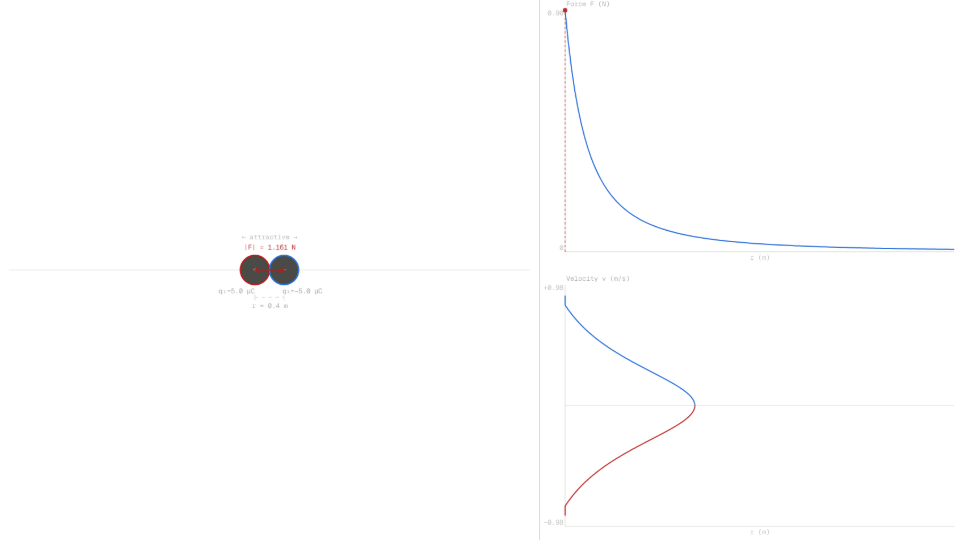
Each charge feels a single electrostatic force from the other, directed along the line that joins them. Coulomb's law gives its magnitude as the product of the two charge sizes divided by the square of their separation, scaled by the constant k. By Newton's third law the two charges feel forces of equal magnitude in opposite directions, which is why the simulator draws a matched pair of arrows. When the charges carry opposite signs the arrows point toward each other and the pair attracts; when the signs match the arrows point apart and the pair repels.
With the simulation defaults q₁ = +5 μC, q₂ = −5 μC, and r = 2.0 m, the arithmetic is direct. Converting to coulombs gives charges of 5 × 10⁻⁶ C each, so the product of magnitudes is 25 × 10⁻¹² C². Dividing by r² = 4 m² and multiplying by k = 8.99 × 10⁹ N·m²/C² yields a force of about 0.0562 N. This is exactly the Force F value the simulator's readout displays the moment the charges are placed, and because the signs differ the arrows point inward to mark the attraction.
The most important feature of the law is the r² in the denominator, which makes the force fall off steeply with distance. Halving the separation from r = 2.0 m to r = 1.0 m does not merely double the force; it quadruples it, because r² shrinks by a factor of four. The static Force F readout climbs from 0.0562 N to about 0.225 N when you drag the separation slider down to half its value. Press Start at the closer spacing and the marker on the force-versus-separation curve climbs the steepening inverse-square curve toward smaller r as the charges rush together, because the gap keeps shrinking until their edges meet.
The charge magnitudes enter linearly, so each one acts as a simple multiplier. Doubling q₁ from +5 μC to +10 μC while holding q₂ = +5 μC and r = 2.0 m doubles the Force F readout to about 0.112 N. Pushing both charges to the slider maximum, q₁ = +10 μC and q₂ = +10 μC at the minimum separation r = 0.5 m, combines a fourfold charge product with a sixteenfold distance factor to drive the readout up to roughly 3.6 N, many times the gentle default force and a vivid demonstration of how quickly electrostatic forces grow.
Key Equations
With q₁ = +5 μC, q₂ = −5 μC, and r = 2.0 m, Coulomb's law gives the full chain from charge and distance to force magnitude:
For the defaults with |q₁| = |q₂| = 5 × 10⁻⁶ C and r = 2.0 m: F ≈ 0.0562 N. This is the length of the red arrow on each charge, and it is where the marker sits on the force-versus-separation curve the moment you press Start.
The constant k sets the overall strength of the electrostatic interaction in vacuum. It is enormous compared with the gravitational constant, which is why the electric force between two protons dwarfs their mutual gravity by some forty orders of magnitude.
Halving the separation quadruples the force: from r = 2.0 m to r = 1.0 m the Force F readout rises from 0.0562 N to about 0.225 N, a factor of four. The same rule means doubling the separation cuts the force to one quarter.
Doubling q₁ from +5 μC to +10 μC at r = 2.0 m doubles the Force F readout to about 0.112 N. Driving both charges to +10 μC at r = 0.5 m pushes the readout to about 3.6 N.
The sign of the product sets the direction only. The 0.0562 N magnitude is identical for the attractive +5/−5 pair and the repulsive +5/+5 pair, since both share the same product of absolute charges.
Key Variables
| Symbol | Name | Unit | Meaning |
|---|---|---|---|
| q₁ | First charge | μC (microcoulombs) | Signed magnitude of the first point charge |
| q₂ | Second charge | μC (microcoulombs) | Signed magnitude of the second point charge |
| r | Separation | m | Distance between the two charge centers |
| k | Coulomb constant | N·m²/C² | 8.99 × 10⁹ in vacuum |
| F | Electrostatic force | N | Magnitude of the push or pull on each charge |
Real World Examples
Why does halving the distance between two charges quadruple the force?
Coulomb's law puts the separation in the denominator as r², so the force depends on one over the distance squared rather than just the distance. Cutting the distance in half therefore divides r² by four, which multiplies the force by four.
The simulator shows this directly. With q₁ = +5 μC, q₂ = +5 μC, and the separation slider at r = 2.0 m, the Force F readout settles near 0.0562 N. Dragging the separation down to r = 1.0 m raises the readout to about 0.225 N, exactly four times larger. This steep inverse-square growth is why two charged spheres feel almost nothing across a room yet snap together violently once they nearly touch, and it is the same mathematical form that governs gravity and the brightness of a lamp as you walk toward it.
Why do two charges with the same magnitude push with the same strength whether they attract or repel?
The force magnitude depends only on the product of the absolute charge values and the distance, never on the signs; the signs decide direction alone.
The simulator makes the point concrete. Starting from q₁ = +5 μC, q₂ = −5 μC, r = 2.0 m, the Force F readout reads 0.0562 N with the arrows pointing inward, an attractive pair. Flipping q₂ to +5 μC so both charges are positive leaves the same 0.0562 N on screen but turns the arrows outward into a repulsive push. Nature treats the strength of attraction between a proton and an electron exactly the same as the strength of repulsion between two protons at the same separation, which is why a salt crystal holds together with the same family of forces that also drive its ions apart when it dissolves.
How does doubling one charge change the electric force between two particles?
Because the force is proportional to each charge, doubling one of them doubles the force while the other charge and the distance stay fixed.
The simulator confirms the linear scaling cleanly. Holding q₂ = +5 μC and r = 2.0 m, the default q₁ = +5 μC gives a Force F readout of about 0.0562 N. Dragging q₁ up to +10 μC raises the readout to about 0.112 N, a clean factor of two. Push both charges to their extremes, q₁ = +10 μC and q₂ = +10 μC at r = 0.5 m, and the readout climbs to about 3.6 N. This proportionality is why a lightning-charged cloud, carrying enormous accumulated charge, exerts a force strong enough to ionize the air and strike the ground, while the tiny static charge on a comb only lifts a few scraps of paper.
Further Reading
- Escape velocity: gravity's own inverse-square force in action, where the same one-over-distance-squared fall-off sets how fast a body must move to break free.
- Free-body diagrams: how to draw and sum force vectors like the electrostatic arrows here, the foundation for any force problem.
- Orbital motion: the same inverse-square form applied to gravity, where the force also falls off as one over distance squared.