Catch the Falling Cat PhysicsWhy Aiming Straight Always Hits
Introduction
The catch-the-falling-cat problem is one of the most cited demonstrations in introductory mechanics. A firefighter aims a net directly at a cat perched on a ledge. The instant the net leaves the launcher, the cat releases its grip and falls. The counterintuitive result is that the net always hits the cat, no matter how fast the net was fired, as long as it reaches the cat's column before the cat hits the ground.
The reason is that both objects experience the same gravitational acceleration g = 9.81 m/s² downward from the moment the net is launched. Although the net starts on an angled aim line and the cat starts at rest, gravity pulls each one down by exactly ½·g·t² at every instant. The vertical drop relative to the original aim line is identical for the two objects, so the geometric path the net traces and the geometric path the cat traces converge at the same point in space, regardless of the net's horizontal speed.
The simulator places the cat at a horizontal distance of 30 m, with adjustable initial height between 10 m and 40 m and net launch speed between 5 m/s and 40 m/s. The aim angle is computed automatically from the geometry, so the user controls only the speed and the cat height. The result is a clean experimental confirmation that interception is guaranteed by physics, not by luck, and that the only way to miss is to fire so slowly that the cat reaches the ground before the net arrives.
The Physics Explained
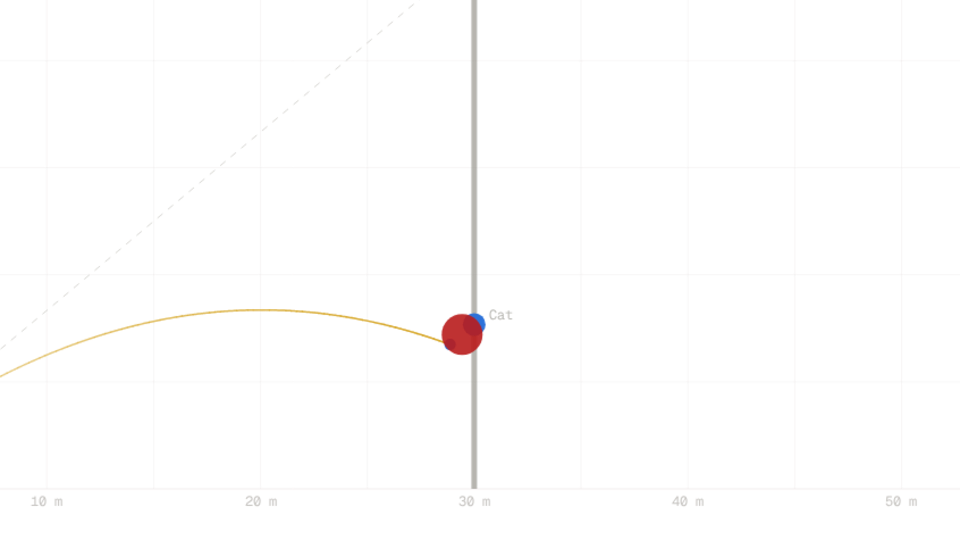
To understand why the net always meets the cat, think of two separate but synchronised motions. The net moves along a straight line from the launch point toward the cat's initial position, with constant velocity components vₓ = v·cos(θ) and vy = v·sin(θ), where θ is the aim angle. At the same time, gravity adds a downward displacement of ½·g·t² to whatever the net's straight-line motion would have produced. The cat, starting at rest, also acquires a downward displacement of ½·g·t² because gravity acts on it from the same instant.
The net's straight-line motion is aimed exactly at the cat's original position, so without gravity the net would pass through that point at time t = d / (v·cos(θ)), where d = 30 m is the horizontal distance. With gravity, the net falls below the aim line by ½·g·t² at that same instant. The cat, having fallen by ½·g·t² from its starting height, is now at exactly the same vertical position as the net. The two objects meet because the same gravitational term subtracts from both paths and the geometry of the aim line guarantees coincidence in the horizontal coordinate.
The time of interception depends only on the net's horizontal velocity component. With v = 20 m/s and cat height 25 m, the aim angle is θ = arctan(25/30) ≈ 39.8°, giving cos(θ) ≈ 0.768 and tcatch = 30 / (20 · 0.768) ≈ 1.95 s. Doubling the net speed to 40 m/s halves the catch time to about 0.98 s, but the Gap readout still reaches zero at the moment of catch. The Time readout traces this inverse proportionality directly: the catch-time ratio between successive speeds matches the inverse ratio of horizontal velocity components.
The constraint that the cat must still be above the ground at the moment of catch sets a minimum net speed. The fall time available is tground = sqrt(2·h/g), which for cat height 25 m gives about 2.26 s. The net must cover 30 m horizontally within that window, so vmin ≈ 30 / (2.26 · cos(θ)) ≈ 17.3 m/s at this height. Below that speed the cat reaches the ground first and the simulation ends without a catch marker, even though the geometric aim was correct.
Key Equations
With cat height h = 25 m and horizontal distance d = 30 m, θ = arctan(25/30) ≈ 0.695 rad ≈ 39.8°. This is the angle above the horizontal at which the net leaves the launcher, computed automatically from the slider settings so the net always points directly at the cat's initial position.
With v = 20 m/s and θ ≈ 39.8°, vₓ ≈ 20 · 0.768 ≈ 15.36 m/s and vy ≈ 20 · 0.640 ≈ 12.80 m/s. The horizontal component stays constant throughout the flight; the vertical component decreases by 9.81 m/s every second because of gravity.
For v = 20 m/s, h = 25 m: tcatch = 30 / (20 · 0.768) ≈ 1.95 s. For v = 40 m/s the time shortens to 30 / (40 · 0.768) ≈ 0.98 s. The simulator's Time readout at the moment of the catch marker matches these values to two decimal places.
At v = 20 m/s, h = 25 m, tcatch ≈ 1.95 s: ycatch = 25 − 0.5 · 9.81 · 1.95² ≈ 25 − 18.70 ≈ 6.30 m. Both net and cat arrive at this height at the same instant; the simulator's Net height and Cat height readouts converge at this value before the red catch marker appears.
For h = 25 m: tground = sqrt(2·25/9.81) ≈ 2.26 s, so vmin ≈ 30 / (2.26 · 0.768) ≈ 17.3 m/s. For h = 40 m: tground ≈ 2.86 s and vmin ≈ 30 / (2.86 · cos(arctan(40/30))) ≈ 30 / (2.86 · 0.6) ≈ 17.5 m/s. No catch marker appears at speeds below vmin, while one appears immediately above it, putting the threshold directly on screen.
Key Variables
| Symbol | Name | Unit | Meaning |
|---|---|---|---|
| v | Net launch speed | m/s | Magnitude of the net's initial velocity vector |
| h | Cat initial height | m | Vertical position of the cat at the moment of launch |
| d | Horizontal distance | m | Fixed distance between firefighter and ledge, 30 m in this simulator |
| g | Gravitational acceleration | m/s² | Constant downward acceleration, 9.81 m/s² near Earth's surface |
| θ | Aim angle | rad | Angle of the net's initial velocity above the horizontal, equal to arctan(h/d) |
| vₓ | Horizontal net velocity | m/s | Constant component v·cos(θ) |
| vy | Vertical net velocity | m/s | Initial value v·sin(θ); decreases by g each second |
| tcatch | Time to interception | s | d / (v·cos(θ)) when the cat is still above ground |
| tground | Cat ground-fall time | s | sqrt(2·h/g), the time for the cat to fall to y = 0 |
Real World Examples
Why is this experiment a standard physics-classroom demonstration of the equivalence of gravitational fall?
The catch-the-falling-cat setup is one of the cleanest visual proofs that gravity accelerates every object at the same rate regardless of mass or horizontal velocity. Instructors use it because the surprise factor is exactly the point: students predict the net will go over the cat if the cat drops, since gravity will pull the projectile away from its initial aim line. The actual outcome, guaranteed interception, only makes sense once you accept that the net is also falling, and both fall by the same amount ½·g·t² at every instant after launch.
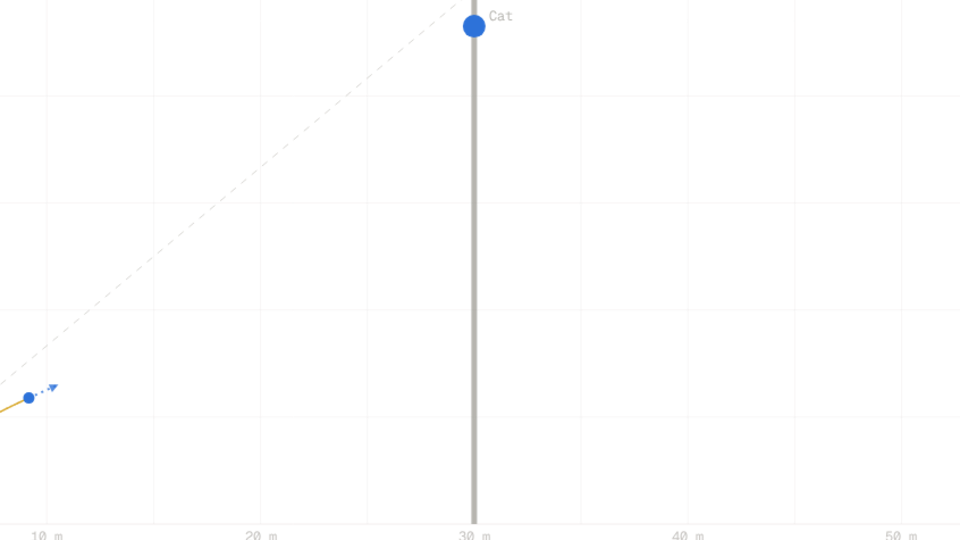
The simulator reproduces the classroom setup with the cat at horizontal distance 30 m and adjustable height. At v = 20 m/s, cat height 25 m, the Time readout at catch shows approximately 1.95 s, and the Gap readout (the vertical distance between net and cat) drops smoothly toward zero throughout the flight rather than ever opening up. Changing net speed to 40 m/s halves the catch time to roughly 0.98 s, but the Gap still reaches zero, demonstrating that interception is independent of launch speed.
The simulator's red catch marker appears at the meeting point in every successful run, even at the slowest speeds where the net's trajectory looks dramatically curved compared to the cat's straight drop. Pedagogically the takeaway is that the net's parabolic path and the cat's straight free-fall path are different projections of the same underlying motion: each is a straight-line motion in the reference frame that falls at g·t together with both objects. In that frame neither one falls, and the net simply travels straight from launcher to cat.
How does this principle apply to aerial refueling and other co-falling vehicle scenarios?
Aerial refueling tankers and receivers maintain a constant relative position vertically because both aircraft experience the same gravitational acceleration when they cut engines briefly during a transfer. The receiver pilot does not need to compensate for vertical drift caused by gravity, only for thrust differences and aerodynamic effects, since gravity acts on both airframes equally. The catch-the-falling-cat setup demonstrates the same invariance in a purer form, with no aerodynamic complications.
The simulator shows this clearly: with v = 20 m/s and cat height 25 m, the Net height and Cat height readouts both fall by ½·9.81·t² from their respective starting heights. At t = 1 s into the run, the net has risen along its aimed trajectory but lost about 4.9 m to gravity below the aim line; the cat has also fallen 4.9 m from 25 m to about 20.1 m. The vertical separation between net and cat shrinks only because of the geometry (the aim angle directs the net toward the cat's initial position), not because gravity treats them differently.
This principle underlies why two objects in the same free-fall reference frame behave as if gravity were absent, a foundational insight that connects elementary projectile physics to general relativity and orbital mechanics. Astronauts in orbit feel weightless not because there is no gravity in low Earth orbit (gravity there is roughly 89 % of its surface value) but because the entire vehicle and everything inside it fall together at the same rate, exactly like the net and the cat in this simulator.
Why does the net sometimes fail to reach the cat at very low launch speeds even though geometry says it should?
At low net speeds the cat reaches the ground before the net covers the 30 m horizontal distance, ending the simulation as a miss even though the aim was correct. The fall time available is fixed by the initial cat height: tground = sqrt(2·h/g). With cat height 25 m and g = 9.81 m/s², the cat hits the ground at about 2.26 s. The net must cover 30 m horizontally in less time than this, so the minimum launch speed for interception is approximately vmin = 30 / (tground · cos(θ)).
At cat height 25 m the aim angle is θ = arctan(25/30) ≈ 39.8°, cos(θ) ≈ 0.768, giving vmin ≈ 30 / (2.26 · 0.768) ≈ 17.3 m/s. The simulator confirms this threshold: at v = 20 m/s the net intercepts the cat at about 1.95 s, comfortably before the cat reaches the ground, but at v = 10 m/s the cat lands while the net is still in flight and the catch marker never appears.
Raising cat height to 40 m extends the available fall time to about 2.86 s and lowers the minimum speed required slightly, while lowering cat height to 10 m shortens fall time to about 1.43 s and raises the minimum speed needed for a successful intercept. The simulation's natural-stop logic ends the run at whichever event happens first (catch, cat reaching ground, or net leaving the visible region), so missed runs end without a red flash, making the threshold easy to find by experiment.
Further Reading
- Projectile motion: the standard horizontal-vertical decomposition for a single object, the foundation on which the catch-the-falling-cat geometry is built.
- Projectile from a cliff: launch height differs from landing height; another geometry where the same free-fall term shapes the trajectory.
- Feather and hammer: direct experimental confirmation that gravitational acceleration is independent of mass, the principle that makes the catch-the-falling-cat interception inevitable.
- Free fall on different planets: explores how changing g rescales fall time, complementing the catch-the-falling-cat setup by varying the gravitational acceleration that both objects share.