Catch the Falling Cat · SimulatorAim at a Falling Target
A firefighter's net-launcher aims dead-on at a cat perched on a ledge that drops the instant the net fires; both fall together under gravity, so a direct aim always catches the cat.
Published: May 17, 2026 · Updated: June 8, 2026
Objective
Verify the dead-on-aim invariant: a projectile aimed directly at a freely falling target always intercepts it, because both objects share the same gravitational acceleration g. A firefighter's net is launched at the line-of-sight angle to a cat that drops from a ledge the instant the net fires; the vertical separation between net and cat shrinks identically regardless of the net's launch speed, confirming that gravity acts equally on both. The simulation uses point-mass objects with no air drag.
Setup
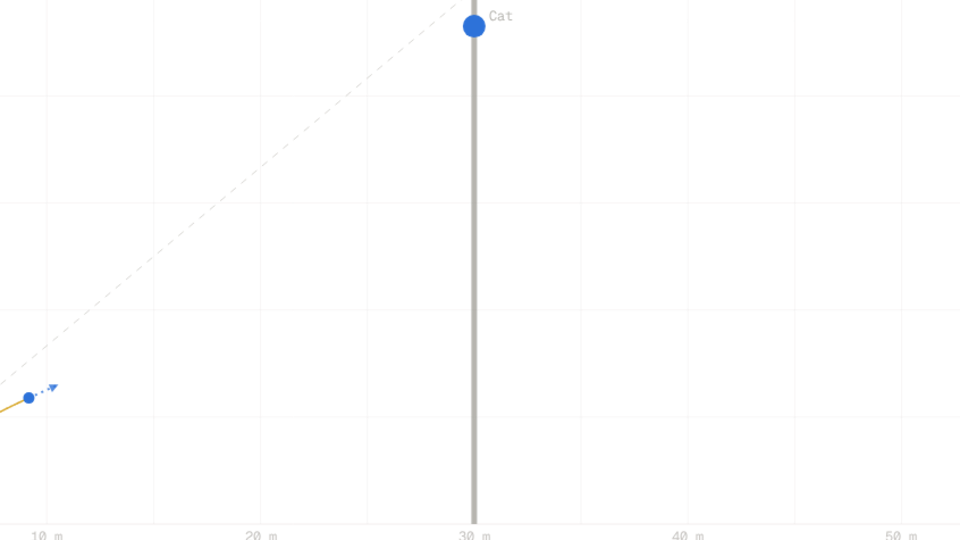
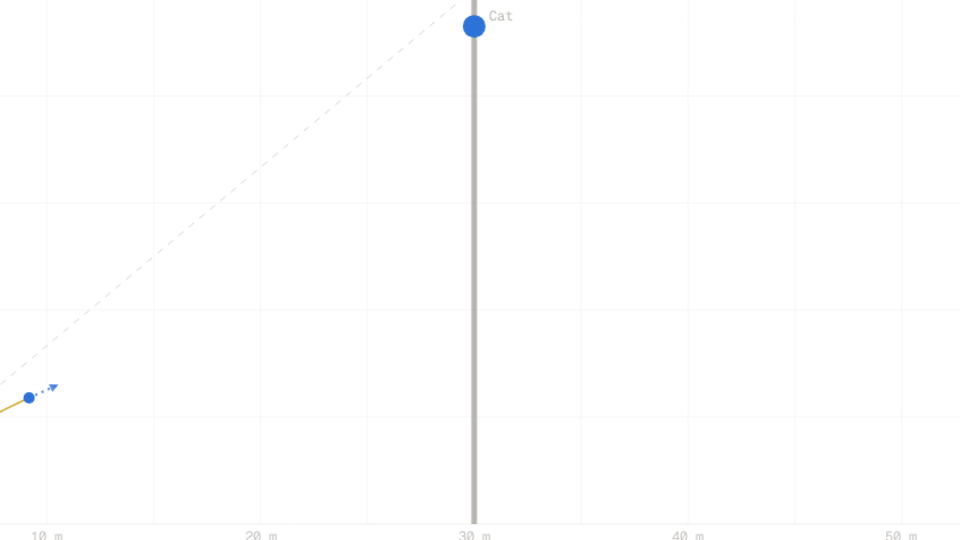
- On a fresh canvas the third button reads Reset; if earlier attempts are on screen it reads Clear; press Clear to wipe them. Set net speed to 20 m/s and cat height to 25 m with the sliders, then press Start. Watch the net arc toward the falling cat.
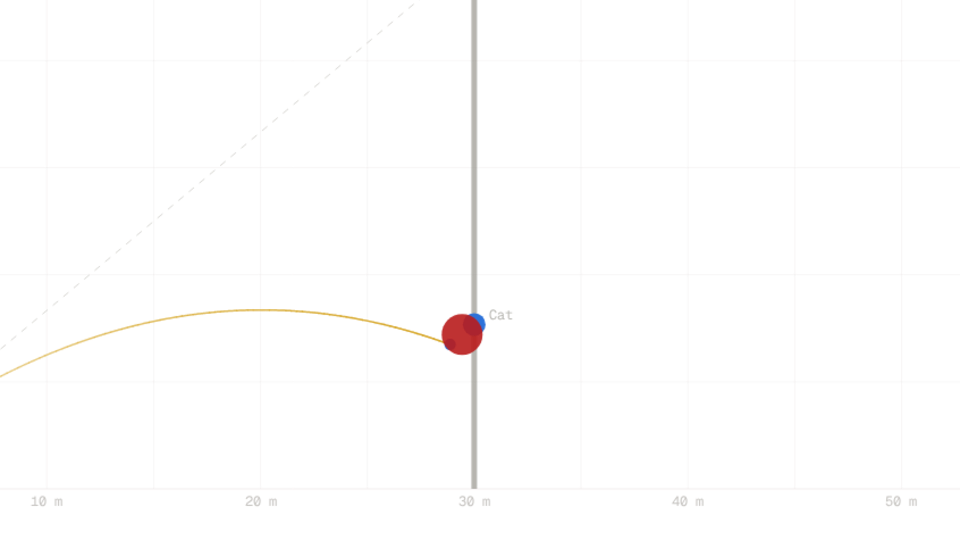
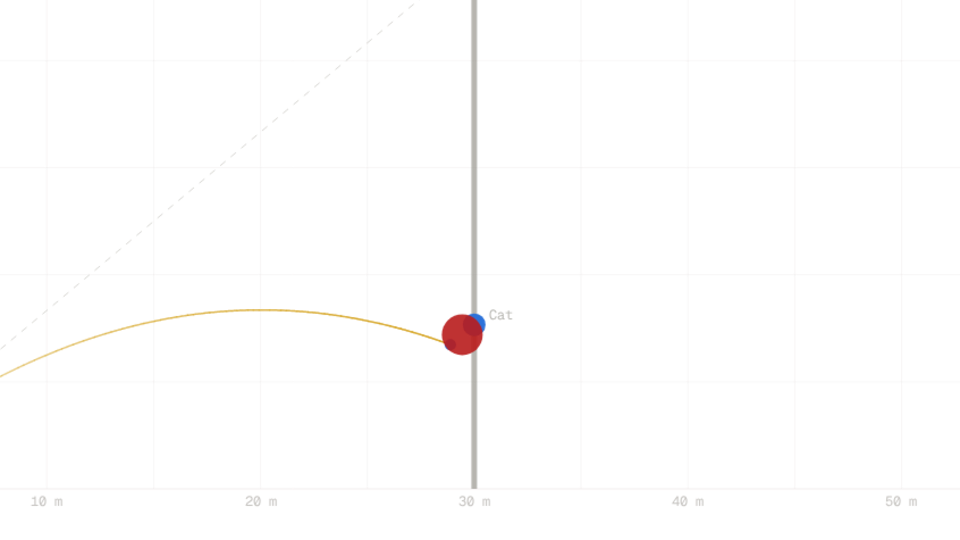
- Note the Gap readout: it falls from 25.00 m toward 0 as the net closes on the cat. Record the Time readout when the red catch marker appears.
- Press Reset: the net's path stays on the canvas as a faded grey ghost. Set net speed to 35 m/s and press Start. The net travels faster and still catches the cat: the Gap still reaches 0, but at a shorter Time. The overlaid paths show the catch happens regardless of speed.
- Press Reset. Set net speed to 40 m/s and press Start. The net reaches the cat even faster: the catch marker appears at roughly 0.98 s compared with about 1.95 s at 20 m/s.
- Press Reset. Set cat height to 15 m with net speed 20 m/s. Press Start and note the shorter flight time than at 25 m. Press Clear to wipe the board when you are done comparing.
- Compare the Time readouts at the catch across speed settings. The catch time scales as t = h / (v · sin θ) (equivalently d / (v · cos θ), since θ = arctan(h/d)), confirming the inverse relationship between speed and catch time.
Analytical Prediction
The net is launched at angle θ = arctan(h/d) where h is cat height and d = 30 m is the horizontal distance to the ledge. Both net and cat fall with acceleration g = 9.81 m/s² from the moment of launch. The net catches the cat when it covers the horizontal distance: t_catch = d / (v · cos θ). With v = 20 m/s, h = 25 m, θ = arctan(25/30) ≈ 0.695 rad, cos θ ≈ 0.768:
With v = 40 m/s the catch time shortens to ≈ 0.98 s. The vertical position of both net and cat at t_catch is h − ½ · g · t_catch² below the cat's initial height, confirming they meet at the same altitude regardless of v. At v = 20 m/s, both are at ≈ 6.30 m when the catch occurs.
Results Analysis
Watch the Gap (m) readout: it measures |y_net − y_cat| and must converge toward 0 at the catch. The Net height (m) and Cat height (m) readouts should show matching values at the moment the red catch marker appears. At default settings (v = 20 m/s, h = 25 m) the Time readout at the catch should read approximately 1.95 s. At v = 40 m/s it should read approximately 0.98 s, close to half the 20 m/s value, consistent with the inverse proportionality t_catch ∝ 1/v. With Reset keeping each net path as a faded ghost, overlay several launch speeds: every path closes the Gap to 0, the visual proof that a dead-on aim always catches the falling cat.
Source of Error
The model assumes point-mass objects with no air resistance, no rotation, and no wind. The net is treated as a particle with zero physical size; the 1.5 m catch-detection threshold is a geometric convenience, not a physical net radius. The cat is similarly a point mass. A real net experiences aerodynamic drag that would make it fall faster than the ideal parabola, potentially causing a miss at low launch speeds, and a real cat is an extended body that would not release instantaneously. Because the analytical prediction makes the same idealisations, the residual between predicted and observed catch times is purely numerical, not physical, for this sim.
Further Exploration
- Set net speed to 40 m/s (maximum). How does the catch time compare to the 20 m/s run? Is the ratio close to 2:1 as the formula t ∝ 1/v predicts? Check the Time readout at the moment the catch marker appears.
- Set cat height to 10 m versus 40 m with net speed fixed at 20 m/s. How does the aim angle θ change? Does a steeper angle take more or less time to reach the cat, and does the net always catch it regardless of angle?
- What happens at very low net speeds? Try 5 m/s with cat height 25 m. Does the net still catch the cat? Why might it miss at low speeds even though the geometry says it should connect? Think about where the cat is when the net arrives.
- Press Reset between runs and set cat height to 40 m (maximum). At what net speed does the sim just barely produce a catch before the cat reaches the ground? The minimum speed is approximately v_min = d / (t_ground · cos θ).