Two-Rope Tension · SimulatorSplit a Load Across Two Ropes
A load hangs from two ropes at adjustable angles; each rope's tension is shown as a labelled vector and a force triangle that closes at equilibrium.
Published: June 1, 2026
Objective
Determine how a hanging load's weight splits into tension along two supporting ropes, and confirm the junction is in static equilibrium: the horizontal components cancel (T₁·cos θ₁ = T₂·cos θ₂) while the vertical components together carry the weight (T₁·sin θ₁ + T₂·sin θ₂ = m·g). Using the T₁, T₂, ΣFx and ΣFy readouts, compare the settled tensions against the closed form T₁ = m·g·cos θ₂ ⁄ sin(θ₁+θ₂) with g = 9.81 m/s². The defaults place both ropes at 45°, so each carries an equal share; flattening an angle reveals how steeply the tension grows.
Setup
- Press Reset. The Time readout returns to 0.00 s, ΣFx and ΣFy read 0.00 N, and the rig shows the load hanging from two ropes with no force arrows drawn yet.
- Confirm the three sliders are at their defaults: Left rope angle = 45°, Right rope angle = 45°, Load mass = 2.0 kg. The Load mg readout shows 19.62 N (2.0 × 9.81).
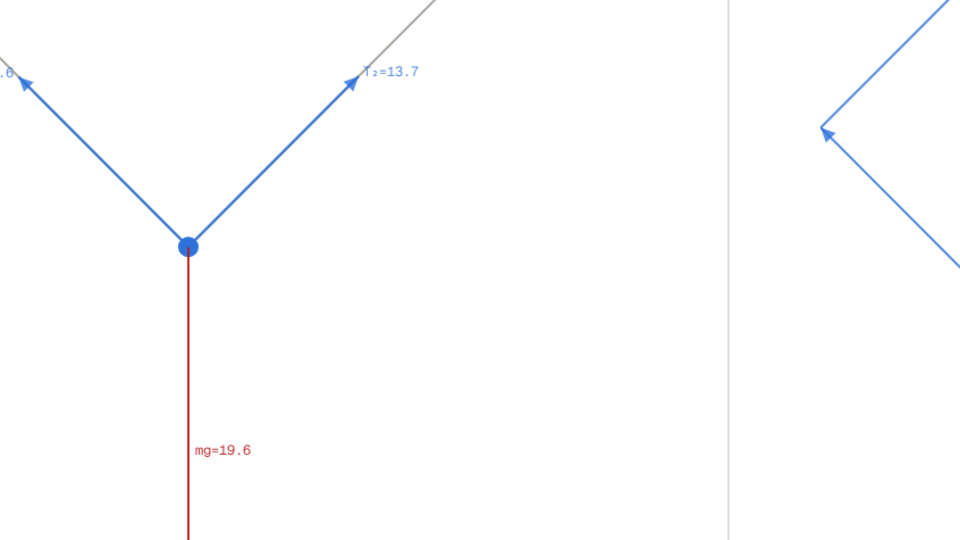
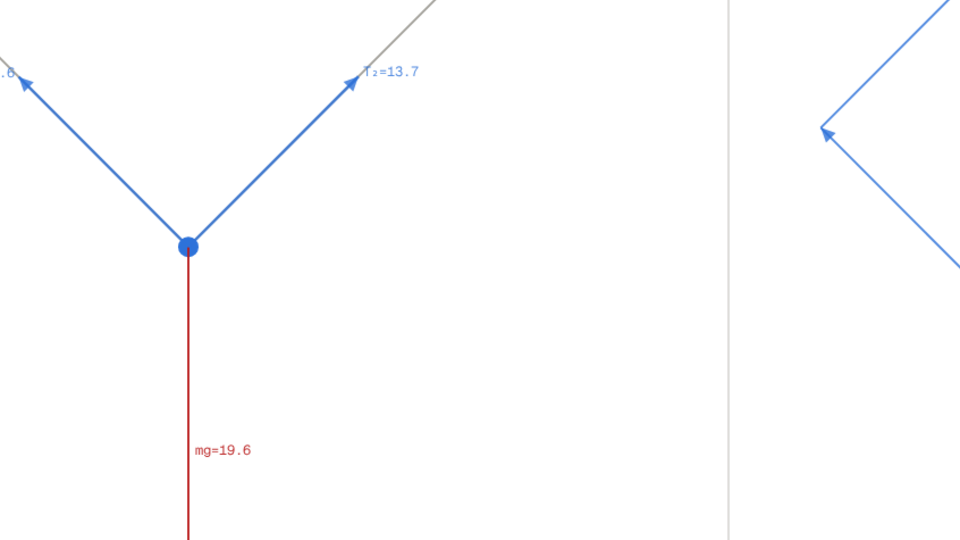
- Press Start. A brief tug runs; the load settles as the force arrows (weight, T₁, T₂) and the head-to-tail force triangle build up, then lock at the static values. Watch ΣFx and ΣFy fall toward 0.00 N.
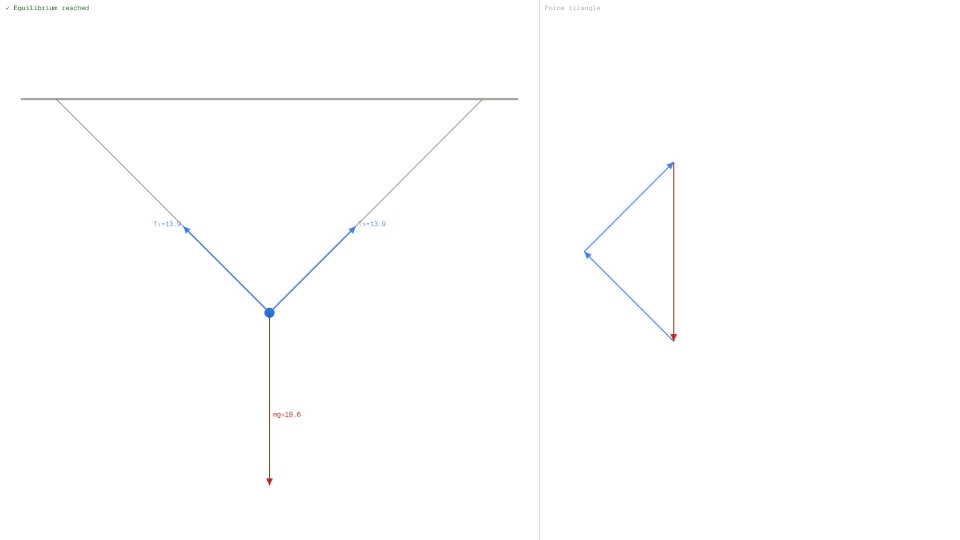
- When the tug damps out the simulation stops on its own and the canvas shows ✓ Equilibrium reached. Record T₁, T₂, ΣFx and ΣFy. With symmetric 45° ropes, T₁ and T₂ should match at 13.87 N.
- Press Reset, then drag both angle sliders down to 15°. Without running, the T₁ and T₂ readouts jump well above mg: the same load, but each rope now pulls with far more force.
Analytical Prediction
With both ropes symmetric at θ₁ = θ₂ = 45° and m = 2.0 kg, g = 9.81 m/s², the closed form gives equal tensions:
The vertical components confirm equilibrium: 2 · 13.87 · sin 45° = 19.62 N = m·g, so ΣFy = 0; by symmetry ΣFx = 0. Crucially the tension magnitudes do NOT sum to the weight; only their vertical components do. Flatten both ropes to θ = 15° and the denominator sin 30° = 0.5 nearly doubles each tension to ≈ 37.9 N, far above the 19.62 N load. Expected at rest: T₁ = T₂ = 13.87 N, ΣFx = ΣFy = 0.00 N, mg = 19.62 N.
Results Analysis
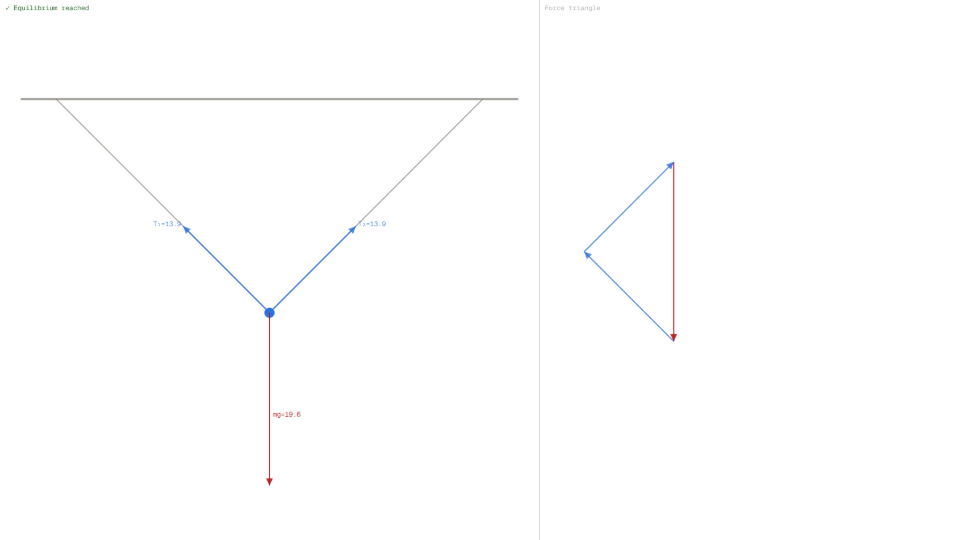
Once the tug settles, T₁ and T₂ should hold steady at 13.87 N each for the 45°/45° default, matching the closed form to two decimals, and ΣFx, ΣFy should read 0.00 N, the quantitative statement of equilibrium. The force triangle in the right panel closes: weight down, then the two tensions head-to-tail returning to the start, with a dashed gap appearing only while the tug is still settling. For an asymmetric test, set Left = 30° and Right = 60°: the readouts split unevenly (T₁ = 9.81 N on the 30° rope, T₂ = 16.99 N on the 60° rope), yet ΣFx and ΣFy still settle to 0.00 N, confirming both equilibrium equations hold for unequal angles.
Source of Error
What this sim does NOT model: the ropes' own weight and stretch (treated as massless and inextensible), any real swinging or pendulum dynamics, friction or give at the anchors, and the load's finite size. The brief tug on Start is a visualization device only: in reality the ropes reach these tensions the instant the load hangs, with no oscillation. The closed form T = m·g·cos θ ⁄ sin(θ₁+θ₂) assumes the same massless, static idealizations, so they cancel rather than contributing error; the residual ΣFx, ΣFy at rest is purely numerical rounding, not physical.
Further Exploration
- Set both angles to 45° and read T₁, T₂. Before changing anything, predict what happens to each tension if you halve the load to 1.0 kg. Adjust the Load mass slider and check: does tension scale linearly with weight?
- Lower both rope angles together from 45° toward 10°. Watch T₁ and T₂ climb. At what angle does each tension exceed twice the load's weight, and why does sin(θ₁+θ₂) in the denominator drive this blow-up?
- Set Left = 20°, Right = 70°. Predict which rope carries the larger tension from T = m·g·cos(other angle) ⁄ sin(θ₁+θ₂), then read T₁ and T₂ to confirm. Does the steeper rope or the shallower one win?
- Find an asymmetric pair of angles where T₁ still equals T₂, or argue from the ratio T₁ ⁄ T₂ = cos θ₂ ⁄ cos θ₁ why equal tensions force equal angles.
- Make one rope nearly horizontal (Left = 10°) and the other steep (Right = 80°). Read ΣFx and ΣFy at rest (both 0.00 N), then explain how a near-horizontal rope can still help hold up a vertical load when its own vertical pull is small.