Kinetic Energy vs Velocity · SimulatorKE Grows with Velocity²
An object with adjustable mass and speed; KE bar grows quadratically with velocity, linearly with mass
Published: June 6, 2026 · Updated: June 7, 2026
Objective
Verify that kinetic energy scales quadratically with speed and linearly with mass: KE = ½mv². By adjusting mass and speed sliders and watching the KE bar and the KE-vs-speed parabola update in real time, learners confirm that doubling speed quadruples KE while doubling mass only doubles it, and that the parabolic shape is a property of the formula, not of the object's mass.
Setup
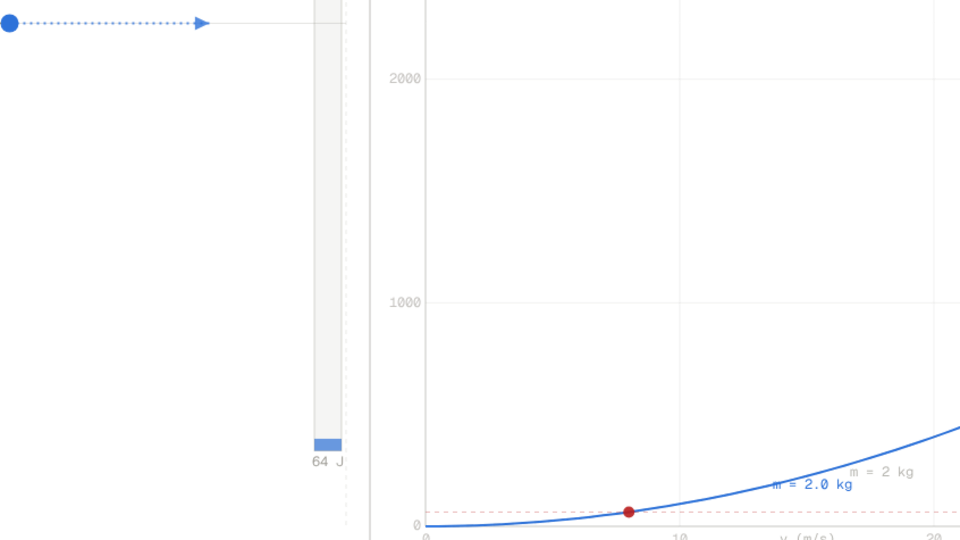
- Set Mass to 2.0 kg and Speed to 8.0 m/s (the defaults). Press Start. Observe the KE bar on the left panel and the live crimson dot on the parabola graph; note the KE readout shows 64.0 J.
- Press Reset. Drag the Speed slider to 10 m/s, note the KE readout (~100 J), then drag it to 20 m/s and note the KE readout (~400 J). Confirm the ratio is 4.00; this is the quadratic law in action.
- Press Reset. Set Speed to 10 m/s and Mass to 2 kg, note KE (~100 J). Then set Mass to 4 kg at the same speed, note KE (~200 J). The ratio is 2.00, a strictly linear effect.
- Press Reset. Set Mass to 10 kg and Speed to 30 m/s, the maximum slider values. Observe the KE bar fill to 4500 J (the worst-case maximum). The bar should reach exactly 100% height.
- While the sim is running at any settings, watch the KE ratio readout: it should hold near 4.00, confirming the ratio KE(2v) / KE(v) = 4 at every speed.
Analytical Prediction
The kinetic energy formula KE = ½mv² predicts three testable results. First, at default settings (m = 2.0 kg, v = 8.0 m/s):
Second, doubling the speed from 10 to 20 m/s at m = 2 kg:
Third, doubling the mass from 2 to 4 kg at v = 10 m/s:
At the slider extremes (m = 10 kg, v = 30 m/s), the predicted KE is 0.5 × 10 × 900 = 4500 J, the bar's full-scale maximum.
Results Analysis
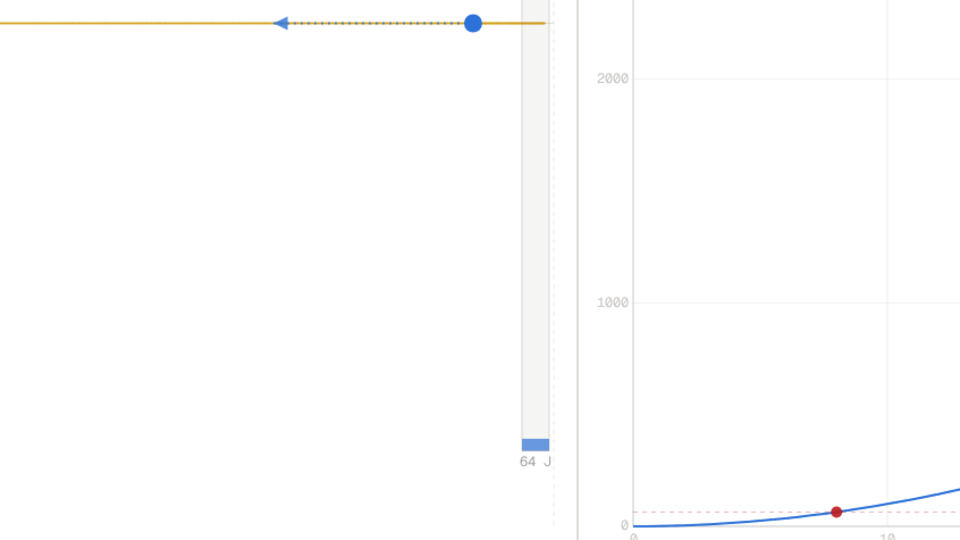
After each run, compare the KE readout (#keOut) against the prediction. At default settings (m = 2.0 kg, v = 8.0 m/s) the readout should display 64.0 J to within ±0.1 J; the sim holds speed constant (no friction), so there is no Euler integration drift. The KE ratio readout (#ratioOut) should read 4.00 at any non-zero speed, confirming the quadratic law. When you drag the speed slider from 10 to 20 m/s in Fresh state, the KE bar visually quadruples; use the bar heights as a visual ratio check. The crimson live dot on the secondary parabola graph should lie exactly on the solid blue curve at all times; if the dot drifts off the curve, the physics is incorrect. At the worst-case slider extreme (m = 10 kg, v = 30 m/s), the #keOut should read 4500.0 J and the bar should fill to 100% height without clipping.
Source of Error
This simulation models a point mass moving at constant speed with instantaneous elastic wall bounces: no air drag, no rolling resistance, no finite ball deformation on impact, and no gravitational potential energy changes (the ball moves purely horizontally). The KE formula assumes all kinetic energy is translational; rotational KE of a spinning ball is not included. The speed is held analytically constant each frame (KE = ½mv² is evaluated directly, not accumulated by an integrator), so there is no Euler drift; the only numerical residual comes from floating-point arithmetic in the multiplication, which is on the order of 10⁻¹³ J. The gap between the predicted 64.0 J and the displayed readout is therefore purely numerical, not physical.
Further Exploration
- Set Speed to 5 m/s and note the KE bar height; then set Speed to 15 m/s. Is the bar three times taller, or nine times taller? Why does the answer reveal that KE depends on v², not v?
- Drag the Mass slider from 0.5 kg to 10 kg while holding Speed fixed at 10 m/s; the ball's radius grows. Does the KE bar grow proportionally to mass? Does the parabola curve shape change, or only its scale?
- At v = 0 m/s (Speed slider all the way left), the KE bar drops to zero. What does this imply about the relationship between motion and energy? Can an object have kinetic energy while at rest?
- Compare two settings: (a) m = 1 kg, v = 20 m/s and (b) m = 4 kg, v = 10 m/s. Which has more kinetic energy? Run both and compare: does the answer match ½mv² for each case?
- Watch the KE ratio readout while the sim runs at any speed above 1 m/s. It should always read approximately 4.00. Why is this ratio independent of both mass and the absolute value of speed?