Friction on an Incline · SimulatorFind the Slipping Angle
A block on an inclined plane: adjust the angle and friction coefficients to find the exact angle at which slipping begins.
Published: May 29, 2026 · Updated: May 31, 2026
Objective
Verify that a block on an inclined plane begins to slide when the gravitational component along the surface (mg·sinθ) exceeds the maximum static friction force (μs·mg·cosθ); equivalently, when tan θ > μs. After slip, observe that kinetic friction (μk·mg·cosθ) governs acceleration. The simulation treats the block as a point mass with constant Coulomb friction and ignores air resistance and rotation.
Setup
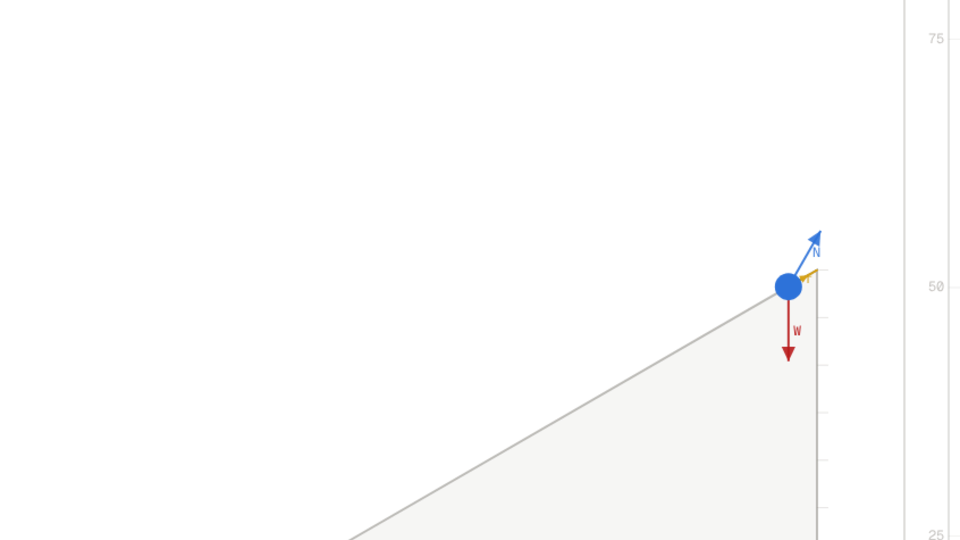
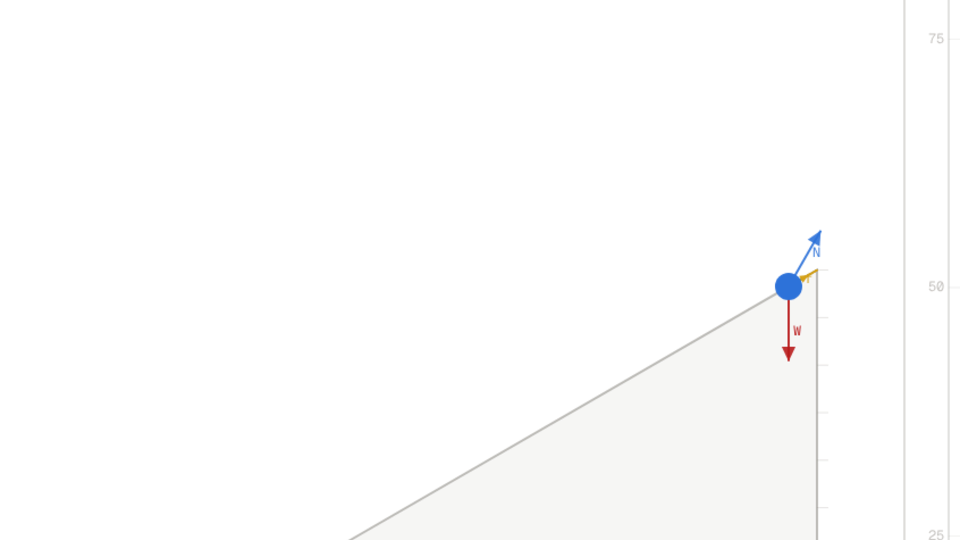
- Set Angle θ to 30°, Static friction μs to 0.50, and Kinetic friction μk to 0.35 (the defaults). Press Start: the block slides immediately because tan 30° ≈ 0.577 > 0.50. Record the Accel. readout.
- Press Reset. Reduce Angle θ to 20° and press Start. The block remains stationary (tan 20° ≈ 0.364 < 0.50); confirm that Accel. reads 0.00 m/s² and Velocity stays 0.00 throughout.
- Press Reset. Set μs to 0.60 and gradually increase θ from 25° to 35° one degree at a time, pressing Start and Reset between each run. Note the angle where the STATIC label switches to SLIDING; it should be near 31° (arctan 0.60 ≈ 30.96°).
- Press Reset. Set Angle θ to 45°, μs to 0.40, and μk to 0.20. Press Start and record the Velocity and Distance readouts at the moment the simulation stops.
Analytical Prediction
The critical slip angle satisfies tan θc = μs, so θc = arctan(μs). With μs = 0.50, θc ≈ 26.57°. At θ = 30° (above θc), the kinetic acceleration is:
For Step 4 (θ = 45°, μk = 0.20, ramp length 8 m):
Final velocity from kinematics (v² = 2·a·s, s = 8 m):
Results Analysis
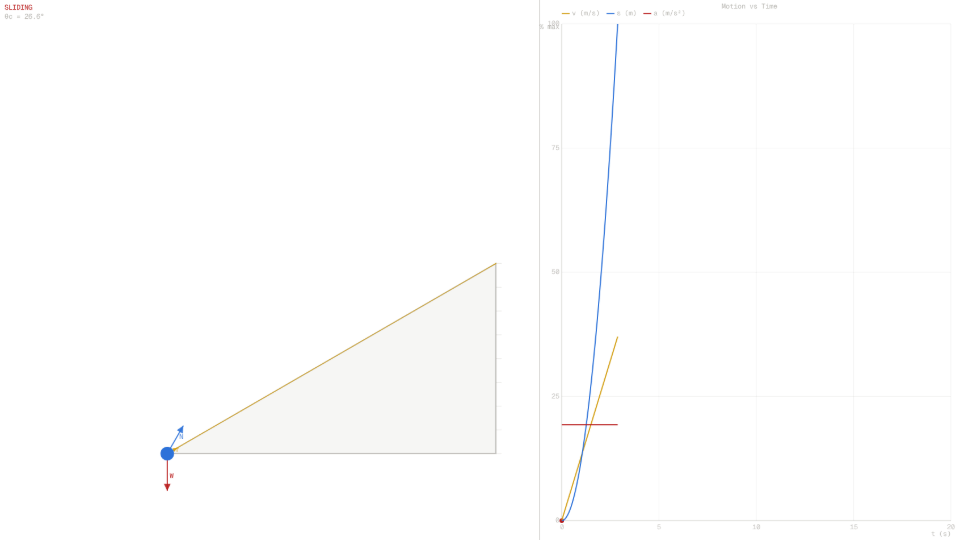
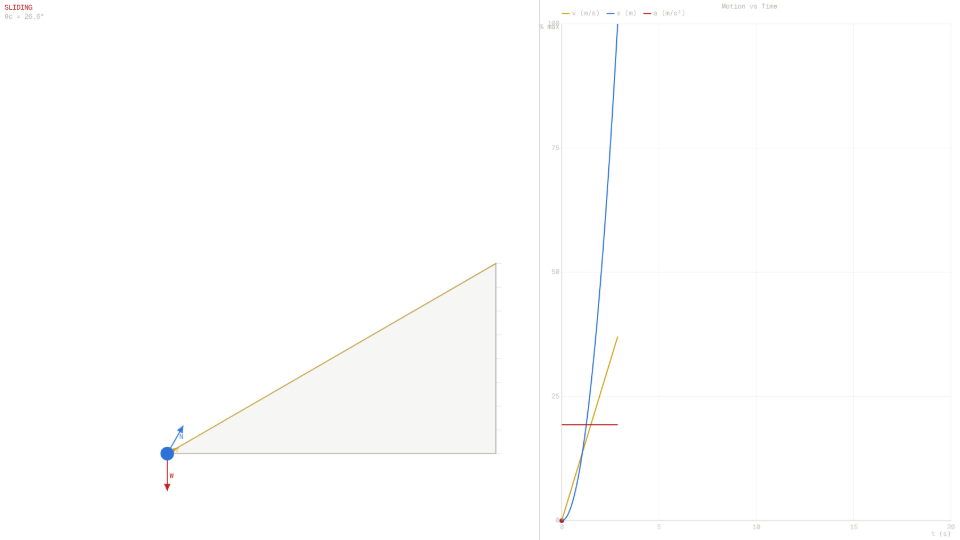
Compare the Accel. readout immediately after Start against the prediction. With θ = 30°, μs = 0.50, μk = 0.35, the readout should show 1.93 ± 0.02 m/s². With θ = 20° and μs = 0.50, Accel. must hold at 0.00; any nonzero value signals an error in the static-friction check. For Step 4 (θ = 45°, μk = 0.20), the Velocity readout when the sim stops should be 9.42 ± 0.10 m/s and Distance should be 8.00 m. The velocity-vs-time graph (right panel) shows a flat line at v = 0 while static, then a straight rising line once sliding begins; the slope of the rising portion equals the Accel. readout.
Source of Error
This simulation models the block as a rigid point mass with perfectly flat contact; it omits rotational inertia, surface micro-deformation, and air resistance. The friction model uses constant μs and μk coefficients independent of contact area, speed, or temperature, which is an idealization of Amontons–Coulomb friction valid only for dry, unlubricated surfaces at moderate speeds. Stick-slip dynamics (briefly elevated friction just at the onset of motion) are not modeled. The kinetic friction coefficient is clamped to at most μs (the μk slider's maximum tracks μs) to enforce the physical requirement μk ≤ μs; in a real experiment these coefficients are measured independently and their difference varies. Because the analytical prediction in the Setup section assumes identical idealizations, any residual gap between the predicted and observed readout values is purely numerical, not physical.
Further Exploration
- Set μs to 0.40 and sweep θ from 5° to 75° in steps of 5°. At what angle does the STATIC label switch to SLIDING? Does arctan(0.40) ≈ 21.8° match the observed transition angle?
- Set μs = 0.80 and fix θ at 45°, then increase μk from 0.05 toward 0.80 one step at a time. What value of μk makes the block barely creep to the bottom within the 20 s time cap? How does increasing μk change the slope of the velocity-vs-time graph?
- Set μs = 0.70 and θ = 35°. The block is near the boundary (tan 35° ≈ 0.700 ≈ μs). Does the simulation classify it as static or sliding? Try θ = 36°. Does it cross over? What does this tell you about the precision of the critical-angle prediction?
- Compare two runs: θ = 60° vs θ = 75°, both with μk = 0.30. How much faster does the block reach the bottom at 75°? Does the ratio of the final velocities match sqrt(a_75 / a_60)?
- Set μs = 1.00 (maximum). What is the steepest angle at which the block remains static? Does the sim correctly hold the block still at θ = 45° (tan 45° = 1.00 = μs, the exact boundary condition)?
- Fix θ = 30°, μs = 0.50, μk = 0.35 and run at mass m = 1 kg, then at m = 10 kg. Does the Accel. readout change? Do the Friction f and KE readouts change? Explain why mass cancels from a = g(sin θ − μk·cos θ) but not from f = μk·m·g·cos θ or KE = ½·m·v².