Free-Body Diagram Builder · SimulatorBuild & Read Force Diagrams
Place an object on an inclined surface with friction and an applied force; all force vectors render live with labeled magnitudes.
Published: May 28, 2026 · Updated: August 24, 2026
Objective
Verify Newton's second law on an inclined surface: observe how weight, normal force, friction, and an applied force combine into a net force that determines acceleration. The sim models a rigid block on a rigid incline with Coulomb friction: the friction direction follows the block's motion, and when friction can balance the other along-surface forces the block is held static (net force zero). Rotational effects are ignored and μk is used for both the static cap and kinetic sliding.
Setup
- Set Mass to 5 kg, Incline angle to 20°, Friction coeff. μk to 0.20, and Applied force to 0 N (the defaults). Press Start and let the diagram run for a few seconds.
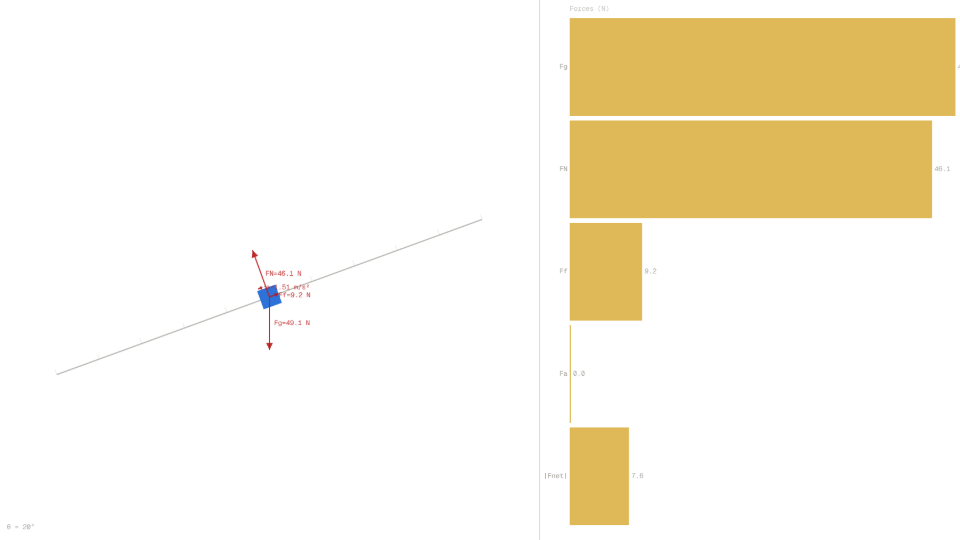
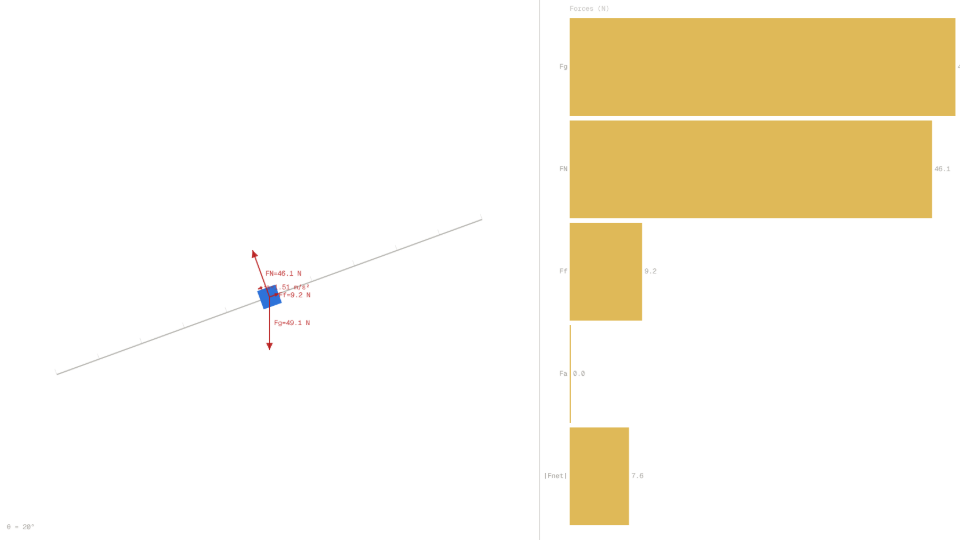
- Read the five force and motion values in the HUD (the sixth readout is Time). Weight (fgOut) should show ≈ 49.05 N; Normal Force (fNOut) ≈ 46.09 N; Friction (ffOut) ≈ 9.22 N; Net Force (fnetOut) ≈ 7.56 N; Acceleration (aOut) ≈ 1.51 m/s². Net Force and Acceleration are signed: positive means downhill, negative means uphill.
- Observe the horizontal bar chart on the right: Fg is the longest bar, Fa is empty (0 N), and |Fnet| is the shortest non-zero bar. Confirm the weight arrow points straight down and the normal-force arrow points perpendicular to the surface.
- Reset. Set Incline angle to 0° (flat surface). Press Start and confirm Normal Force equals Weight: the ratio FN/Fg should be exactly 1.00.
- Reset again. Increase Applied force to 8 N with angle 20° and μk 0.20. The applied force nearly cancels the 16.78 N downhill pull, leaving only ≈ 8.78 N, less than the friction cap (μk·FN ≈ 9.22 N), so the block is held static: Net Force reads 0 N, Acceleration 0 m/s², and the friction arrow points uphill at ≈ 8.78 N.
Analytical Prediction
With mass m = 5 kg, incline θ = 20°, and μk = 0.20 (no applied force), Newton's second law along the surface gives:
The HUD should display Net Force ≈ 7.56 N and Acceleration ≈ 1.51 m/s² (both positive, meaning downhill). On a flat surface (θ = 0°), cos 0° = 1 so FN = Fg exactly.
Results Analysis
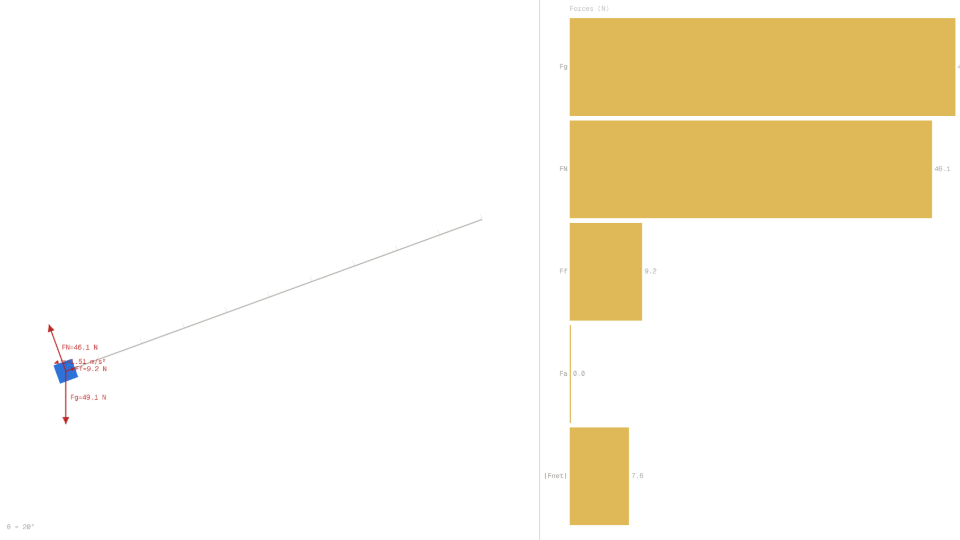
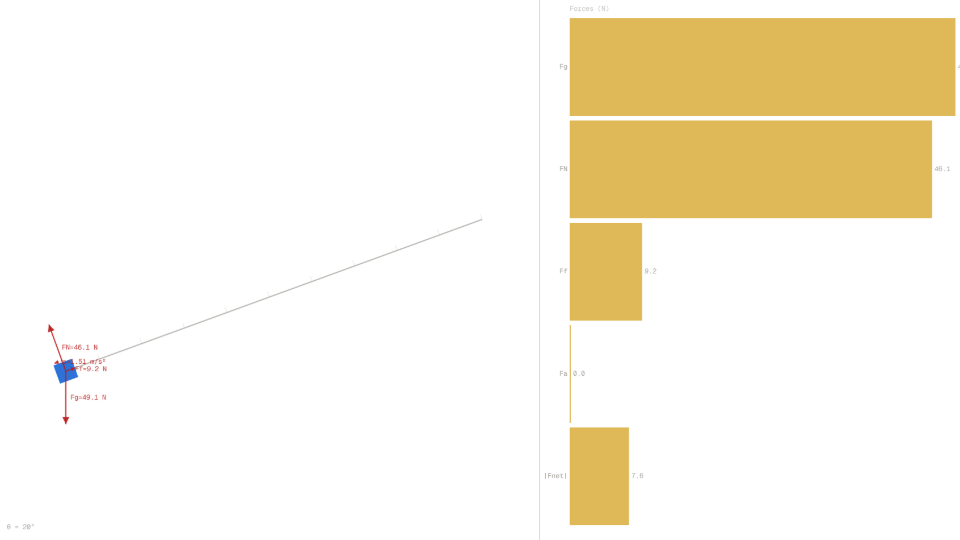
After pressing Start with default parameters (m = 5 kg, θ = 20°, μk = 0.20, Fa = 0 N), read the five force and motion HUD values (Time is the sixth). Weight (fgOut) shows 49.05 N; Normal Force (fNOut) ≈ 46.09 N; Friction (ffOut) ≈ 9.22 N; Net Force (fnetOut) ≈ 7.56 N; Acceleration (aOut) ≈ 1.51 m/s². The horizontal bar chart shows Fg as the longest bar, Fa as an empty bar (0 N), and |Fnet| as the shortest non-zero bar, confirming friction and the normal force decomposition. At θ = 0°, FN and Fg match within rounding. Compute the implied mass from the HUD: fnetOut / aOut = 7.56 / 1.51 ≈ 5.0 kg; this confirms Newton's second law is satisfied. Adjust the Applied force slider and watch Net Force update in real time.
Source of Error
This sim models the block as a point mass with Coulomb friction: the friction direction is resolved from the motion (opposing the velocity while sliding, balancing the other along-surface forces while at rest), and the block is held static whenever |Fg∥ − Fa| ≤ μk·FN. A single coefficient μk is used for both the static cap and kinetic sliding, so the gradual static-to-kinetic transition and any difference between μs and μk are not modeled. Rolling resistance and rotational inertia are ignored, and the applied force is constrained to act along the incline surface; oblique forces with a normal component are omitted. These idealizations match the analytical prediction exactly, so any residual difference between prediction and HUD readouts is purely numerical, not physical.
Further Exploration
- Set Friction coeff. μk to 0 and sweep Incline angle from 0° to 60°. Does Net Force grow with sin θ? Compare fnetOut at 30° and 60°: the ratio should be sin 60°/sin 30° ≈ 1.73. Does it?
- With θ = 20° and μk = 0.20, find the Applied force that brings the block to rest. The downhill pull is Fg·sin θ ≈ 16.78 N and friction can supply at most μk·FN ≈ 9.22 N, so once Fa reaches about 7.6 N the block is held static and Net Force reads exactly 0, and it stays static until Fa reaches 26 N, where the push finally overcomes gravity plus friction and starts driving the block uphill.
- Double the mass from 5 kg to 10 kg while keeping θ = 20° and μk = 0.20. Does the Acceleration change? Both Fg and Ff scale with mass, so a = Fnet/m should stay constant; verify this with the aOut readout.
- Set Incline angle to 45° and increase μk from 0 to 0.8 in steps of 0.2. At what friction coefficient does Net Force approach zero? Note that the threshold μk = tan 45° = 1.0 is outside the slider range. What does that tell you about this surface?
- Compare θ = 30° and θ = 60° with μk = 0.30 and Fa = 0. Which angle gives greater acceleration? Are the results symmetric around 45°, and why or why not?