Launcher on a Platform PhysicsInherited Velocity & Galilean Relativity
Introduction
Fire a ball straight up from a cart that is rolling along, and a surprising thing happens: the ball comes straight back down into the cart, even though the cart has moved on. To a bystander on the ground the ball traces a wide arc; to a passenger on the cart it goes straight up and straight down. Both are watching the same motion, and both agree on the ending: the ball lands exactly where it started relative to the cart.
The reason is inherited velocity. When the launcher releases the ball, the ball is already moving sideways at the cart's speed, and nothing in flight changes that horizontal motion; gravity pulls only downward. The ball and the cart therefore keep pace horizontally for the whole flight, so the ball stays directly above the cart and drops back into it. The simulator draws the ground-frame arc, rolls the cart beneath it, and reports the horizontal Offset between ball and cart so you can watch it hold at zero.
Many students expect a faster cart to leave the ball behind, reasoning that an airborne ball can no longer keep up. The Offset readout records no such lag: at cart speed 10 m/s it reads 0.00 m throughout the 4.08 s flight, and at 15 m/s it still reads 0.00 m. The cart never outruns its own ball, because the ball was given the cart's speed at launch and keeps it.
The Physics Explained
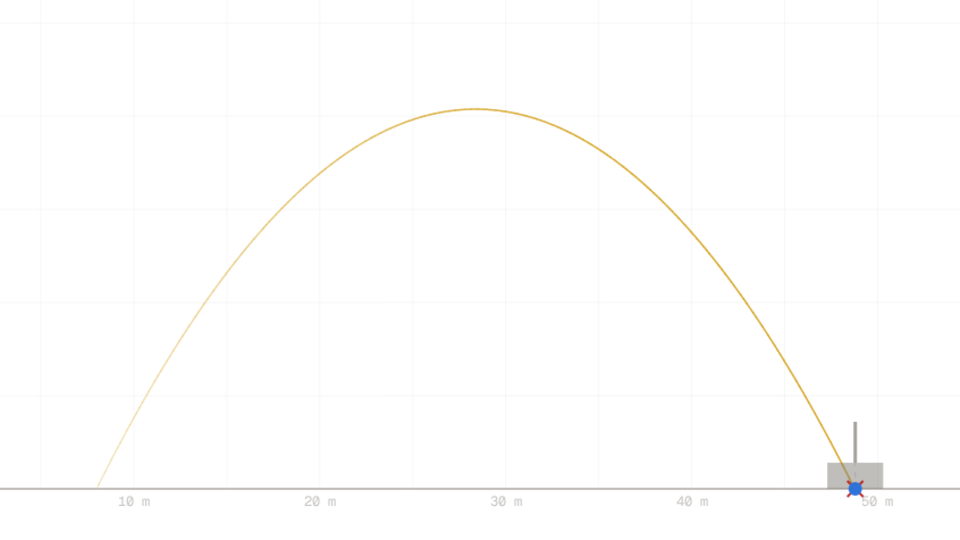
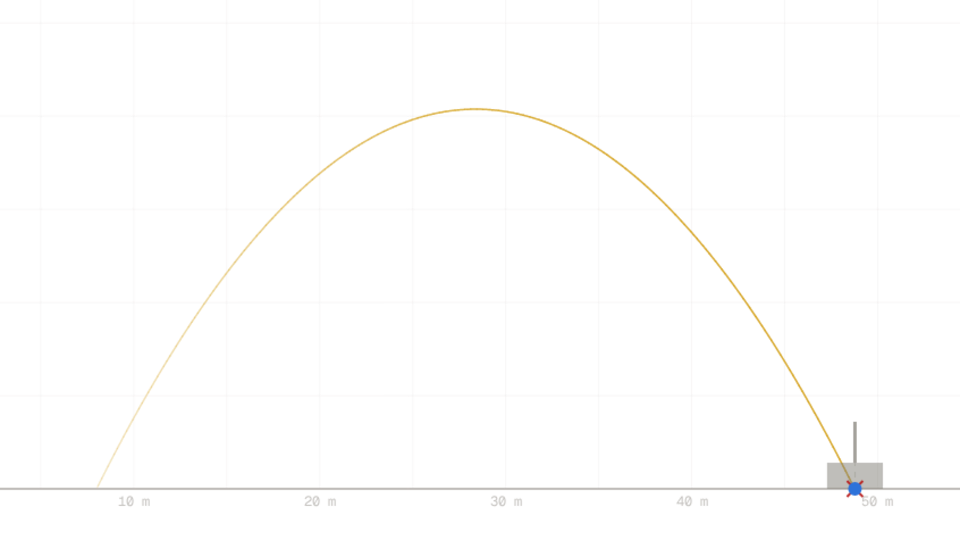
Velocities add. At the moment of launch the ball's velocity in the ground frame combines two contributions: the cart's horizontal velocity, carried along by the ball, plus the upward launch velocity from the spring. Firing straight up means the launch velocity is purely vertical, so the horizontal component of the ball's ground-frame velocity is exactly the cart speed: vₓ = vcart + vlaunch·cos(90°) = vcart. The vertical component is the full launch speed: vy = vlaunch·sin(90°) = vlaunch.
Because vₓ equals the cart speed, the ball and the cart have identical horizontal velocities and identical horizontal accelerations (zero, since no horizontal force acts on either). Two objects that start at the same horizontal position with the same horizontal velocity and the same horizontal acceleration stay at the same horizontal position forever. That is why the Offset readout holds at exactly 0.00 m: the ball is always directly above the cart, and when it falls it falls straight into it.
The vertical motion is ordinary free fall under gravity, untouched by the horizontal story. The ball climbs, decelerates, halts, and drops back, with a flight time of T = 2·vlaunch/g. With vlaunch = 20 m/s, T = 2·20/9.81 ≈ 4.08 s, which the simulator's Time readout shows at landing. The peak height is H = vlaunch²/(2g) = 400/19.62 ≈ 20.4 m, matching the highest value of the Ball height readout. Neither quantity depends on the cart speed at all.
During that flight the cart rolls a distance vcart·T. At 10 m/s that is 10·4.08 ≈ 40.8 m, which the Cart distance readout confirms at landing. The ball, carried sideways at the same 10 m/s, covers the same 40.8 m, so the two arrive together. Change the cart speed and this distance changes with it (15 m/s gives about 61.2 m), but the coincidence at the landing point never breaks, because both distances are computed from the same horizontal speed.
Key Equations
The cosine of 90° is zero, so the launch adds nothing horizontal: the ball's sideways speed is simply the cart's. With vcart = 10 m/s, vₓ = 10 m/s, constant for the whole flight. This single fact is why the Offset readout never leaves 0.00 m.
The sine of 90° is one, so the full launch speed goes into the vertical climb. With vlaunch = 20 m/s, the ball leaves at 20 m/s upward and loses 9.81 m/s of that every second to gravity.
With vlaunch = 20 m/s and g = 9.81 m/s²: T = 2·20/9.81 ≈ 4.08 s. Raising the launch speed to 25 m/s extends the flight to 2·25/9.81 ≈ 5.10 s; the cart speed has no effect on how long the ball stays up.
With vlaunch = 20 m/s: H = 400/19.62 ≈ 20.4 m. At vlaunch = 25 m/s the peak rises to 625/19.62 ≈ 31.9 m. The simulator's Ball height readout reaches this value at the top of the arc, independent of cart speed.
With vcart = 10 m/s and T ≈ 4.08 s: d = 10·4.08 ≈ 40.8 m. The ball covers the identical horizontal distance because its horizontal speed is also 10 m/s, so the Cart distance readout and the ball's landing point always agree.
Key Variables
| Symbol | Name | Unit | Meaning |
|---|---|---|---|
| vcart | Cart speed | m/s | Constant horizontal velocity of the cart and launcher |
| vlaunch | Launch speed | m/s | Speed of the ball relative to the cart, directed straight up |
| θ | Launch angle | ° | Angle of the launch in the cart frame; fixed at 90° (straight up) |
| g | Gravitational acceleration | m/s² | Downward acceleration due to gravity; 9.81 m/s² at Earth's surface |
| vₓ | Ground horizontal velocity | m/s | The ball's sideways speed in the ground frame; equals vcart |
| T | Flight time | s | Time from launch until the ball returns to the cart |
| H | Peak height | m | Greatest height the ball reaches above the cart |
| d | Cart distance | m | Horizontal distance the cart (and ball) travels during the flight |
Real World Examples
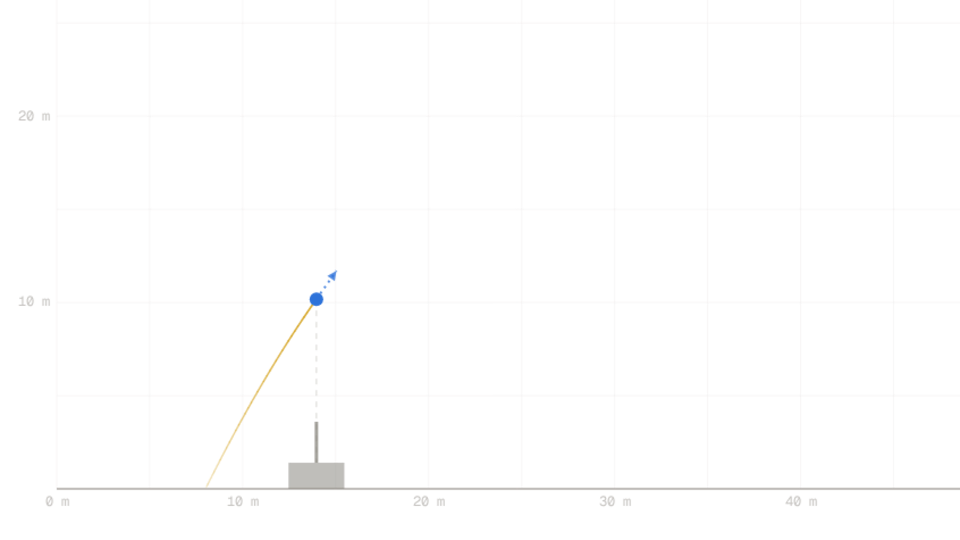
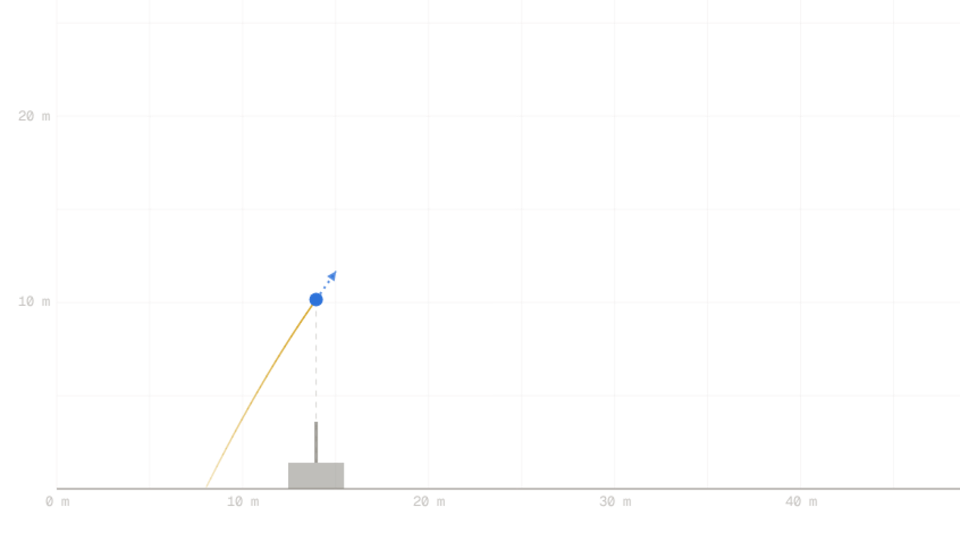
Why does a ball tossed straight up inside a moving train land back in your hand?
When you toss a ball straight up inside a smoothly moving train, it lands back in your hand rather than behind you because the ball already shares the train's forward velocity the instant it leaves your hand. Nothing removes that horizontal speed in flight (there is no horizontal force), so the ball drifts forward at exactly the train's speed while it rises and falls, and your hand drifts forward by the same amount.
The simulator reproduces this with a cart and a launcher that fires straight up. At cart speed 10 m/s and launch speed 20 m/s, the Offset readout holds at 0.00 m for the entire 4.08 s flight, and the ball lands back in the cart after the cart has rolled about 40.8 m forward. Raising the cart speed to 15 m/s widens the ground-frame arc but the Offset still reads 0.00, because the faster cart carries the ball forward at exactly its own speed.
The only way to make the ball land behind the launch point would be to apply a horizontal force after launch. Air drag does this slightly in the real world, which is why the idealised simulator shows a perfect zero offset while a real, fast-moving train car would show a tiny backward lag that grows with speed.
How does this connect to Galileo's ship and the principle of relativity?
Galileo argued that inside the cabin of a ship sailing smoothly on calm water, no mechanical experiment can reveal whether the ship is moving or at rest: a dropped ball falls straight to the deck, and a ball tossed upward returns to the hand, exactly as they would in port. The launcher-on-a-platform is the same experiment. In the cart's own frame the ball simply goes straight up and straight down; you can see precisely that motion by setting the cart speed to 0, where the ground-frame arc collapses to a vertical line.
At cart speed 10 m/s the ground-frame arc instead spans about 40.8 m horizontally, yet in the cart frame the ball still never moves sideways at all; the two descriptions are equally valid views of one motion. This frame-independence is the seed of the principle of relativity: the laws of motion are the same in every uniformly moving frame, so no constant-velocity motion can be detected from inside.
The simulator makes the equivalence concrete. The same launch produces a vertical line or a 40.8 m arc depending only on whether you ride with the cart or stand on the ground. In both stories the ball ends up back in the cart, because the ending is a physical fact that every frame must agree on.
Why doesn't the cart's speed change where the ball lands relative to the cart?
After launch the ball's horizontal velocity is fixed at the cart's speed and nothing alters it, because gravity acts only vertically and there is no horizontal force in flight. The cart, also free of horizontal forces, keeps the same constant speed. Two objects moving horizontally at the same constant velocity never separate horizontally, so the ball stays directly above the cart and lands back in it regardless of how fast the cart rolls.
The simulator confirms this across the whole slider range: the Offset readout stays pinned at 0.00 m whether the cart speed is 0, 10, or 15 m/s. What does change with cart speed is the width of the ground-frame arc (at 10 m/s the cart travels about 40.8 m during the 4.08 s flight, at 15 m/s about 61.2 m), but the landing always coincides with the cart.
The launch speed, by contrast, controls the flight time T = 2·vlaunch/g and the peak height H = vlaunch²/(2g): raising it from 20 to 25 m/s lengthens the flight to about 5.1 s and the peak to about 31.9 m, while leaving the zero offset untouched. Cart speed sets how far everything travels sideways; launch speed sets how high and how long; only a horizontal force, absent here, could ever open a gap.
Further Reading
- Projectile motion: the same horizontal-vertical decomposition for a single launch, the foundation the inherited-velocity result is built on.
- Projectile from a cliff: another two-dimensional launch where the vertical and horizontal motions are independent, here with unequal launch and landing heights.
- Free fall: the vertical motion in isolation, the up-and-down half of this sim that sets the flight time and peak height.