Power Output of a Motor · SimulatorP = F·v: Force Times Velocity
A motor lifts a weight at adjustable speed; power readout updates as P = F·v with input voltage analogy
Published: July 6, 2026
Objective
Verify that mechanical power P = F·v depends jointly on the lifting force (weight m·g) and the lift speed v, that doubling either quantity exactly doubles the power output, and that the total work W = F·h grows linearly with height. The model assumes constant-speed vertical lift with no acceleration losses.
Setup
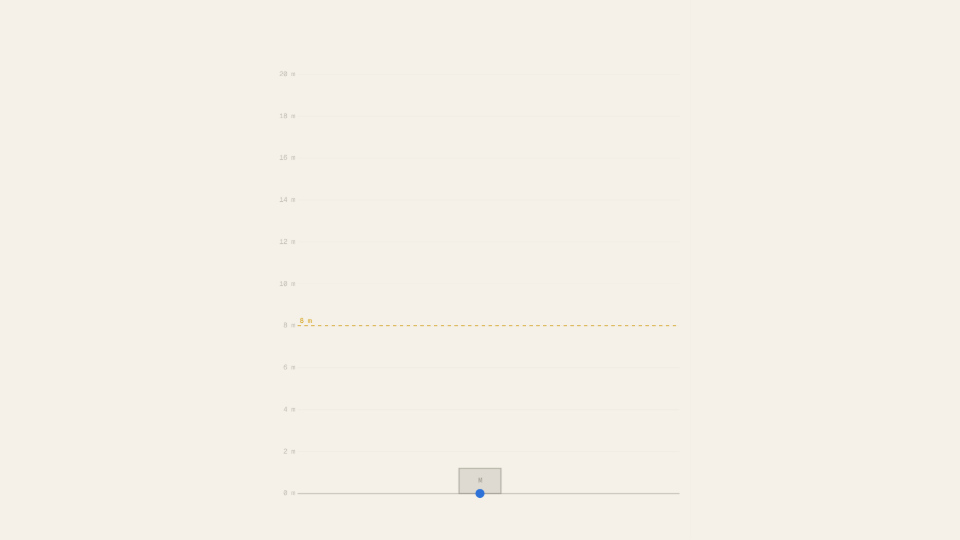
- Set mass to 10 kg, lift speed to 3 m/s, and target height to 8 m (the default slider positions). Note the Force readout: it should read 98.1 N, equal to m·g.
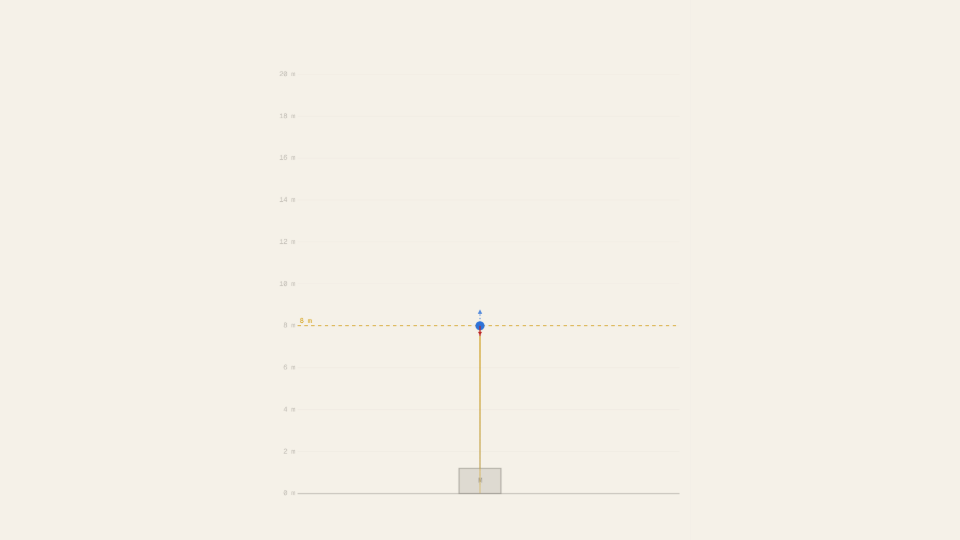
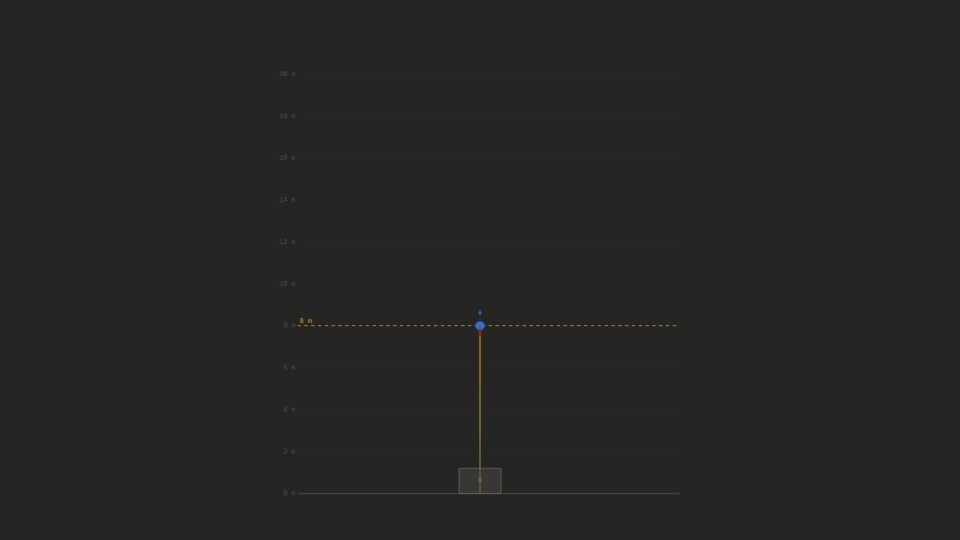
- Press Start and watch the block rise. Read the Power readout as it lifts; it should stay constant at 294.3 W throughout the entire ascent.
- When the block reaches 8 m the run stops. Record the final Work Done readout and the Time readout.
- Press Reset, change mass to 20 kg (everything else the same), and start again. Compare the new power readout to the previous run.
- Press Reset again, restore mass to 10 kg, change lift speed to 6 m/s, and start. Compare power to the first run.
- Press Reset, change target height to 16 m at mass 10 kg, speed 3 m/s, and start. Compare final work done to the first run.

Analytical Prediction
For constant-speed vertical lift the motor does no acceleration work, so tension equals weight and power is the product P = F·v = m·g·v. With mass = 10 kg, speed = 3 m/s, and height = 8 m:
Doubling mass to 20 kg doubles F to 196.2 N and doubles P to 588.6 W at the same speed. Doubling speed to 6 m/s at the original mass also doubles P to 588.6 W (force unchanged, velocity doubled). Doubling height to 16 m doubles total work to 1569.6 J but leaves instantaneous power unchanged at 294.3 W.
Results Analysis
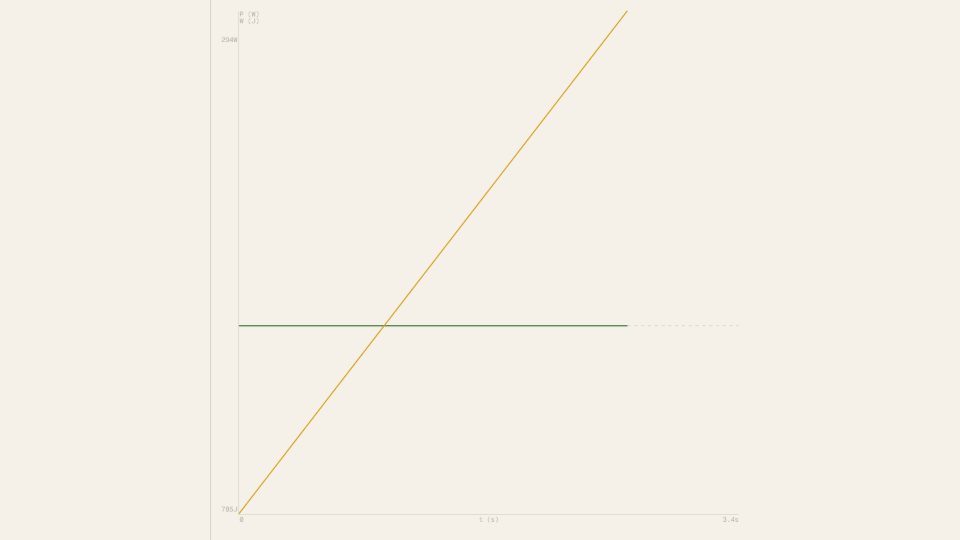
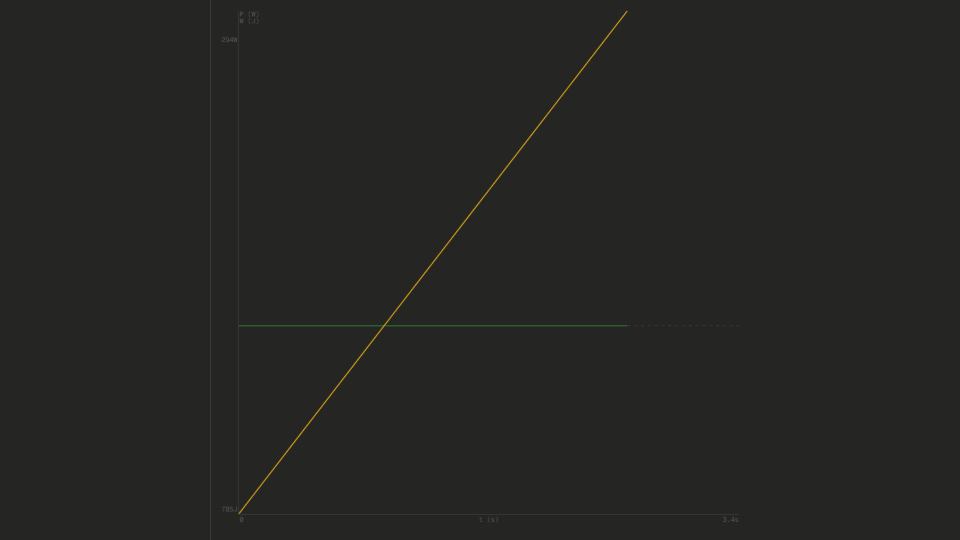
Confirm the Force readout shows 98.1 N before Start (mass 10 kg). During the run the Power readout should hold steady at 294.3 W with no fluctuation, confirming that constant-speed lift produces constant power. At the stop frame the Work Done readout should read approximately 784.8 J (within 5% is expected, owing to the discrete-step integrator landing one frame past the exact 8 m boundary). The Time readout at stop should be close to 2.67 s. The P(t) line in the right panel should be visibly horizontal (flat), and the W(t) line should be a straight diagonal rising from 0 J to ~784.8 J. Compare these values against the analytical prediction to confirm agreement.
Source of Error
This model assumes perfectly constant speed throughout the lift: tension equals weight exactly and the motor supplies no acceleration work. Real motors accelerate the load from rest (adding inertial work) and experience friction, heat losses, and motor inefficiency, none of which appear here. The rope, pulley, and motor housing are massless. Air drag on the block is absent. These idealizations mean the predicted P = m·g·v is an exact lower bound on real-world motor power for the same lift task. The residual gap between the readout and the analytical prediction is therefore purely numerical, not physical, for this sim.
Further Exploration
- Set mass to 1 kg and speed to 10 m/s. What power is required? Now set mass to 10 kg and speed to 1 m/s. Is the power the same? What does this reveal about the tradeoff between force and velocity in a motor?
- Fix mass at 10 kg and height at 8 m. Sweep lift speed from 0.5 to 10 m/s. How does the total work done change? How does the time to complete the lift change? What stays constant and what varies?
- At speed = 3 m/s, double the mass from 10 kg to 20 kg, then to 40 kg. Does the power readout double each time? Does the time to complete the lift change?
- Change only the target height slider (mass = 10 kg, speed = 3 m/s). Does changing height affect the instantaneous power readout? What does it change?
- Run a lift at default settings (mass 10, speed 3, height 8). Then reset and run at mass 10, speed 6, height 8. Compare the ghost trail from the first run to the live run. Which finished faster, and why does the P(t) line sit at a different height?