Newton's Third Law: Pushing Carts · SimulatorEqual Forces, Unequal Accelerations
Two carts pushed apart by an equal internal spring force: equal and opposite impulses leave total momentum at zero, while the lighter cart reaches proportionally greater speed.
Published: May 27, 2026 · Updated: May 28, 2026
Objective
Verify Newton's third law by observing that two carts released from a compressed spring always receive equal and opposite impulses (so total momentum stays zero) while a lighter cart acquires proportionally greater speed. The model omits friction, air drag, and rotational inertia, isolating the mass–acceleration relationship under equal internal forces.
Setup
- Set m₁ to 1 kg and m₂ to 3 kg using the sliders. Note the carts start touching at the centre of the track with a compressed spring between them.
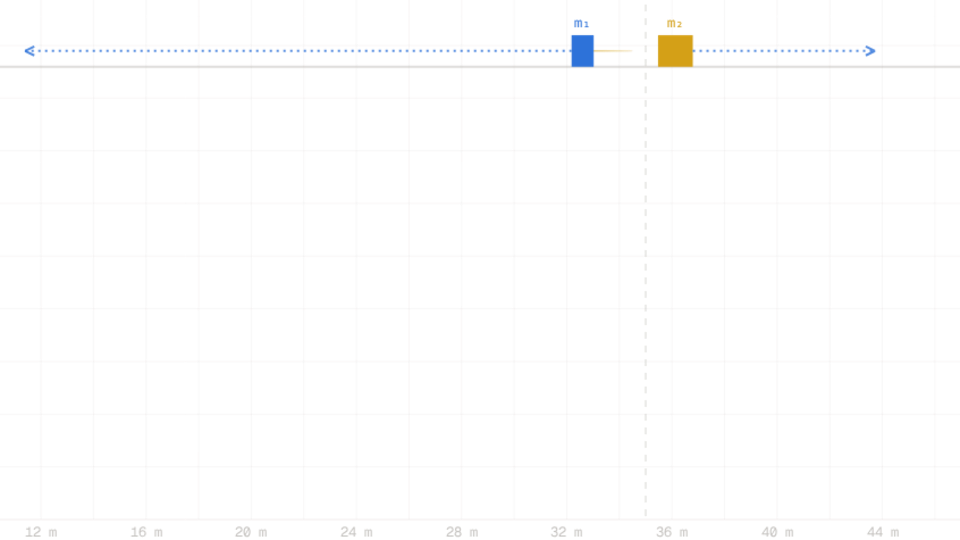
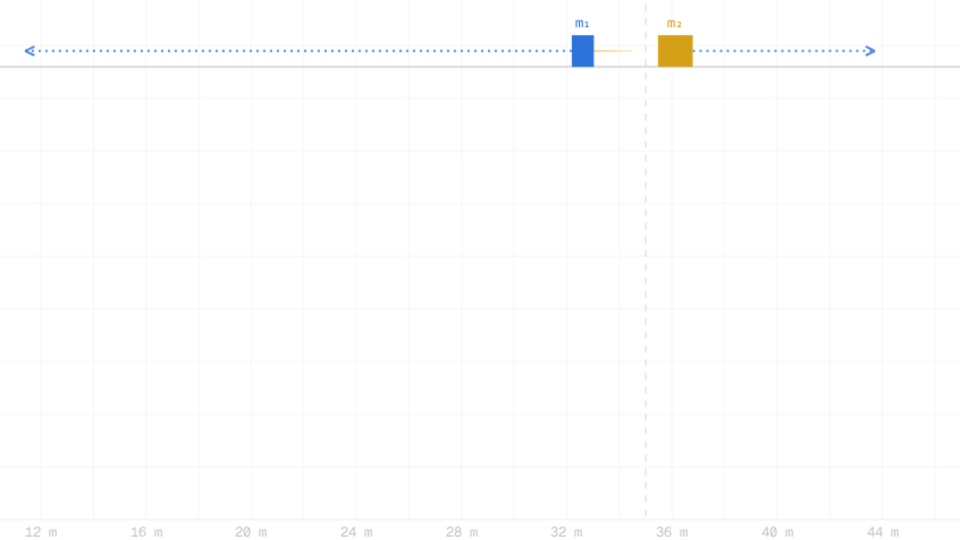
- Press Start. Watch the red force arrows appear briefly on each cart (equal in magnitude, opposite in direction) during the brief spring-release push, then disappear.
- Once the push ends, record v₁ and v₂ from the readouts. With m₁ = 1 kg and m₂ = 3 kg the values should be v₁ ≈ −3.46 m/s and v₂ ≈ +1.15 m/s, a 3:1 speed ratio matching the inverse mass ratio.
- Check the p_tot readout throughout: it should remain at 0.00 kg·m/s. Press Reset and set m₁ = m₂ = 2 kg; both carts should reach the same speed in opposite directions.
Analytical Prediction
Newton's third law guarantees the spring pushes both carts with equal and opposite force, so each cart receives the same impulse magnitude J. The compressed spring (k = 100 N/m, initial compression x₀ = 0.4 m) releases its stored energy through the reduced mass μ = m₁·m₂/(m₁+m₂), giving J = x₀·√(k·μ). With m₁ = 1 kg and m₂ = 3 kg:
After the push phase, the v₁ readout should show approximately −3.46 m/s and v₂ should show approximately +1.15 m/s. The p_tot readout should read 0.00 kg·m/s at all times from start to finish.
Results Analysis
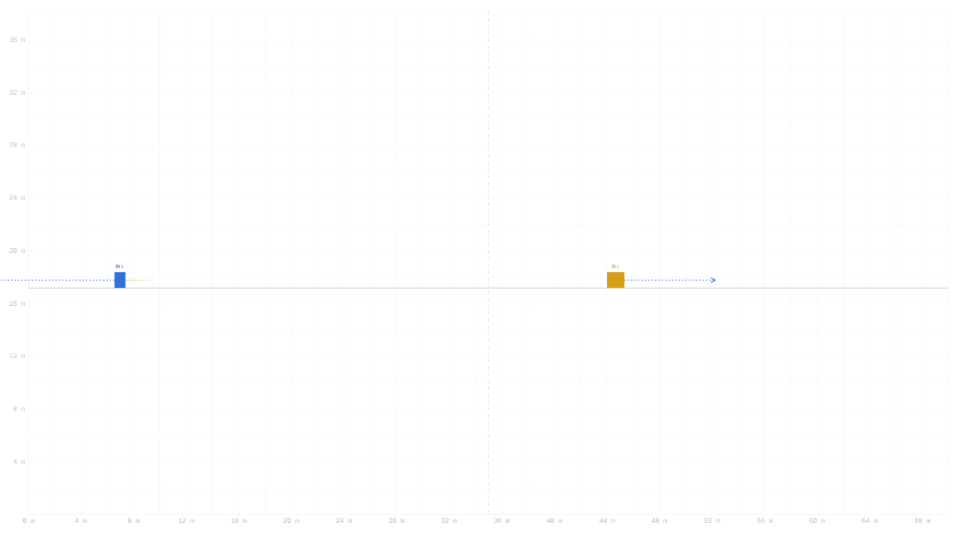
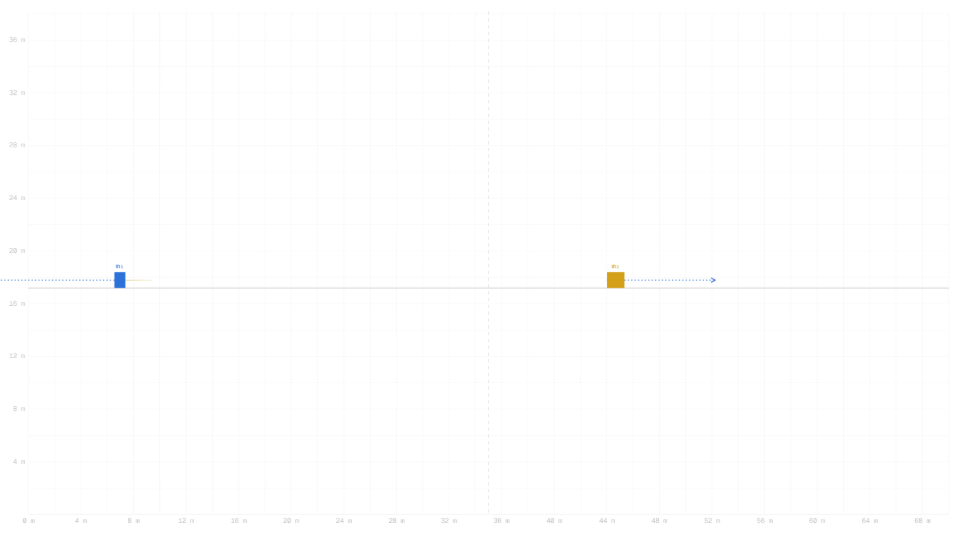
After pressing Start, monitor the p_tot readout: it should remain within ±0.05 kg·m/s of zero throughout, confirming momentum conservation. When the red force arrows disappear (the spring has fully released), read v₁ and v₂ immediately after. With default settings (m₁ = 1 kg, m₂ = 3 kg) expect v₁ ≈ −3.46 m/s and v₂ ≈ +1.15 m/s. Multiplying each by its mass (1 × 3.46 ≈ 3 × 1.15 ≈ 3.46 kg·m/s) confirms the impulses were equal. The blue velocity arrows scale with speed, making the 3:1 ratio visible. Any residual drift in p_tot beyond ±0.05 kg·m/s is a purely numerical artifact of the sub-step integrator; the snap-to-analytical correction at push-end keeps drift near zero.
Source of Error
This simulation treats each cart as a point mass on a frictionless, horizontal, massless track: no rolling resistance, no air drag, no axle friction. The spring is modelled with Hooke's law (F = k·x, k = 100 N/m) released from an initial compression x₀ = 0.4 m, delivering an equal and opposite impulse J = x₀·√(k·μ) as it extends. Cart dimensions on screen are scaled with mass for visual clarity only; no moment of inertia is computed. The analytical prediction uses the same frictionless, energy-conserving idealizations, so both the prediction and the sim share the same omissions. The residual gap between the predicted velocities and the readout values is therefore purely numerical, not physical.
Further Exploration
- Set m₁ = m₂ = 2 kg and press Start. Do the carts reach the same final speed in opposite directions? Does p_tot stay at 0.00 kg·m/s? This equal-mass case is the simplest demonstration of Newton's third law.
- Set m₁ to 1 kg (minimum) and m₂ to 5 kg (maximum), then press Start. Can you verify from the readouts that 1 × |v₁| ≈ 5 × |v₂|, confirming the equal-impulse principle despite the large mass difference?
- Try swapping the masses: set m₁ = 5 kg and m₂ = 1 kg. Does the faster cart switch sides? Does p_tot remain at zero? This tests whether the law is symmetric in mass assignment.
- Slowly increase m₁ from 1 kg to 5 kg while keeping m₂ = 3 kg fixed. Predict how |v₁| will change before each run. At what value of m₁ do both carts reach the same speed?