Momentum Vector · SimulatorVisualise p = mv as a Scaled Arrow
A cart with adjustable mass and velocity; the momentum vector renders as an arrow scaled by p = mv, revealing how equal momentum can arise from very different (m, v) combinations.
Published: August 15, 2026
Objective
Verify that linear momentum p = mv is a vector quantity: its magnitude is the product of mass and velocity, and its direction follows the sign of velocity. Explore how the same momentum magnitude arises from different (m, v) pairs (heavy and slow vs. light and fast), and compare their kinetic energies. The cart moves at constant velocity on a frictionless, level track with no external forces.
Setup
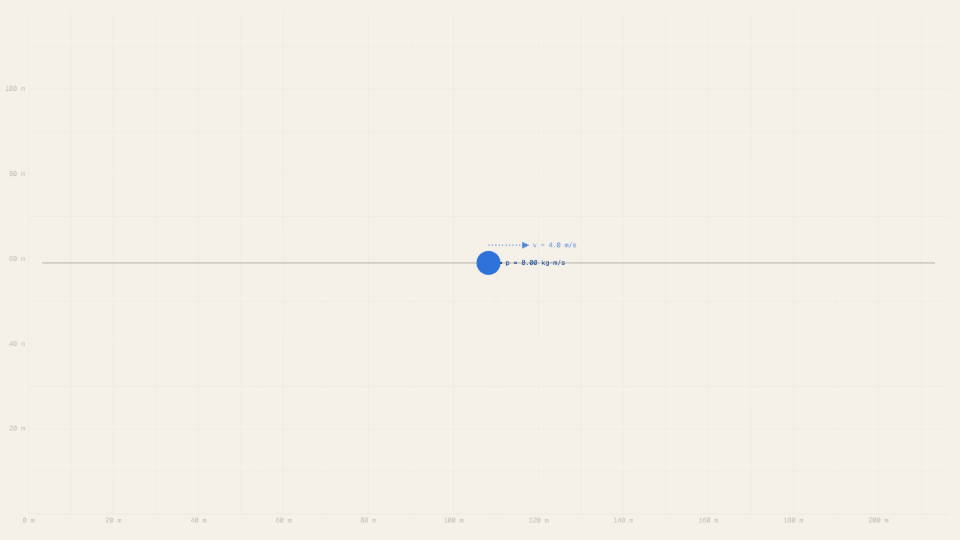
- Leave sliders at defaults: mass = 2 kg, velocity = 4 m/s, run time = 5 s. Note the navy momentum arrow and the sky-dotted velocity arrow both point right. Record the p readout (8.00 kg·m/s) and the KE readout (16.00 J).
- Press Start and let the sim run to completion. Observe the cart rolling right and the ghost trail left behind. Press Reset.
- Set mass = 8 kg, velocity = 2 m/s. Confirm the p readout now reads 16.00 kg·m/s and the KE readout reads 16.00 J before pressing Start. Let it run to completion.
- Press Reset. Set mass = 2 kg, velocity = 8 m/s. Confirm the p readout still reads 16.00 kg·m/s while the KE readout now reads 64.00 J. Start and compare the ghost from step 3 with the live run: the momentum arrows are the same length, but the cart travels much farther.
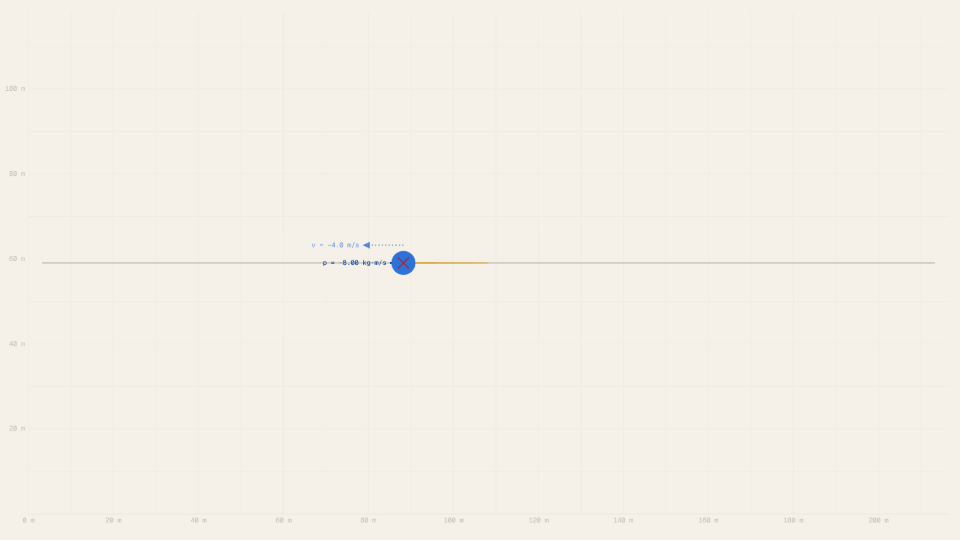
- Drag the velocity slider to a negative value (e.g. −4 m/s). Observe the momentum arrow flip direction and the p readout show −8.00 kg·m/s, illustrating the vector nature of momentum.
- Set velocity = 0 m/s and confirm both arrows vanish and the p readout shows 0.00 kg·m/s.




Analytical Prediction
With mass m = 2 kg and velocity v = 4 m/s, the momentum and kinetic energy are:
For the equal-momentum comparison (m = 8 kg, v = 2 m/s vs. m = 2 kg, v = 8 m/s):
Both arrows are identical in length (same |p|), but KE₂ is four times KE₁. The relationship KE = p²/(2m) shows that for fixed p, KE scales inversely with mass.
Results Analysis
After each run, compare the p and KE readouts against the predictions above. In the default run (m = 2, v = 4), the readout should show p = 8.00 kg·m/s and KE = 16.00 J with no numerical drift since both are computed analytically from slider values each frame. In the equal-momentum comparison, verify that the p readout shows 16.00 kg·m/s for both runs while the KE readout shows 16.00 J for the heavy-slow run and 64.00 J for the light-fast run. The ghost trail from run 1 (heavy+slow) will end closer to the start than the live run 2 (light+fast), even though both momentum arrows are identical in length. For the negative-velocity test, confirm the p readout is exactly opposite in sign to the positive case: −8.00 kg·m/s at v = −4 m/s.
Source of Error
This sim models a frictionless, level track with no external forces. The cart's velocity is constant throughout, so there is no air resistance, rolling friction, or gravitational component along the track. Mass is a point value with no rotational inertia. The momentum and kinetic energy readouts are computed directly from slider values each frame (not from an accumulated integrator), so there is no numerical drift in those quantities. The cart position is advanced with a simple Euler step (x += v·dt); because the velocity is constant, that step is exact, so the position carries no integration error either. The residual gap between predicted and displayed momentum and KE values is therefore purely numerical rounding at the display precision, not a physical error.
Further Exploration
- Set mass = 5 kg and sweep velocity from −10 to +10 m/s. At what velocity does the momentum arrow exactly change direction? What does the p readout show at velocity = 0?
- Find three different (m, v) combinations that all produce p = 20 kg·m/s. Compare their KE readouts. Which combination stores the most kinetic energy?
- Set velocity = 10 m/s and increase mass from 0.5 to 10 kg. How does the arrow length change? How does the cart body size change? Why do both grow?
- Run the sim with m = 8 kg, v = 2 m/s, then reset and run with m = 2 kg, v = 8 m/s. The ghost and live arrows are the same length. How far does each cart travel in 5 s? Confirm using the formula x = v · t.
- Set run time to 2 s and velocity to 10 m/s. Where does the cart stop? Now set run time to 10 s and velocity to 2 m/s. Do the carts travel the same distance in different times, or different distances in the same time?