Corner Kick into the Box · SimulatorCurve a Cross into the Box
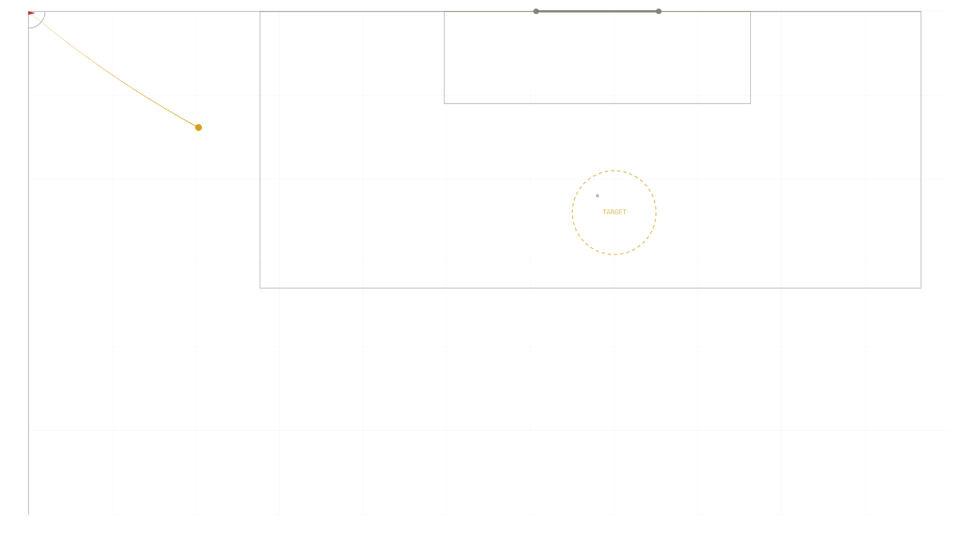
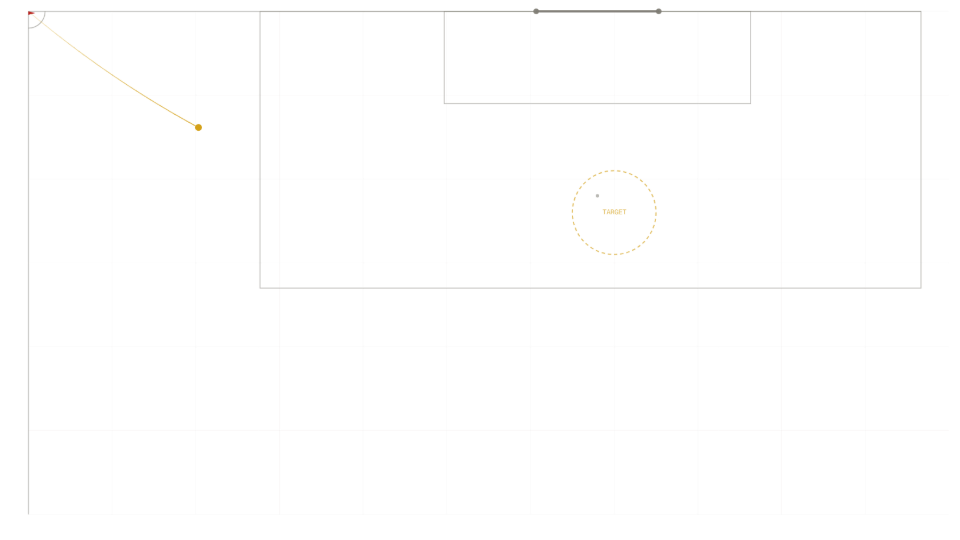
Top-down corner kick with Magnus curl, drag, and wind. Land the ball in a target zone at the far post.
Published: May 3, 2026 · Updated: May 28, 2026
Objective
Investigate how a corner kick reaches a marked target zone in the penalty area when Kick Speed, Heading, Spin Rate, and Lateral Wind act together on the ball. Confirm that the straight-line geometry from the corner flag to the goal line predicts only part of the landing point: Magnus curl from spin and quadratic drag bend and shorten the trajectory. Identify combinations of the four sliders that minimize the Δ Target readout, and isolate how a steady cross-wind reshapes the arrival point over a 2-3 second flight.
Setup
- Press Reset to put the ball back at the corner flag at (0, 30), top-left of the canvas, on the goal line. The Landing X, Landing Y, and Δ Target readouts will show dashes, indicating no run has completed.
- Leave the four sliders at their defaults: Kick Speed 22 m/s, Spin Rate +4 rev/s, Heading 40°, Lateral Wind 0 m/s.
- Press Start. The ball leaves the corner flag and curls into the box. The simulator times out at t = 2 s with the ball at roughly (33.4, 16.8); read Landing X, Landing Y, and Δ Target; Δ Target should land near 2.0 m, inside the 2.5 m radius around the target at (35, 18).
- Now run with the spin off: press Reset, drag Spin Rate to 0 rev/s, then Start. The ball drops onto the front edge of the penalty area at (19.7, 13.5) with Δ Target ≈ 16 m; that gap between the no-spin and tuned runs is the Magnus impulse over the 2-second flight.
- Run the over-curl mode: set Heading to 25° and Spin Rate to +8 rev/s, then Reset and Start. Magnus is too strong for the shallow heading; the ball recrosses the goal line at y ≈ 30 within 1.3 s with Δ Target near 15.6 m. Compare to confirm spin and heading must balance.
- Optional: sweep Lateral Wind from −5 to +5 m/s at the default Kick Speed, Spin Rate, and Heading to see how a cross-wind nudges Δ Target by about 0.1 m per m/s of wind.
Analytical Prediction
If drag, Magnus, and wind were all switched off, the ball would fly in a straight line from the corner flag at (0, 30) with v_x = v·cos(θ) along the goal line and v_y = −v·sin(θ) into the field (the y axis decreases into the field). For the defaults v = 22 m/s and θ = 40°:
The ball would reach the front of the penalty area at y = 13.5 after t = (30 − 13.5) / 14.14 ≈ 1.17 s, landing at x ≈ 16.85 · 1.17 ≈ 19.7 m. The target sits at (35, 18) with radius 2.5 m, so the no-spin straight-line miss distance would be:
This is well outside the target zone. The simulation adds quadratic drag a_d = −(k/m)·v·|v| and a Magnus acceleration a_M perpendicular to v that grows with ω. With the default Spin Rate of +4 rev/s, the Magnus impulse over the 2-second flight curls the trajectory deep and right, expecting the simulator to time out near (33.4, 16.8) with Δ Target ≈ 2.0 m, inside the target radius.
Results Analysis
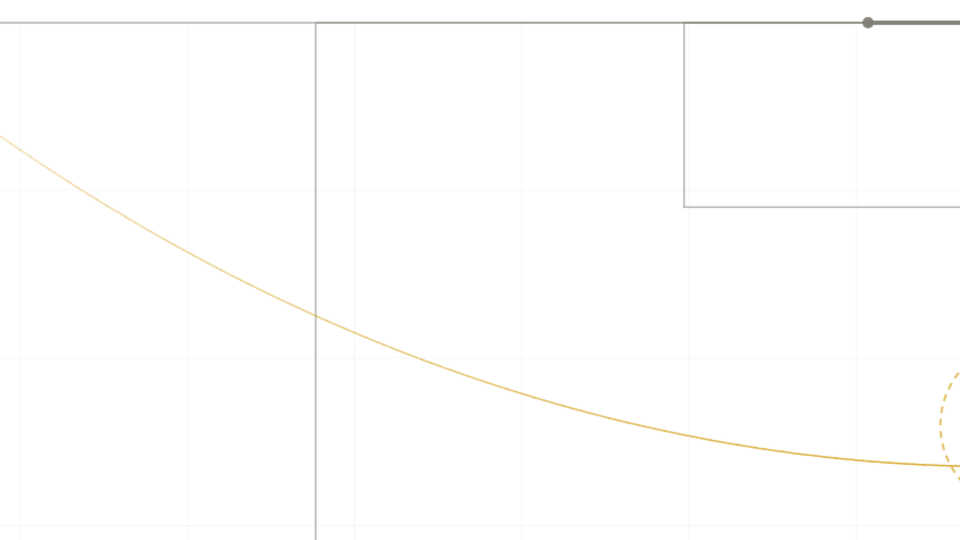
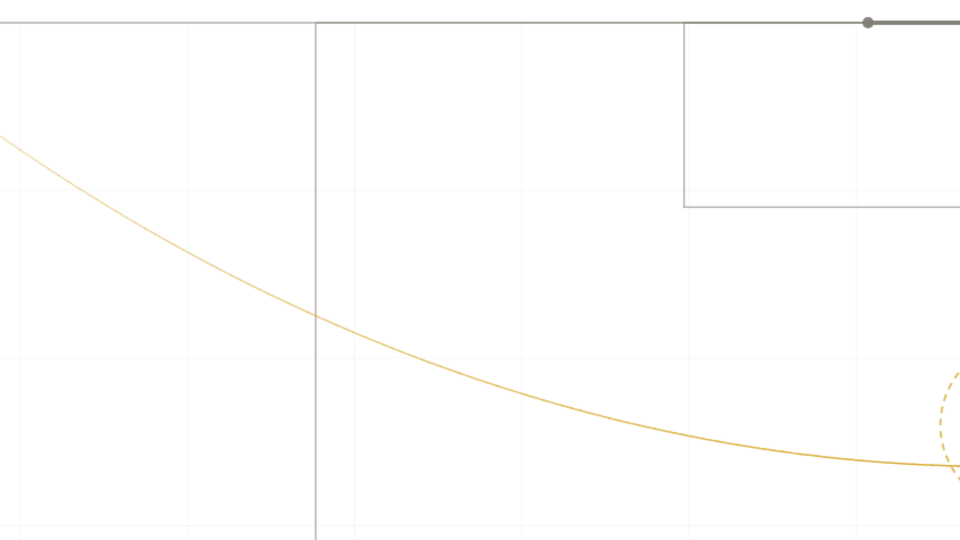
After Start completes with the defaults (Kick Speed 22 m/s, Heading 40°, Spin Rate +4 rev/s, Lateral Wind 0 m/s), the simulator hits the 2 s time cap with the ball still in flight; the readouts typically settle near (33.4, 16.8) and Δ Target ≈ 2.0 m, inside the target radius. Re-run with Spin Rate at 0 rev/s and the same speed and heading to see the no-spin baseline: the ball lands on the front edge of the penalty area at (19.7, 13.5) and Δ Target jumps to about 16 m. The difference between the two runs is the integrated Magnus impulse over the ~2 s flight. A second comparison: drop Heading to 25° and raise Spin Rate to +8 rev/s. The shallower heading lets Magnus over-curl the ball back across the goal line at y ≈ 30, with Δ Target above 15 m. Spin and heading must balance: the defaults sit near the centre of that trade-off, and the readouts make the lesson visible.
Source of Error
What this sim does NOT model: vertical motion (this is a top-down view, so the ball stays on the ground plane), spin-axis tilt away from vertical, post-landing roll-out across the box, defender bodies blocking the path, ball deformation, or drag-coefficient variation with Reynolds number. The closed-form a_total = a_M(ω, v) + a_d(v) + a_wind assumes the same idealizations, so they cancel rather than contributing to the residual landing position or curve peak. The remaining gap between prediction and readouts is therefore purely numerical, not physical.
Further Exploration
- Hold Kick Speed at 22 m/s, Heading at 40°, and Lateral Wind at 0 m/s. Sweep Spin Rate from −12 to +12 rev/s in 2 rev/s increments and record Δ Target at each step. Which spin minimises Δ Target, and at what positive spin does the ball start over-curling off-field across the goal line?
- Find the over-curl boundary at the simulator's default heading. With Heading at 25° and Lateral Wind 0, sweep Spin Rate from 0 to +12 in 2 rev/s steps. Below what spin value does the ball still reach the front of the penalty area at y = 13.5? Above it, where does the readout latch: at the goal line (y ≈ 30) or off the side of the canvas?
- Quantify the wind effect. Set the tuned out-swinger (Kick Speed 22 m/s, Spin Rate +4 rev/s, Heading 40°) and run with Lateral Wind at −5, −2, 0, +2, and +5 m/s. How many cm of Δ Target does each m/s of wind shift? (Hint: it's modest, about 0.1 m of Δ per m/s of wind.)
- Probe in-swing geometry. With this sim's far-post target at (35, 18), what does in-swing curl (negative spin) buy you? Try Kick Speed 22 m/s, Spin Rate −4 rev/s, Heading 30°–50°, and report Δ Target; confirm in-swing curls the ball away from the target in this geometry.
- Trade speed for spin. Starting from the tuned run (22, +4, 40°), lower Kick Speed by 2 m/s and find the Spin Rate that restores Δ Target to its original value. Repeat at −4 m/s. Is Δ Target dominated by the Magnus integral or by raw kick speed?