Corner Kick into the Box PhysicsMagnus Curve & Landing Zone
Introduction
A corner kick is a free shot at geometry. The taker stands in the one-metre quadrant at the corner flag and tries to deliver the ball into the most dangerous slice of the penalty area, usually a small zone close to the far post or the penalty spot. Conversion rates from corner kicks cluster around 2–3 % at the top professional level (far more corners die in defensive headers than produce goals), but corners are common enough that they remain a meaningful contributor to the overall goal tally.
What decides whether the ball reaches that target is physics: the speed and heading at which it leaves the boot, the curl imparted by spin, and any lateral wind drifting across the goalmouth. The simulator models all four with sliders and reports a Δ Target readout in metres, so the gap between intent and outcome is a single number rather than a vague impression.
Pressing Start on the defaults (Kick Speed 22 m/s, Spin Rate +4 rev/s, Heading 40°, Lateral Wind 0 m/s) produces a clean cross that the simulator times out near (33.4, 16.8) with Δ Target ≈ 2.0 m, inside the 2.5 m target radius. The trade-offs the four sliders expose make for the lesson: a steeper heading buys flight time inside the field, lighter spin avoids over-curling the ball back across the goal line, kick speed trades momentum for flight time, and any cross-wind nudges the landing point by a small fraction of a metre. The sections below walk through how each lever moves the readouts.
The Physics Explained
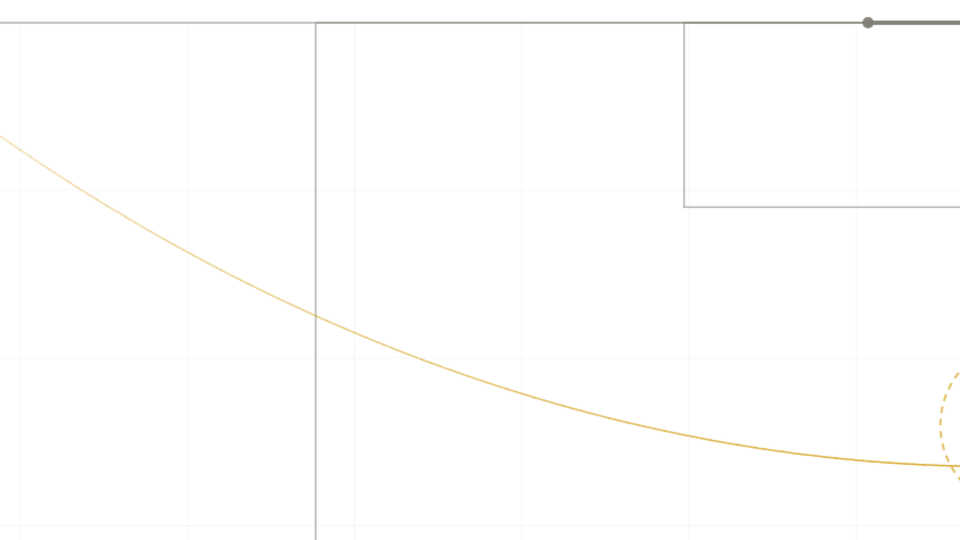
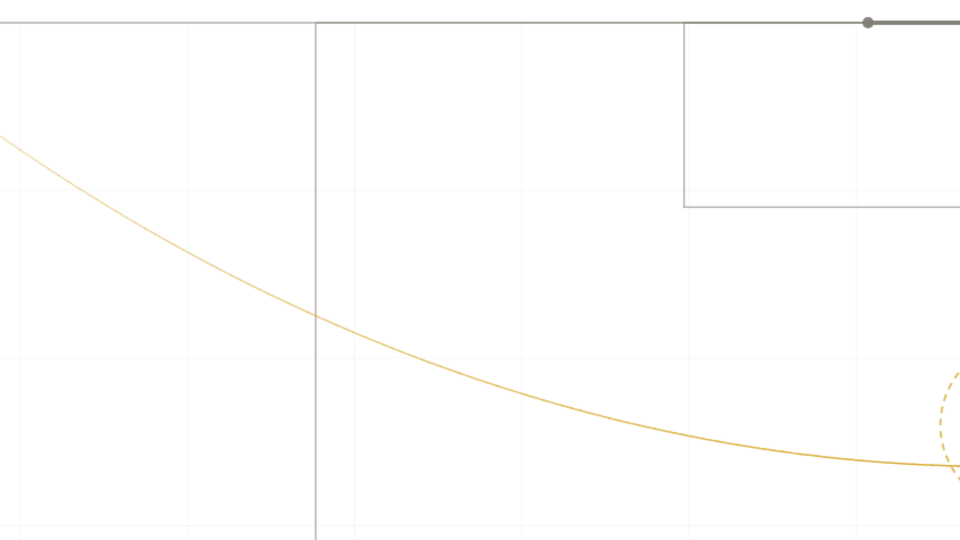
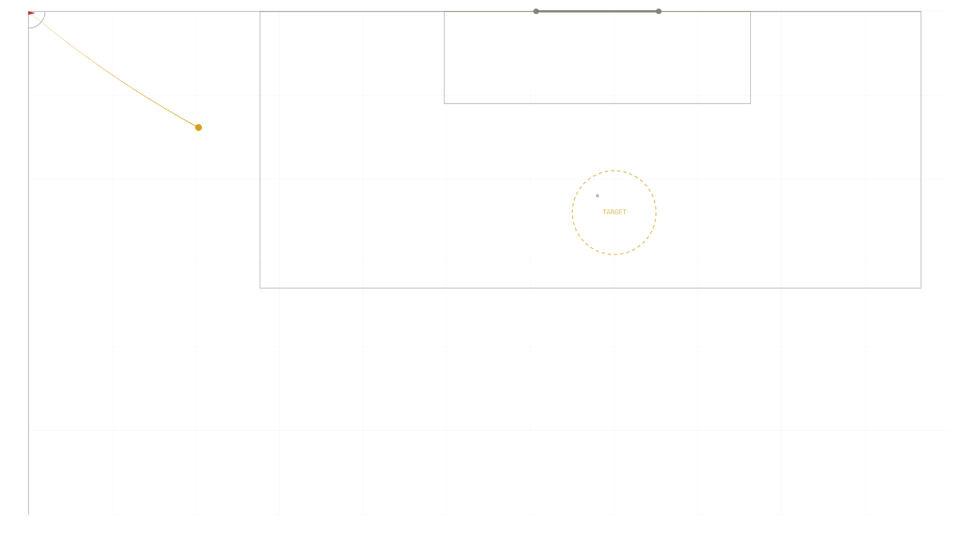
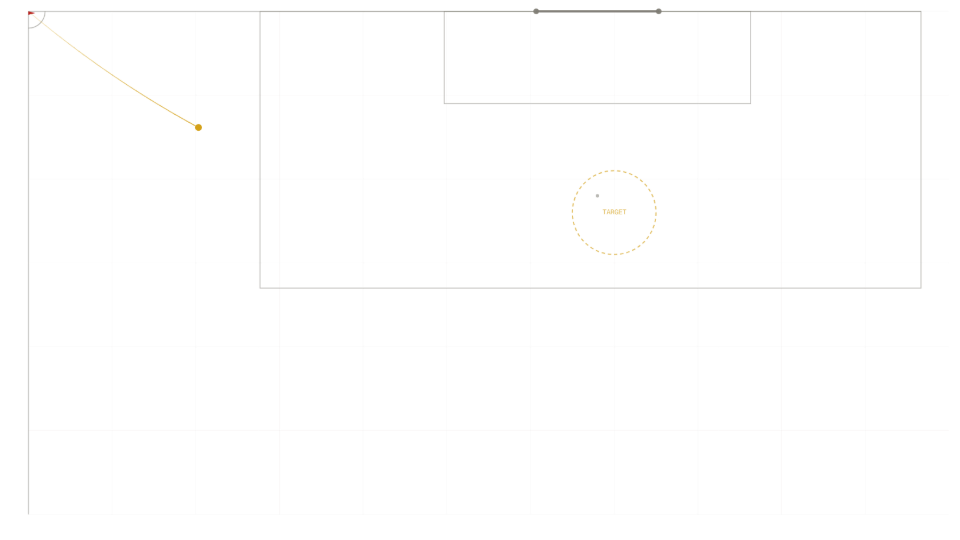
The simulator places the corner flag at (0, 30). The +x axis runs along the goal line away from the corner; the goal mouth sits along the top edge centred at x = 34 m, with posts at x = 30.34 m and x = 37.66 m. The ball flies into the field as y decreases. The Heading slider is the angle below the goal line, so a launch with v = 22 m/s and θ = 40° has components vx = 22·cos(40°) ≈ 16.85 m/s along the goal line and vy = −22·sin(40°) ≈ −14.14 m/s into the field. The simulator records a "landing" when the ball reaches y = 13.5 (the front edge of the penalty area, 16.5 m in from the goal line), leaves the canvas, or the 2-second flight cap fires. The target zone is a 2.5 m radius circle around (35, 18), roughly 1 m past the penalty spot at (34, 19), in the patch where a far-post header is normally won.
Three lateral effects shape the trajectory. Quadratic drag pulls back along velocity and grows with speed squared, costing the ball 1–2 m/s over a 1–2 second flight at typical kick speeds. Magnus lift acts perpendicular to velocity, with magnitude proportional to ω·v in the linear-spin regime; positive spin curls the ball toward larger x (out-swing, away from the goal centre), negative spin toward smaller x (in-swing, back toward the corner). A constant lateral wind adds a small acceleration on vx. Vertical motion is omitted: the model treats the ball as if it travels on a flat horizontal sheet, so any 3D rise-and-drop is folded into the "landing fires at y = 13.5" approximation.
At the opening settings (22 m/s, +4 rev/s, 40°, 0 wind), the Magnus acceleration starts at roughly 7.5 m/s² perpendicular to velocity, about three-quarters of gravity, deepening the trajectory into the box. The simulator hits the 2 s time cap with the ball still in flight at (33.4, 16.8), Δ Target ≈ 2.0 m, inside the 2.5 m target radius. The same kick with no spin (+0 rev/s) lands on the front edge of the penalty area at (19.7, 13.5), Δ Target ≈ 16 m; the Magnus impulse over 2 seconds is doing all the work. Push the heading shallower or the spin heavier and the trajectory over-curls: setting Heading to 25° with Spin Rate +8 rev/s lets Magnus recross the goal line at y ≈ 30 within 1.3 s, parking Δ Target near 15.6 m.
Spin rate is the cheapest accuracy lever. Two-rev-per-second changes in ω translate into roughly a metre of lateral shift on a corner-length flight, with the relationship nearly linear over the −12 to +12 rev/s slider range. Heading is the second lever; switching from 40° to 30° at fixed speed and spin pushes the ball back toward the near post and grows Δ Target above 4 m. Kick speed trades flight time against momentum and shifts the optimal spin rather than the geometry directly.
Key Equations
The simulator's y axis decreases into the field, and Heading is the angle below the goal line, which is why vy0 carries the negative sign. For the defaults (v = 22 m/s, θ = 40°): vx0 = 22·cos(40°) ≈ 16.85 m/s and vy0 = −22·sin(40°) ≈ −14.14 m/s. These are the velocity components the integrator carries into its first substep.
Drag opposes velocity and scales with speed squared. With k = 0.0042 and m = 0.43 kg, the prefactor k/m ≈ 0.0098. At the default 22 m/s launch, drag delivers about 0.0098·22² ≈ 4.7 m/s² opposite to velocity, removing roughly 1–2 m/s of speed over a 1–2 second flight.
With ρ = 1.225 kg/m³, A = π·(0.11)² ≈ 0.038 m², Cl = 0.25 (fixed in the model), and m = 0.43 kg, the prefactor (½·ρ·A·Cl)/m ≈ 0.0135 (1/m). At the default ω = 4·2π ≈ 25.13 rad/s and v = 22 m/s, the Magnus magnitude reaches roughly 0.0135·25.13·22 ≈ 7.5 m/s². That is about three-quarters of gravity. Doubling spin to 8 rev/s doubles aM to ≈14.9 m/s² (larger than gravity), which is enough to over-curl the ball back across the goal line at low headings.
Lateral Wind enters as a small constant acceleration on vx. The 0.08 (1/s) coefficient is heuristic, calibrated so a 5 m/s breeze contributes about 0.4 m/s²: an intentional under-estimate of real cross-wind, because in 3D the wind also acts on the ball's vertical drop, which this top-down 2D model omits.
The target sits at (35, 18) with radius 2.5 m. For an in-flight landing at the front of the penalty area, yland = 13.5, so Δ collapses to √((xland − 35)² + 20.25). At xland = 35 the floor is Δ = √20.25 ≈ 4.5 m, the geometric gap from the front of the penalty area back to the target's y of 18. Combinations that beat that floor must keep flying past y = 13.5 until the 2-second cap fires, ending nearer (35, 18) than the front edge can reach.
Key Variables
| Symbol | Name | Unit | Meaning |
|---|---|---|---|
| v | Kick speed | m/s | Launch speed at the corner flag; default 22 m/s, slider range 15–30 m/s |
| θ | Heading | degrees | Angle below the goal line into the field; default 40°, slider range 10°–50° |
| ω | Spin rate | rev/s | Positive curls outward (out-swing); negative curls inward (in-swing); default +4 rev/s, slider range −12 to +12 rev/s |
| w | Lateral wind | m/s | Constant cross-wind acting on vx; default 0, slider range −5 to +5 m/s |
| (xland, yland) | Landing point | m | Ball's position when it crosses y = 13.5, leaves the canvas, or hits the 2 s time cap |
| Δ | Miss distance | m | Distance from landing point to target centre (35, 18) |
| rtarget | Target radius | m | 2.5 m header zone around (35, 18), about 1 m past the penalty spot |
Real World Examples
Why does an out-swinging corner outperform a straight delivery?
Coaches favour the out-swinging corner because it lets the attacker meet the ball in motion, adding their own velocity to the header rather than stopping the ball dead. The trajectory curls away from the keeper into space, dragging defenders out of position and giving the attacker a clean run at the contact point.
The simulator quantifies the curl directly. At Kick Speed 22 m/s, Heading 40°, and Spin Rate 0 rev/s, the no-spin trajectory droops under drag and lands near x ≈ 19.7 on the front edge of the penalty area, with Δ Target ≈ 16 m; the ball is well short and well to the near-post side of the target. Re-running with +4 rev/s of out-swing at the same speed and heading lifts the ball deeper into the box and times out at (33.4, 16.8), with Δ Target ≈ 2.0 m, inside the 2.5 m radius. The Magnus impulse over the 2-second flight does all of the work.
Push spin too far or steepen too little and the same kick over-curls. At Heading 25° with +8 rev/s, Magnus alone is enough to recross the goal line within 1.3 s, latching the readouts at Landing Y ≈ 30 and Δ Target ≈ 15.6 m. The lesson is that spin and heading have to balance: a steeper heading buys time inside the field for moderate spin to do useful work, while a shallow heading paired with heavy spin sends the ball back over the goal line.
How much does a stadium cross-wind shift the landing point?
Open-bowl stadiums sit in predictable wind corridors that funnel air across the goal line. A 5 m/s breeze is roughly 18 km/h, easy to feel as a player but easy to underestimate when planning a corner. Over the ≈2-second flight of a 22 m/s delivery, the integrated lateral acceleration shifts the landing point by a metre or so on this 2D top-down model.
The simulator brackets the effect cleanly. Holding a tuned out-swinger at Kick Speed 22 m/s, Spin Rate +4 rev/s, Heading 40°, and sweeping Lateral Wind from −5 to +5 m/s, Δ Target moves from about 2.7 m (head-wind opposing the cross) down to about 1.5 m (tail-wind helping it). The change is roughly 0.1 m of Δ per m/s of wind: modest compared to the metre-per-2-rev/s sensitivity of spin, but enough to flip a 2.0 m miss into a 1.5 m miss in the goalkeeper's favoured direction.
Coaches at home grounds learn the wind patterns and sometimes switch which side a corner is taken from when conditions favour it. The simulator's wind contribution is intentionally under-stated relative to a 3D model: in reality wind also acts on the ball's vertical drop, which this top-down sim omits. Read the sweep as a lower bound on what a real cross-wind could do.
What slider combination gives the closest cross to the target?
A coarse parameter sweep across the slider ranges shows a sweet spot for a successful far-post delivery: Kick Speed 22–25 m/s, Heading 35°–45°, and Spin Rate +4 to +6 rev/s, all with Lateral Wind 0. These combinations consistently land the ball within 2–3 m of (35, 18), often inside the 2.5 m target radius. At fixed +4 rev/s and Heading 40°, kick speed barely moves Δ; the trajectory is dominated by the Magnus integral, not raw momentum.
Push the spin past +6 rev/s or drop the heading below 30° and the same kick over-curls, ending off-field across the goal line. Pull the spin negative (in-swing) and the ball curves toward the corner side instead of the far-post target; in this sim's geometry, in-swing is the wrong direction for a far-post target. The Heading slider's max of 50° can recover some accuracy at very low spin (Heading 50°, Spin +6 rev/s gives Δ ≈ 3.0 m) but never quite matches the 35°–40° band with a moderate out-swing.
The takeaway: in this simulator's geometry a successful corner lives inside a narrow combination band where spin and heading balance. A coach trying to translate the lesson to a real player would say: aim a bit deeper than feels natural, and trust the curl rather than over-spinning.
Further Reading
- Magnus free kick: the same Magnus-plus-drag physics over a shorter range with a defensive wall as the obstacle.
- Ball bounce on grass and turf: what happens after a delivered cross meets the ground at the far post.
- Foot–ball collision: how kick speed and spin are imparted to the ball in the first place.
- Penalty kick versus the keeper: a related set-piece geometry where placement beats raw power.