Period vs Radius · SimulatorHow Period Grows with Radius
Adjust the radius of a uniform circular orbit at fixed speed; period and frequency update live with the visualization.
Published: May 22, 2026 · Updated: August 24, 2026
Objective
Verify that the period of uniform circular motion obeys T = 2πr/v (linear in radius and inversely proportional to speed), using an idealized point mass moving at constant tangential speed with no gravity or friction.
Setup
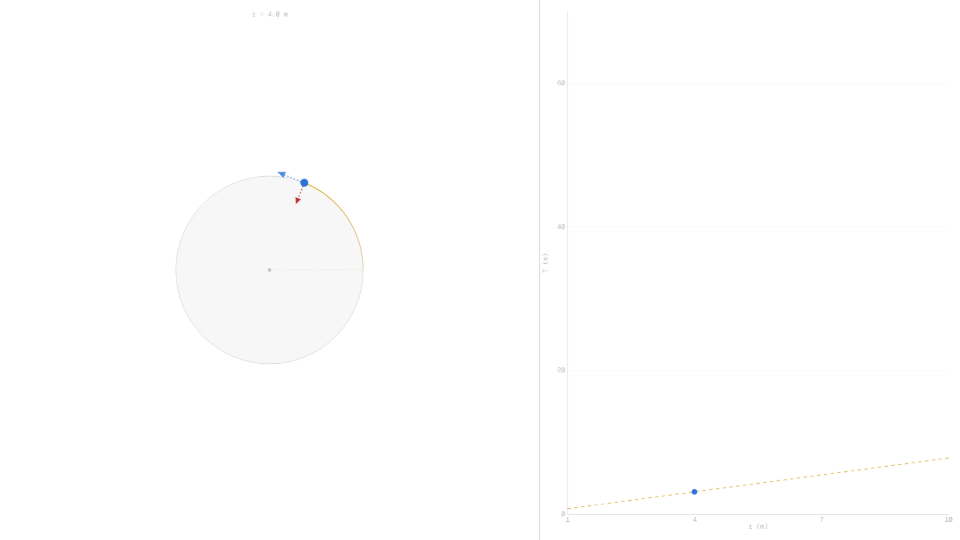
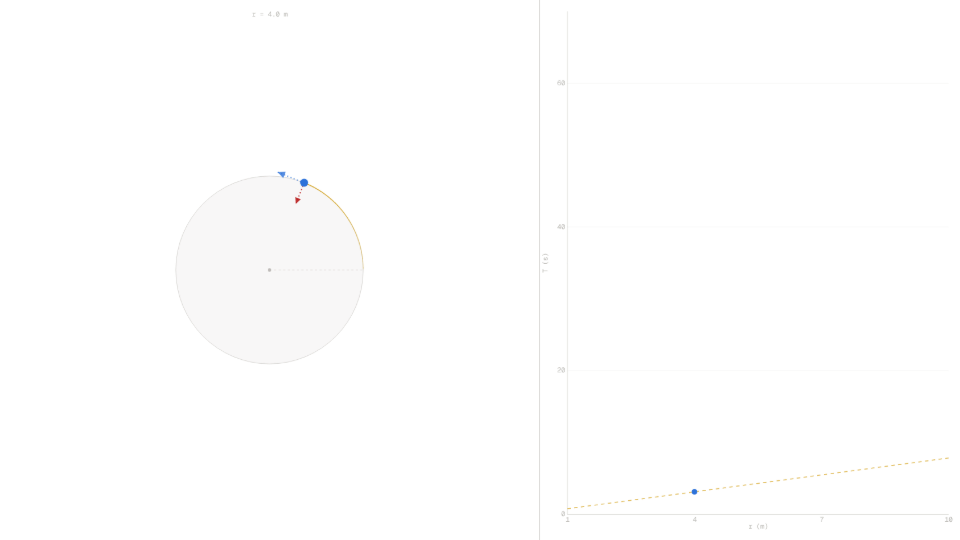
- Set Radius to 4 m and Speed to 8 m/s (the defaults). Note the Period readout: it should show approximately 3.14 s.
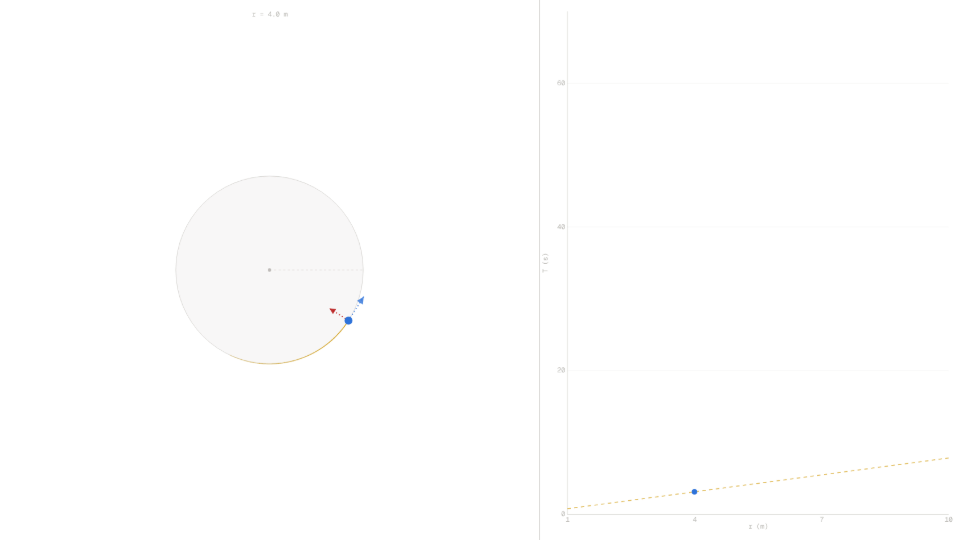
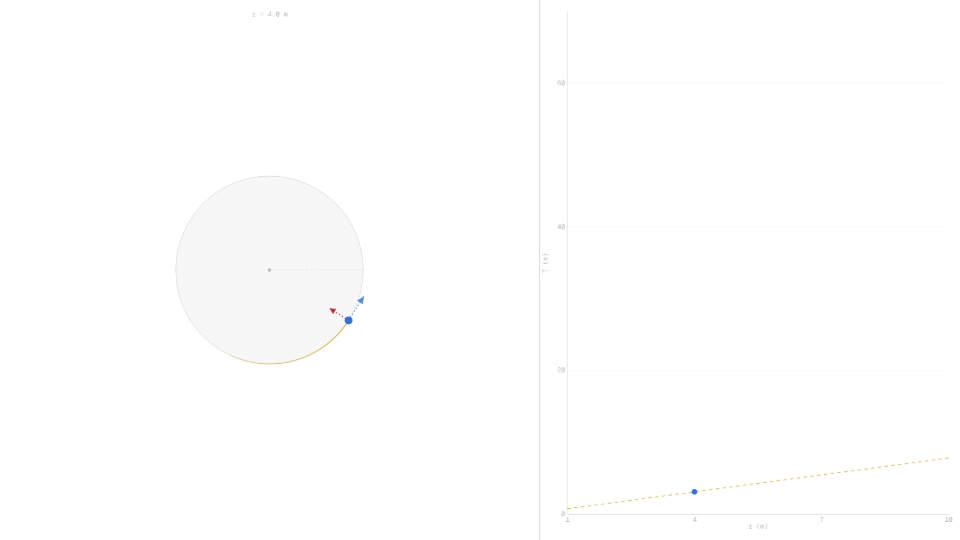
- Press Start and watch the particle complete orbits. The elapsed time increases; when it reaches 6 s the sim stops automatically.
- Press Reset, drag Radius to 8 m (keeping Speed at 8 m/s), then press Start. The orbit circle doubles in size; record the new Period readout.
- Press Reset, set Radius back to 4 m and Speed to 4 m/s, then press Start. Halving the speed at fixed radius should double the Period readout.
- Press Reset, set Radius to 2 m and Speed to 1 m/s: Period readout should show approximately 12.57 s. The T vs r chart live dot moves to a higher position.
Analytical Prediction
The period formula is T = 2π · r / v. With the default r = 4 m and v = 8 m/s:
When radius doubles to 8 m at v = 8 m/s:
When speed halves to 4 m/s at r = 4 m:
Both changes double the period, consistent with T ∝ r and T ∝ 1/v. The Period and Frequency readouts should match these values within 0.02 s.
Results Analysis
After each run, compare the Period readout (labeled T (s)) to the prediction. At r = 4 m, v = 8 m/s the readout should show 3.14 s ± 0.02 s. At r = 8 m, v = 8 m/s it should show 6.28 s ± 0.02 s. The Frequency readout (labeled f (Hz)) is the reciprocal: at default settings it reads approximately 0.318 Hz. The secondary panel shows a T vs r reference curve at the current speed; the live blue dot marks the current (r, T) pair and lies on the curve at all times.
Source of Error
This simulation models a point mass in uniform circular motion with no gravitational field, no friction, and no relativistic corrections. The tangential speed is held exactly constant: no centripetal force mechanism is modeled, so there is no orbital decay or speed variation. The analytical prediction T = 2πr/v assumes the same idealizations, so the physical model and the formula are self-consistent; neither omission produces a residual. The gap between the predicted period and the readout is therefore purely numerical, not physical.
Further Exploration
- Set Speed to 2 m/s and sweep Radius from 1 m to 10 m. Does the Period readout grow proportionally? The T vs r chart live dot should trace the reference curve exactly; verify this holds at every radius.
- Fix Radius at 5 m and sweep Speed from 1 m/s to 20 m/s. How does the Period change? At v = 20 m/s, what is the minimum period? And does the Frequency readout confirm f = 1/T?
- Find a combination of radius and speed that gives T ≈ 3.14 s (one lap in π seconds). There are infinitely many pairs. What constraint must r and v satisfy? Try r = 2 m: what speed is needed? Then try r = 4 m and r = 1 m. Confirm each with the Period readout.
- Set Radius to 1 m and Speed to 1 m/s. The Period readout shows about 6.28 s, close to the sim run duration. Does the particle complete a full orbit before the sim stops? What does this tell you about the relationship between T and the observation window?