Magnus Effect Free Kick · SimulatorBend It Past the Wall
Curl a free kick around a wall: Magnus force perpendicular to velocity, plus quadratic drag. Top-down half-pitch with goal at 30 m.
Published: May 3, 2026 · Updated: May 29, 2026
Objective
Confirm that a spinning soccer ball curls because the Magnus force F_M = ½·ρ·A·C_l·v² acts perpendicular to the velocity vector, with direction set by ω̂ × v̂. Verify that lateral deflection at the goal line grows with both spin rate ω and lift coefficient C_l, and shrinks as ball speed rises (because flight time falls). Build intuition for why a kick aimed wide of the wall can still cross the goal line inside the post: the curve, not the aim, finishes the shot.
Setup
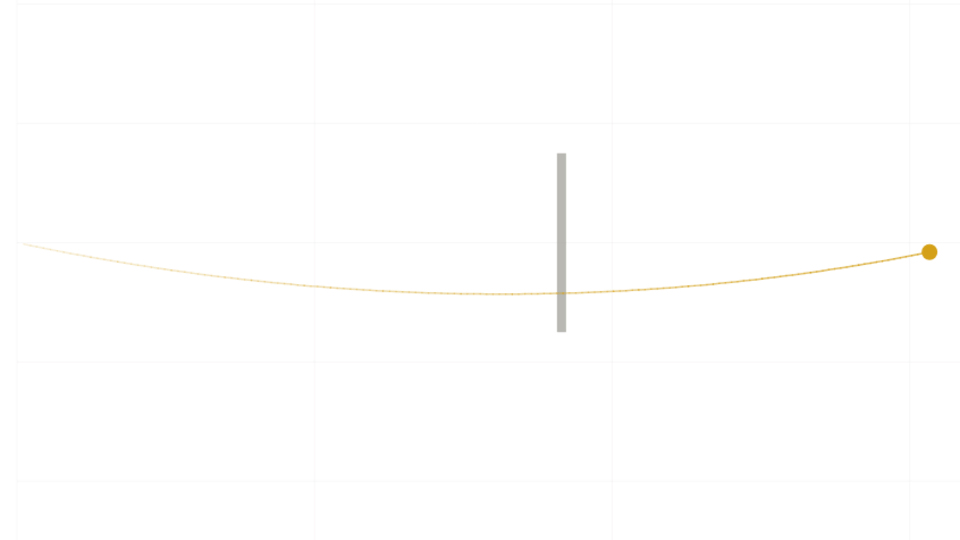
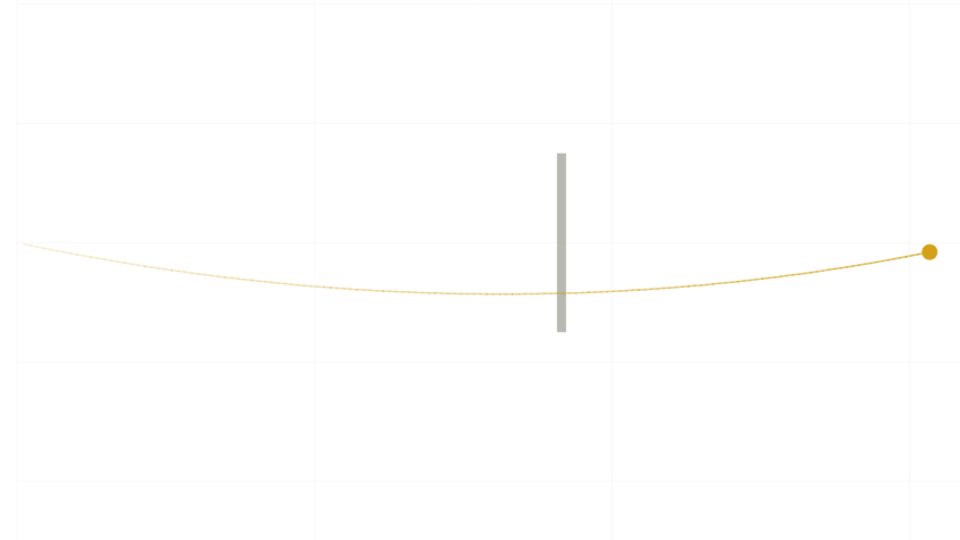
- Set Ball Speed to 28 m/s, Spin Rate to 8 rev/s, Heading Offset to −12°, and Lift Coefficient to 0.25: the default configuration aims wide of the right side of the wall and curls back toward the goal.
- Press Start. The ball leaves x = 0, the trail shades by time, and the readouts update each frame for Time, Lateral Deflection, Peak Curve, and Time to Goal.
- Wait until the ball crosses x = 30 m or the simulation stops at the 3 s cap. Note the final Lateral Deflection (m) and Time to Goal (s).
- Press Reset. Set Spin Rate to 0 rev/s and re-run: the trajectory becomes essentially straight, modulated only by quadratic drag.
- Reset again. Restore Spin Rate to 8 rev/s, raise Ball Speed to 35 m/s, and re-run to see how a faster shot curls less because it spends less time in the air.
- Reset and sweep Lift Coefficient from 0.15 to 0.35 in three runs at fixed speed and spin to isolate the linear scaling of curl with C_l.
Analytical Prediction
With Ball Speed 28 m/s, Spin Rate 8 rev/s, Heading Offset −12°, Lift Coefficient 0.25:
Ignoring drag for a quick estimate, time to the goal line at x = 30 m is roughly 30 / 27.39 ≈ 1.10 s. Magnus acceleration magnitude scales as a_M ≈ (½·ρ·A·C_l/m)·ω·v with ρ = 1.225 kg/m³, A ≈ 0.038 m², m ≈ 0.43 kg:
Acting perpendicular to velocity for ~1.1 s, this yields a lateral velocity change of order 21 m/s, but only the integrated transverse displacement matters. The expected outcome is a path that starts heading down-and-right, then curls back so the Lateral Deflection at x = 30 m lands near zero or slightly positive, with Peak Curve reaching roughly 1–2 m off the straight line. Drag (≈ 5–8 % speed loss over 25 m) lengthens Time to Goal slightly and reduces curl through reduced v.
Results Analysis
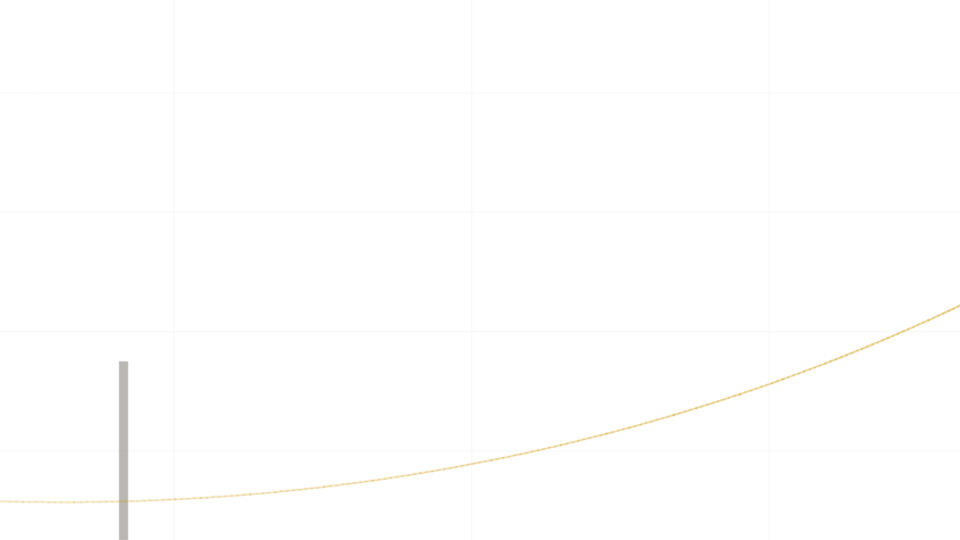
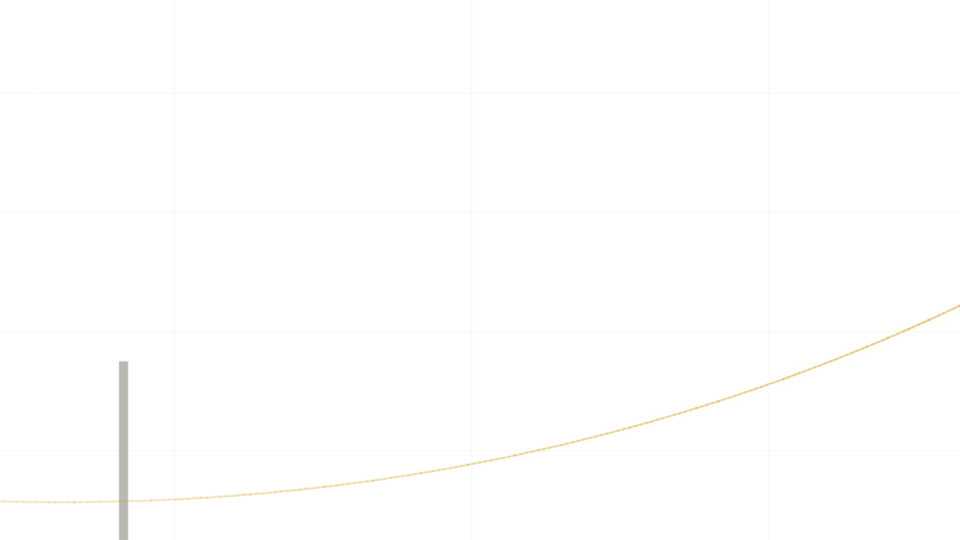
Compare the Lateral Deflection readout across runs to see how the answer depends on each slider. With Spin Rate 0, the deflection at x = 30 m should be governed only by the heading angle: about 30·tan(−12°) ≈ −6.4 m, well outside the goal mouth (half-width 3.66 m). Re-introducing 8 rev/s of spin pulls the ball back across the line, which is the whole point of the curl. Doubling Spin Rate from 4 to 8 rev/s should roughly double Peak Curve, confirming the linear-in-ω regime that the simulation uses. Raising Ball Speed at fixed spin reduces curl in two ways: shorter time in the air, and a larger v_x meaning the same lateral acceleration produces a smaller angle change relative to the path. Lift Coefficient acts as a pure multiplier: sweeping 0.15 → 0.35 should scale Peak Curve by roughly the same factor 0.35/0.15 ≈ 2.3. Where readings disagree with these scaling rules, the explanation lies in the coupled effect of drag bleeding speed (and therefore Magnus magnitude) along the flight.
Source of Error
What this sim does NOT model: vertical motion (this is a top-down view, so the ball trajectory is planar), keeper or wall-defender bodies in the path, post-cross-line ball roll, ball deformation, or drag-coefficient variation with Reynolds number across the speed range. Spin axis is held vertical and constant. The closed-form a_total = a_M(ω, v) + a_d(v) assumes the same idealizations, so they cancel rather than contributing to the residual deflection or peak curve. The remaining gap between prediction and readouts is therefore purely numerical, not physical.
Further Exploration
- Aim 12° wide right with +12 rev/s of spin at 30 m/s. Does the Lateral Deflection readout settle near zero, indicating the ball cleared the wall and curled back into the goal mouth? Now try aiming 18° wide. What spin rate is needed to bring the ball back inside the far post?
- At fixed Heading Offset −12° and Lift Coefficient 0.25, sweep Ball Speed from 22 to 34 m/s in 2 m/s steps with Spin Rate held at 8 rev/s. Plot Lateral Deflection vs Ball Speed in your notebook. Is the relationship monotonic, and why?
- Set Spin Rate to its maximum +15 rev/s and reduce Ball Speed to 22 m/s. The spin parameter S = ω·r/v ≈ (2π·15·0.11) / 22 ≈ 0.47 enters the regime where the linear C_l model starts to break down. Does the simulation still produce a clean curl, and what real-world phenomenon does this regime resemble?
- Compare a pure +8 rev/s shot to a pure −8 rev/s shot at the same speed and heading. Are the trajectories mirror images about y = 0 as the symmetry of ω̂ × v̂ would predict?
- The wall sits at x = 9.15 m with half-width 1.5 m. With Heading Offset 0° and Spin Rate 8 rev/s, does the ball pass the wall on the inside or outside? What heading is needed to skim just past the wall and still finish inside the goal mouth (half-width 3.66 m)?
- Reduce Lift Coefficient to 0.15 to mimic a smoother ball or thinner air. By what factor does Peak Curve drop compared to C_l = 0.35 at otherwise identical settings, and does that ratio match the linear scaling implied by F_M = ½·ρ·A·C_l·v²?