Free Fall on Different Planets · SimulatorFall Under Any Gravity
Drop an object on Earth, Moon, Mars, or Jupiter with adjustable g and matching fall times
Published: May 11, 2026 · Updated: June 2, 2026
Objective
Verify the free-fall kinematic law x = ½·g·t² by dropping a point mass from a fixed height under different gravitational accelerations. The simulation models vacuum free fall (no air resistance, no rotation), so the analytical formula and the readouts should agree to within the numerical integration tolerance.
Setup
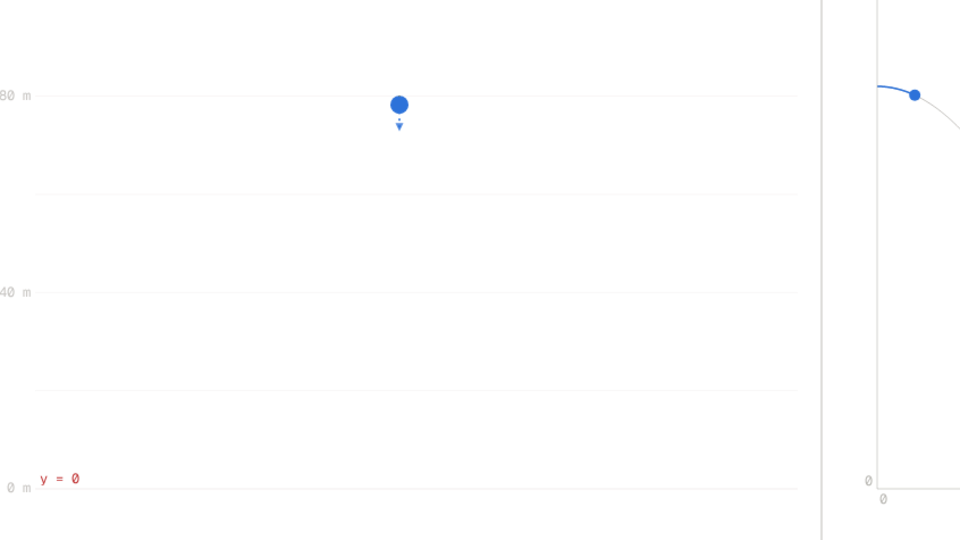
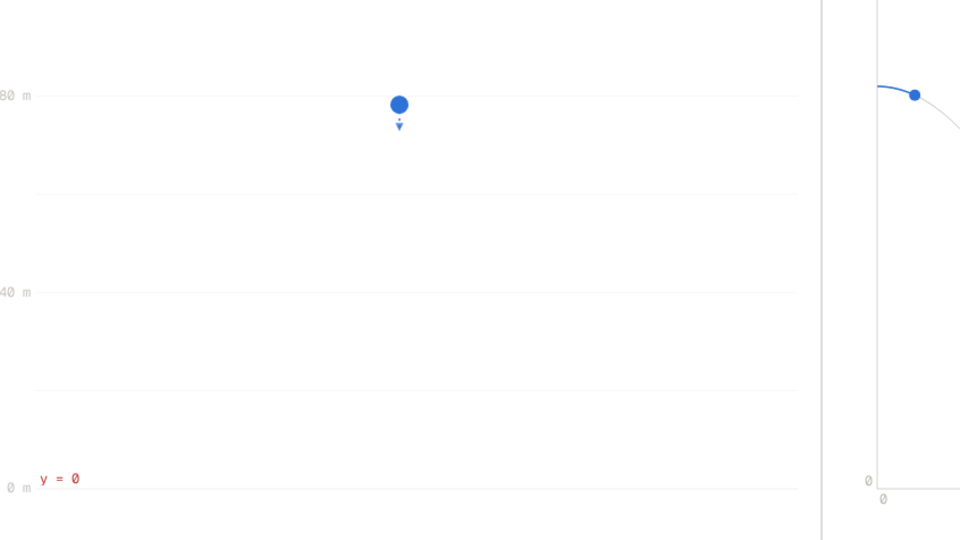
- Set Gravity to 9.8 m/s² (Earth default) and Drop height to 80 m. Press Start and note the Time readout when the ball hits the ground.
- Reset, then change Gravity to 1.6 m/s² (Moon). Press Start: the ball takes noticeably longer to reach the ground. Record the Time readout.
- Reset, set Gravity to 3.7 m/s² (Mars) and Drop height to 80 m. Press Start and note the Time and Velocity readouts at impact.
- Reset, set Gravity to 24.8 m/s² (Jupiter surface). Press Start: the ball reaches the ground rapidly. Compare the fall time with the Earth run.
- Reset. Set Drop height to 160 m and Gravity to 9.8 m/s². Predict the new fall time using T = sqrt(2h/g) before pressing Start.
Analytical Prediction
For vacuum free fall from rest, the fall time is T = sqrt(2h / g) and impact velocity is v = g·T = sqrt(2·g·h). With h = 80 m and g = 9.8 m/s² (Earth):
With h = 80 m and g = 1.6 m/s² (Moon):
With h = 80 m and g = 24.8 m/s² (Jupiter):
The Time readout at impact should match these values to within ±0.05 s.
Results Analysis
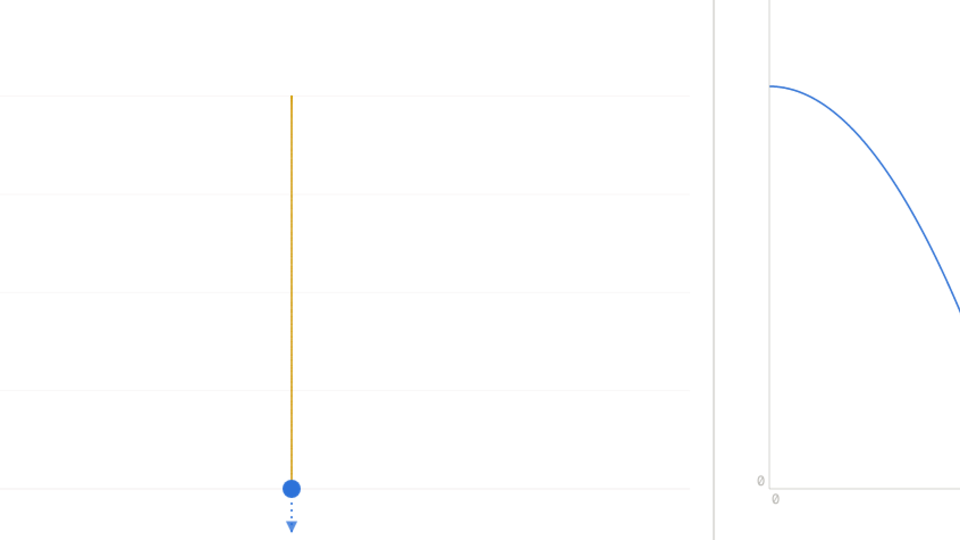
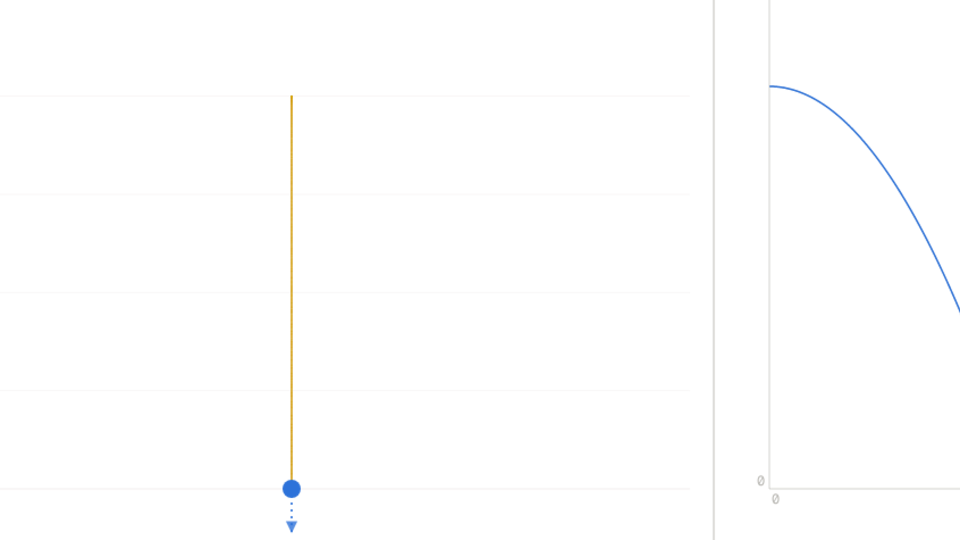
After each run, read the Time (s) readout at the moment the ball reaches the ground; the sim freezes the HUD at impact. Compare to the analytical T = sqrt(2h/g). For Earth (g = 9.8, h = 80): expected 4.04 s. For Moon (g = 1.6, h = 80): expected 10.00 s. For Jupiter (g = 24.8, h = 80): expected 2.54 s. The Height (m) readout should read 0.0 at impact and the Velocity (m/s) readout should match v = sqrt(2·g·h). The height-vs-time graph in the right panel shows the reference parabola; the live dot should track it exactly. Residual discrepancy is typically under 0.05 s, attributable to fixed-substep integration.
Source of Error
This simulation models a point mass in a uniform gravitational field with no atmosphere. It omits air resistance (which would reduce terminal velocity and extend fall time on bodies with thick atmospheres like Earth and Venus), the variation of g with altitude (significant only for very tall drops: g decreases by ~0.3% per kilometer on Earth), and the object's own rotation or shape. The analytical prediction in this worksheet makes the same idealizations. Both the sim and the formula assume constant g and vacuum conditions, so the idealizations cancel and the residual gap between prediction and readouts is purely numerical, not physical.
Further Exploration
- On Earth (g = 9.8 m/s²), double the drop height from 80 m to 160 m. Does the fall time double, or does it grow by a different factor? What does the formula T = sqrt(2h/g) predict?
- Set Gravity to its minimum (1.6 m/s², Moon) and maximum (24.8 m/s², Jupiter approximation). How many times longer does the Moon fall take compared to Jupiter? Compute the ratio T_Moon / T_Jupiter from the formula before checking with the sim.
- Watch the height-vs-time graph in the right panel. The reference curve is a downward parabola. At what fraction of the total fall time does the ball reach half its starting height? Is it at t = T/2, before T/2, or after T/2?
- Set Drop height to 10 m (minimum) and sweep Gravity from 1.6 to 24.8 m/s². At what gravity does the fall become too fast to follow visually? What is the fall time at g = 24.8 m/s² from just 10 m?
- Compare the Velocity readout at impact for two settings with the same product g·h (e.g., g = 9.8 h = 100 vs g = 19.6 h = 50). The formula predicts equal impact speeds. Does the sim agree?