1D Motion Plotter · SimulatorPlot Position, Velocity & Time
An object moves along a line; set initial position and velocity with sliders and watch a live position-vs-time graph trace the result.
Published: May 6, 2026 · Updated: May 28, 2026
Objective
Verify the uniform-motion equation x(t) = x₀ + v₀·t by observing that the position-vs-time graph produces a straight line whose slope equals the chosen velocity. The simulation assumes zero net force (no gravity along the axis, no friction, no drag), so velocity is constant throughout the 30-second run. Any initial position and any velocity between −5 m/s and 5 m/s can be tested.
Setup
- Press Reset to clear any previous run. The Time readout shows 0.00 s, Position shows the current x₀ value, and Displacement shows 0.00 m.
- Set the Initial Position slider to 0 m and the Initial Velocity slider to 3.0 m/s. These are the default values and place the starting point at the origin with a gentle positive slope.
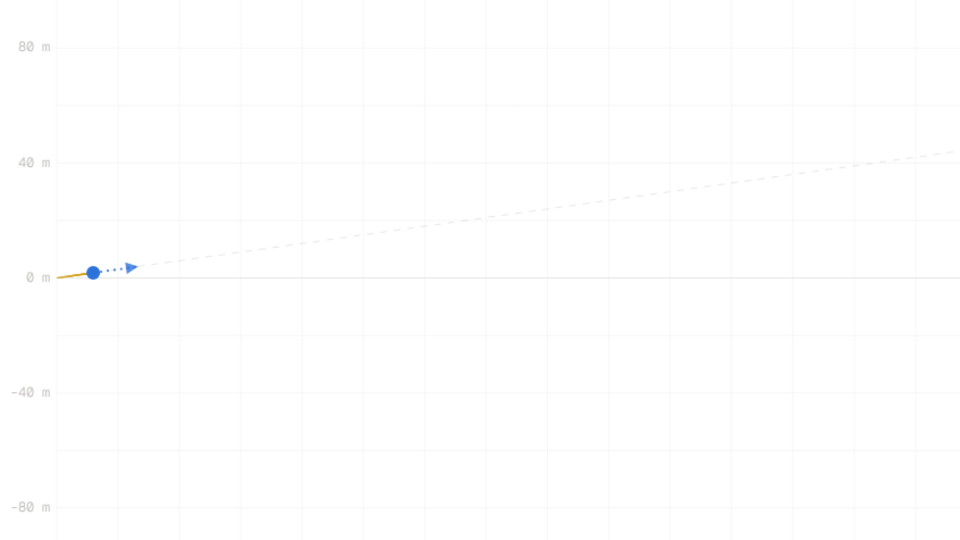
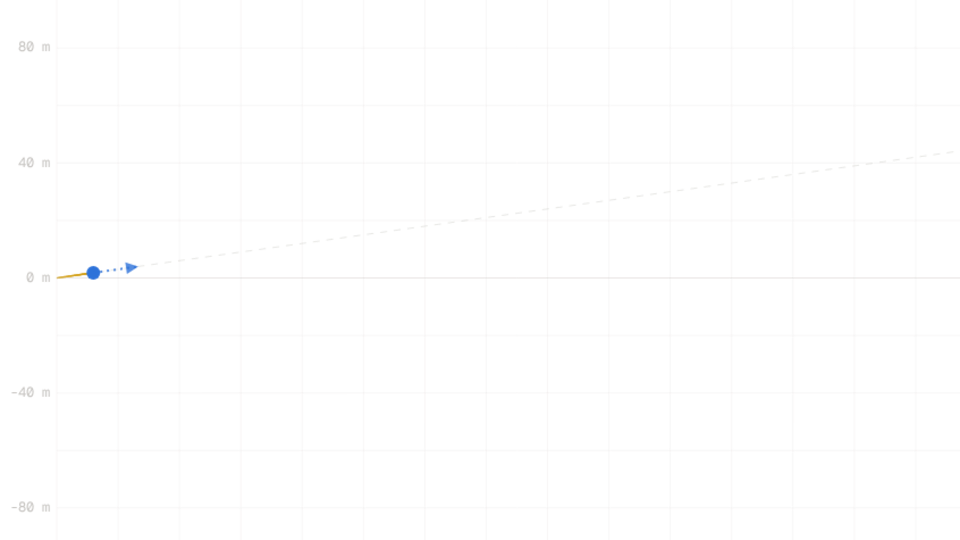
- Press Start and watch the amber dot trace a straight line across the graph. The Time and Position readouts update in real time; record the Position value at t = 10 s and t = 20 s.
- After the run ends at t = 30 s, press Reset. Set Initial Velocity to −3.0 m/s and press Start again. The line now slopes downward; compare it to the previous run.
- Try x₀ = 10 m with v₀ = −2.0 m/s. Predict where the line crosses the x = 0 level before pressing Start, then verify against the Position readout.
Analytical Prediction
For an object moving at constant velocity from initial position x₀, the kinematic equation gives x(t) = x₀ + v₀·t, with displacement Δx = v₀·t. No acceleration term appears because the net force is zero. With the defaults x₀ = 0 m and v₀ = 3 m/s:
At specific check-times:
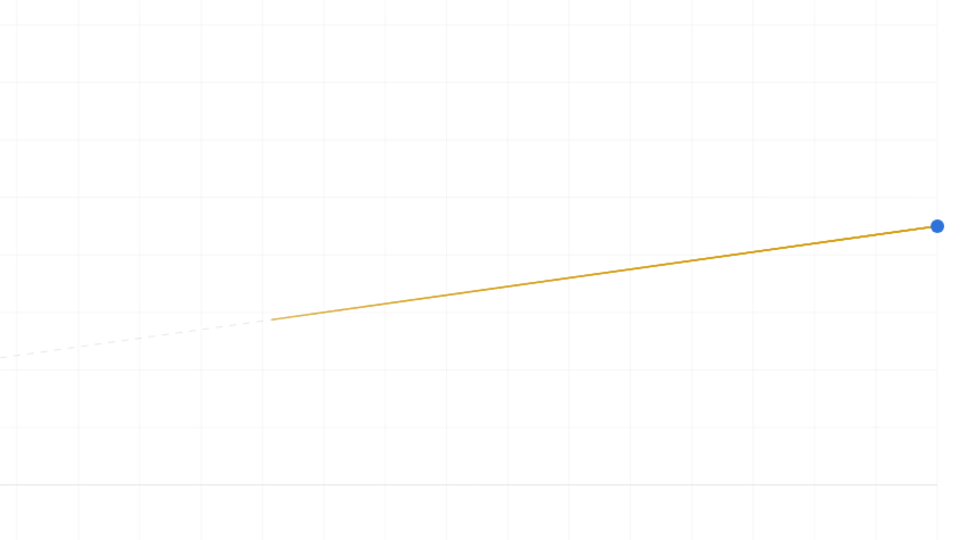
The graph should show a straight line from (0, 0) to (30, 90). Displacement equals 90 m and Speed remains 3.00 m/s throughout. The slope of the traced line, read off the graph as rise-over-run in (m/s), equals v₀ exactly, the defining property of uniform motion.
Results Analysis
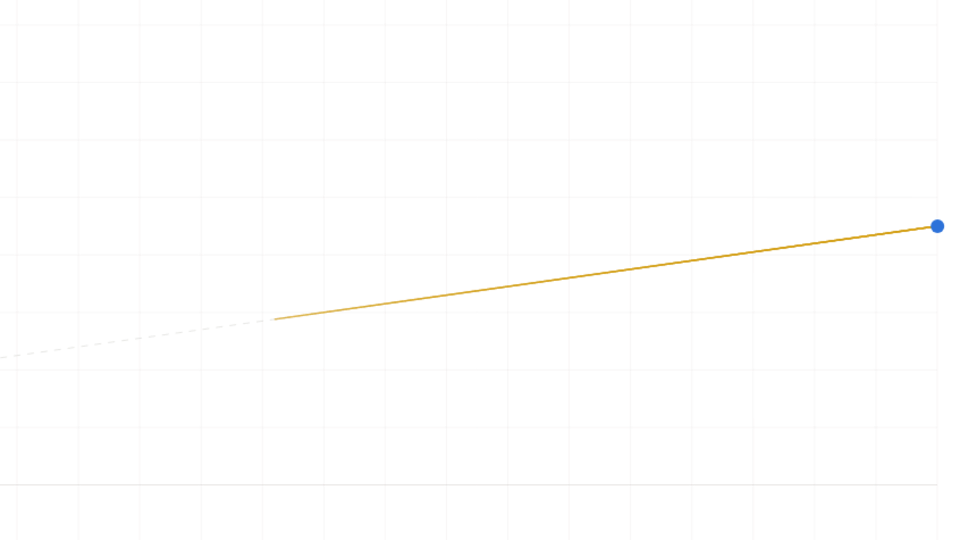
After the run with x₀ = 0 m and v₀ = 3 m/s, the Position readout should freeze at 90.00 m and the Time readout at 30.00 s. The Displacement readout should also read 90.00 m (since x₀ = 0), and Speed should hold at 3.00 m/s throughout. Cross-check by pausing mid-run: at t = 10 s the Position readout should show 30.00 m; at t = 20 s, 60.00 m, both matching the predictions above to within 0.02 m. For x₀ = 10 m and v₀ = −2 m/s, the line crosses Position = 0 at t = x₀ / |v₀| = 5 s; pause the simulation at that moment and verify the Position readout reads near 0.00 m.
Source of Error
This simulation models uniform motion with no forces: no gravity component along the line, no friction, no air resistance, no relativistic effects. The constant-velocity equation x(t) = x₀ + v₀·t is evaluated analytically each step, not by numerical integration, so there is no Euler or Runge-Kutta truncation error. The model and prediction assume identical idealizations, so they cancel rather than contributing to the residual. No physical object can maintain constant velocity indefinitely without a net force to counteract perturbations. The remaining gap between prediction and readouts is therefore purely numerical, not physical.
Further Exploration
- Slope as velocity. Set v₀ to 1, 2, 3, 4, and 5 m/s and run each trial. Can you measure the slope of each traced line graphically (rise over run in m/s) and recover v₀ without reading the Speed readout? At what velocity does the line become steepest within the 30-second window?
- Negative velocity and mirror symmetry. Set x₀ = 0 and run with v₀ = 3 m/s, then reset and run with v₀ = −3 m/s. The two lines are mirror images about the x = 0 axis. What does this tell you about the relationship between speed and the direction of displacement?
- Zero-crossing prediction. Set x₀ = 15 m and v₀ = −3.0 m/s. Before starting, predict the time at which the position crosses zero using t = −x₀/v₀ = 5 s. Pause the simulation at that moment and check the Position readout. How close is it to 0.00 m?
- Maximum reachable positions. With x₀ = 20 m and v₀ = 5 m/s, the object reaches x = 170 m at t = 30 s, the most positive position reachable. What initial conditions send the object to the most negative position by t = 30 s, and what is that limiting value?